People looking for a “sugar-free” option
The exact wording matters more to you than a similar claim such as “no added sugar”. Check the wording on the product you’re considering, then look at its sugars per 100 g.


If avoiding sugars is your top priority, look for the words “sugar-free”: “no added sugar” does not exclude sugars naturally present in fruit. If you’re choosing traditional fruit jelly primarily as a confectionery treat, compare the ingredients, sugars per 100 g, pack size and allergens instead. If there’s a Nutri-Score on the pack, it doesn’t replace these checks.
The exact wording matters more to you than a similar claim such as “no added sugar”. Check the wording on the product you’re considering, then look at its sugars per 100 g.
You’re happy with sugars naturally present in fruit, but want a recipe without added sweetening ingredients. A fruity snack that meets this requirement won’t necessarily be a fruit jelly.
You prefer traditional fruit jelly for its flavours or presentation. The ingredients, nutrition information, pack size and allergens can help you choose between products.
Start by deciding whether your priority is avoiding sugars, avoiding added sugars or choosing traditional confectionery: these criteria don’t point to the same product.
| Criterion | What to check | Who is it for? |
|---|---|---|
| No sugars | The exact wording “sugar-free” and the “of which sugars” value per 100 g. | If only an option labelled “sugar-free” meets my needs, a recipe that is simply “no added sugar” isn’t enough. Around 30% of consumers put this distinction first. |
| No added sugars | The claim on the pack, the ingredients used to sweeten the product and sugars per 100 g. | I’m happy with sugars naturally present in fruit, but want to avoid ingredients added to sweeten the recipe. This is the top priority for around 50% of consumers. |
| Traditional confectionery | The ingredients, sugars per 100 g, pack size and allergens for the specific product. | If I’m buying fruit jelly as a gift or to portion out, I prioritise the confectionery while checking what it contains. Around 20% of consumers prioritise this choice. |
EU Regulation (EC) No 1924/2006 sets a limit of 0.5 g of sugars per 100 g of product for the “sugar-free” claim. A recipe labelled “no added sugar” may still contain sugars naturally present in fruit.
If you have a strict requirement, look for “sugar-free” on the product and check the nutrition information per 100 g.
In France, the Ministry of the Economy says that this logo is optional. The DGCCRF states that a nutrition declaration is generally compulsory for prepacked foods.
Compare the nutrition values and ingredients whether or not the Nutri-Score is shown.
The Carrefour Bio fruit jelly featured by the retailer contains cane sugar and rice syrup. Gerblé lists sugar and glucose syrup in its Pâtes de fruits Sport product.
Check the ingredients for the specific product and flavour before considering it as a sugar-free option.
Gerblé lists gluten and wheat starch in its Pâtes de fruits Sport product.
If you need to avoid an allergen, check the information on the exact pack before buying.
A traditional organic fruit jelly to consider as confectionery, rather than as a “sugar-free” option.
Its Pâtes de fruits Sport product is marketed for use during exercise, not as sugar-free confectionery.
A range designed for sport by Andros; Carrefour lists Andros Sport fruit jellies.
This selection features a no-added-sugar fruit purée pouch for anyone considering a fruity snack. Its texture and product type differ from traditional fruit jelly, and it isn’t suitable if you’re specifically looking for a “sugar-free” product.
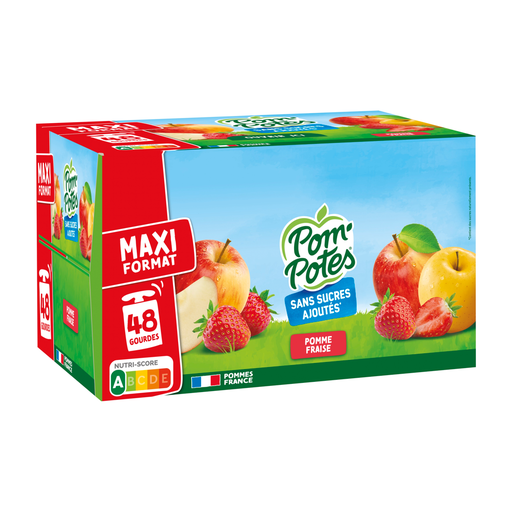 Image unavailable
A fruit purée pouch for anyone looking to avoid added sugars and who prefers this format to fruit jelly.
The pack contains 48 pouches of 90 g. “No added sugar” doesn’t mean “sugar-free”: check the claim and the “of which sugars” value on the pack you receive.
No. The Ministry of the Economy says that Nutri-Score is optional. The DGCCRF states that a nutrition declaration is generally compulsory for prepacked foods. Use it to compare sugars on the same 100 g basis.
No. Under EU Regulation (EC) No 1924/2006, the “sugar-free” claim allows no more than 0.5 g of sugars per 100 g of product. “No added sugar” does not exclude sugars naturally present in fruit.
Compare the “of which sugars” value per 100 g, then check the ingredients and allergens. If you’re looking for a no-added-sugar recipe, check the claim on each product rather than relying on its name alone.
No. Gerblé lists 66 g of sugars per 100 g for its Pâtes de fruits Sport product, which contains sugar and glucose syrup. The word “Sport” doesn’t replace checking the nutrition information for each product.