Anyone planning a family get-together
For a Mother’s Day table, the pack’s weight and stated number of pieces can help you work out how to serve several guests.


For serving fruit jellies to a group on Mother’s Day, choose a pack size to suit the number of guests: a large pack if you’re planning to share, or an assortment with a stated number of pieces to make portioning easier. If you’d also like to pack some in lunchboxes, look at x6 formats. In every case, compare the nutritional information per 100 g and, if a Nutri-Score is shown, check it for the exact product.
For a Mother’s Day table, the pack’s weight and stated number of pieces can help you work out how to serve several guests.
If you’d like to save some fruit jellies to take with you later, a multi-pack makes it easier to plan what goes into each lunchbox. Check whether the pieces are individually wrapped.
To compare two products, check the nutritional values per 100 g. Nutri-Score can provide extra information when it appears on the packaging; its display is optional in France, according to the Ministry of the Economy.
First decide whether the pack is mainly for sharing at the table, packing in lunchboxes or comparing labels. Each use means checking different information about the product you choose.
| What to consider | What to check | Who is it for? |
|---|---|---|
| Sharing at the table | Total weight, number of pieces and storage instructions. | If I’m hosting several family members on Mother’s Day, I want to share the pack without ending up with too many leftovers. Sharing would be the main reason for buying for around 45% of consumers. |
| Portions to take with you | Number of pieces and whether they’re individually wrapped. | When I’m preparing lunchboxes, I’d rather know how many portions I can take with me without opening a large pack. Around 33% of consumers would put this convenience first. |
| Ingredients and nutritional information | Sugars per 100 g, ingredients list and Nutri-Score, if shown. | If I’m comparing several fruit jellies before choosing a pack size, I want to read the nutritional information rather than go by the product name. For around 22% of consumers, this would be the priority. |
The name alone doesn’t tell you how much sugar a product contains. For example, Monoprix Courses’ listing for Père Louis bars states that they contain 71 g of sugars per 100 g.
Compare the sugars per 100 g and the ingredients lists of the products you’re considering, whatever their format.
In France, the Ministry of the Economy states that displaying the Nutri-Score is optional. The DGCCRF says that a nutritional declaration is compulsory for prepacked foods.
If there’s no logo, use the nutrition table to compare products.
A 1 kg pack can be ideal for sharing, but you’ll need to follow the product’s storage instructions. Auchan’s listing for the Jacquot assortment says to store it away from humidity and heat, between 18 °C and 20 °C.
Check the instructions on the pack you buy and plan how you’ll use it after the celebration.
E.Leclerc’s listing for a Nos Régions ont du Talent product mentions possible traces of gluten and nuts; this information doesn’t apply to all fruit jellies.
If this information matters to someone who’ll be eating the product, check the packaging of the exact product you’re buying, including the flavour you choose.
Auchan lists a Vendôme assortment of 30 fruit jellies weighing 375 g, worth considering if you want to count out pieces to serve or give as gifts.
Auchan describes a 1 kg Jacquot assortment with four recipes, designed for sharing with family.
Monoprix Courses lists organic Père Louis fruit jelly bars in a pack of six, with a total weight of 180 g.
Monoprix Courses lists a 180 g pack of six Andros Sport fruit jellies in apricot-banana and red fruit flavours.
This selection features an x6 format to consider if you’re planning to pack fruit jellies in lunchboxes, rather than putting a large assortment on the table.
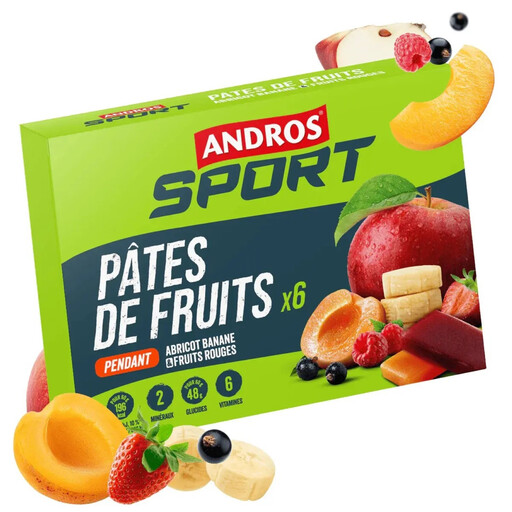 Image unavailable
This format could work well if you’re planning several portions to take with you. The pack is listed as x6, with a total weight of 180 g. Check whether the pieces are individually wrapped, then look at the nutritional information and Nutri-Score, if shown.
No. The Ministry of the Economy says that displaying this logo is optional in France, while the DGCCRF reminds businesses that a nutritional declaration is compulsory for prepacked foods. So, even without a logo, you can still compare nutritional values.
Check the nutritional values per 100 g on both products, particularly the sugars, and then compare their ingredients lists. The Nutri-Score on one pack provides an additional point of reference, but its absence from the other doesn’t, by itself, tell you which is better.
The number of pieces is useful for planning portions, but check whether they’re individually wrapped if you intend to carry them that way. The format alone doesn’t tell you about the nutritional values. For example, Monoprix Courses gives its x6 Andros Sport apricot-banana and red fruit product a Nutri-Score D.
Follow the instructions on the relevant pack. For its 1 kg Jacquot assortment, Auchan recommends storing it away from humidity and heat, between 18 °C and 20 °C. Don’t assume the same instructions apply to another product without checking its packaging.