Households making several desserts
If you use fruit in syrup regularly or in baking, the drained weight and storage instructions after opening can help you choose a tin that suits how much you’ll use.


When shopping on a budget, choose a pack size you can finish after opening and compare the drained weight, which tells you how much fruit there is without the liquid. Don’t rely on the “low fat” claim alone: two Auchan products state that they contain less than 0.5 g of fat per 100 g, while also listing sugars. So it’s worth checking the recipe, the “of which sugars” line and the portion sizes too.
If you use fruit in syrup regularly or in baking, the drained weight and storage instructions after opening can help you choose a tin that suits how much you’ll use.
If you’re looking for fruit in juice or a no added sugars recipe, check the ingredients list and the “of which sugars” line. The claim doesn’t mean the fruit contains no sugars at all.
For a snack or dessert to take with you, fruit pots let you open one portion at a time. Check how many pots there are and how much fruit each one contains.
Start with the pack size and how much fruit you’ll use, then check the recipe and the nutritional information per 100 g.
| Criteria | What to check | Who it’s relevant to |
|---|---|---|
| Usable quantity | Compare the drained weight and the storage instructions after opening. | When making several desserts, I want to use the fruit in a tin without leaving the rest to go to waste; around 36% of consumers prioritise this usable quantity. |
| Added sugars | Read the ingredients list, the exact claim and the “of which sugars” line per 100 g. | If I avoid added sugars, I need to distinguish this claim from the sugars naturally present in fruit. This comes before other criteria for around 29% of consumers. |
| Fat | Check the fat per 100 g, without overlooking the other nutritional values. | I’m primarily looking for a product whose fat content I can check on the label; around 21% of consumers prioritise this. |
| Convenient portions | Check how many pots there are and their drained weight. | For an individual dessert or one to take away, I prefer to open only the portion I need. This convenience is the main criterion for around 14% of consumers. |
Two Auchan products each state that they contain less than 0.5 g of fat and 14 g of sugars per 100 g. A low figure in the first row tells you nothing about the second.
Compare the fat and “of which sugars” figures on the same per-100 g basis, then read the ingredients.
The claim refers to added sugars, not the sugars naturally present in fruit. This claim is governed by European Union Regulation (EC) No 1924/2006.
If this distinction matters to you, check the exact claim and the “of which sugars” line for the product you choose.
Drained weight is the weight of the fruit without the covering liquid. So comparing the total weights of two different packs won’t tell you how much fruit they contain.
Look for the drained weight and choose an amount that suits the portions you plan to serve.
Once opened, a tin needs to be stored according to the instructions for that product. Any remaining contents could go to waste if they aren’t used within the stated time.
Before choosing a pack size, read the label and plan how you’ll use the fruit after opening.
The retailer offers fruit in syrup in tins and pots, including a Carrefour Classic' pineapple recipe with no added sugars.
The €co+ range includes several types of fruit in tins with light syrup.
The retailer offers products including mixed fruit in light syrup and fruit pots for dessert or a snack.
These tins of fruit in syrup offer a range of fruits and pack sizes for desserts or baking. To choose the right amount for how you’ll use it, distinguish the pack weight from the drained weight where it’s given.
 Image unavailable
For a dessert or recipe using several portions of pears, the title states that there are 455 g of drained fruit.
Check the ingredients and storage instructions after opening before choosing this pack size.
 Image unavailable
For a recipe that calls for peaches, the title states that there are 230 g of drained fruit.
Light syrup doesn’t mean you can skip checking the ingredients list and the “of which sugars” line.
 Image unavailable
For a dessert made with pineapple pieces, the title distinguishes the 565 g pack weight from the 260 g of drained fruit.
If you’re comparing recipes, check the ingredients and sugars per 100 g too.
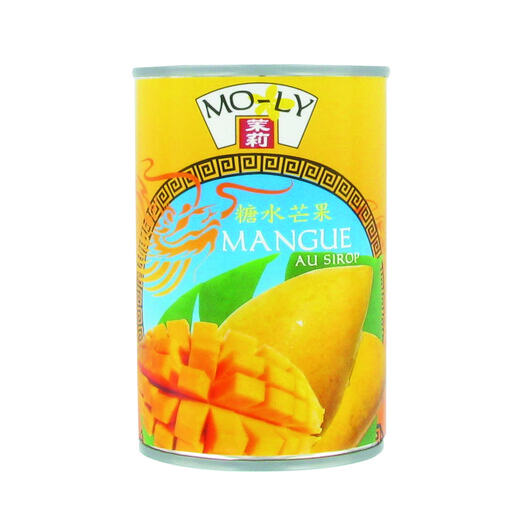 Image unavailable
For a mango dessert, the title gives the pack weight as 425 g.
If the amount of fruit without syrup matters to you, check the drained weight on the packaging.
 Image unavailable
For serving a fruit mix with several desserts, the title gives the pack size as 850 g.
Check the drained weight and storage instructions after opening to see if it suits how much you’ll use.
No. A recipe with no added sugars can still contain sugars naturally present in fruit. This claim is governed by European Union Regulation (EC) No 1924/2006. To find out how much sugar a product lists, check the “of which sugars” line per 100 g.
No. It doesn’t tell you about the sugars or the amount of fruit without syrup. Two Auchan products state that they contain less than 0.5 g of fat per 100 g; check their ingredients and all the nutritional information too.
Follow the instructions on the label of the product you buy, as storage times and conditions vary by product. An Auchan product listing for St Mamet pears advises keeping them in a suitable container in the fridge for 3 to 4 days after opening.