For a dessert to share
If you’re preparing a bowl or dessert glasses for the table, the amount of drained fruit and the number of tins you’ll need to open matter more than the total weight shown on the pack.


For a dessert to share, start by comparing the net drained weight: the large figure on a tin includes the liquid too. A large tin is a good choice if you plan to serve all its contents soon; a multipack of smaller tins means you can open only some of them, while individual pots make serving easier. Then choose the fruit format and check the ingredients list and nutritional information if the sugar content matters to you.
If you’re preparing a bowl or dessert glasses for the table, the amount of drained fruit and the number of tins you’ll need to open matter more than the total weight shown on the pack.
Individual pots make it easy to serve each guest their own portion. A multipack of small tins is another option if you’d rather open only as many as you need.
If you’re looking for a recipe with no added sugars or fruit preserved in its own juice, check the ingredients list and the ‘of which sugars’ line too. As Anses points out, ‘no added sugars’ does not mean ‘sugar-free’.
First decide how you’ll serve the fruit, then compare the drained weight, the recipe and what you’ll do with any opened tin.
| What to consider | What to check | Who is it for? |
|---|---|---|
| Amount of fruit | Compare net drained weights before planning portions. According to Auchan, a 825 g tin of Pouce fruit cocktail contains 500 g of drained fruit; this ratio does not apply to every tin. | If I’m preparing a bowl for the table, I want to know how much fruit I’ll actually be able to serve. Around 36% of consumers make this their top priority. |
| Sugar content | Read the ingredients list, the ‘of which sugars’ figure per 100 g and the exact claim on the packaging. | I’d rather compare the recipes before choosing than rely on the claim on the front of the pack alone. The ingredients are the top priority for around 29% of consumers. |
| Serving and leftovers | Check the number and weight of the individual units, then read the storage instructions for any opened tin. | If everyone needs a portion and we might not finish the dessert, I want to limit the number of opened tins. Ease of serving comes first for around 21% of consumers. |
| Fruit format | Choose based on the format described — pieces or halves — and check which fruits are in the mix. | For plated desserts, I might prefer fruit halves; for a bowl, I might look for a mix. Around 14% of consumers prioritise the presentation or variety. |
A tin also contains liquid. According to Auchan, the 825 g Pouce fruit cocktail contains 500 g net drained weight. The DGCCRF states that the net drained weight must be shown for a product packed in liquid.
Check this figure on each product before deciding how much to serve.
Anses points out that this claim does not rule out sugars naturally present in the ingredients.
Compare recipes by checking the ingredients list and the ‘of which sugars’ line in the nutritional information.
Storage instructions after opening vary by product. Auchan’s product details for Pouce fruit cocktail say to transfer it to a suitable airtight container, keep it in the fridge and consume it within two days.
Check the instructions on the tin you choose. If you don’t plan to serve it all, consider a format where you can open the units separately.
Carrefour offers a fruit cocktail in syrup, including a tin with a net drained weight of 500 g.
Carrefour’s range includes an 850 g tin of fruit cocktail and a pack of 6 × 120 g individual pots of pineapple with no added sugars.
Auchan offers 840 g tins of peach halves, with a net drained weight of 475 g, as well as 825 g tins of Pouce fruit cocktail, with a net drained weight of 500 g.
These products offer options for different desserts: fruit halves for a plated dessert, a fruit cocktail for a sharing bowl, small tins to open as needed, or a single fruit to add to your dessert. To plan portions, check the drained weight of the product you choose.
 Image unavailable
A format to consider for plating a dessert or topping a pastry.
The product name states 455 g drained; check the weight on the packaging of the product being sold before calculating portions.
 Image unavailable
A large tin of fruit cocktail to consider for serving pieces of fruit in a sharing bowl.
The 850 g figure is the weight shown for the tin, not the amount of drained fruit. Check the drained weight before planning portions.
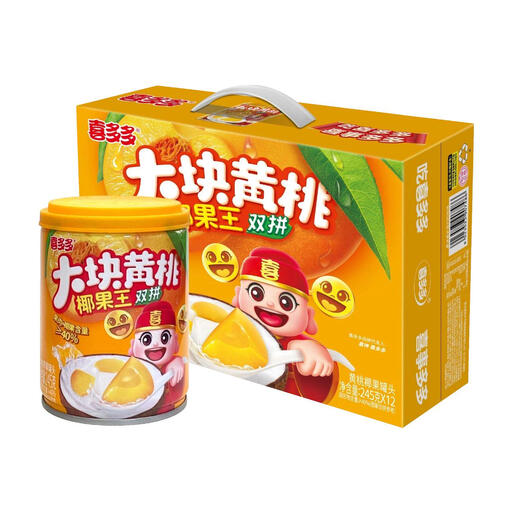 Image unavailable
The multipack lets you open tins separately, without assuming that one tin is the right portion for each guest.
To find out how much fruit you’ll be serving, check the drained weight of each tin and its ingredients list.
 Image unavailable
Three small tins could be a good choice if you want to open only part of the pack for dinner.
The 125 g shown for each tin does not tell you how much fruit it contains without the syrup. Check the drained weight before planning the number of portions.
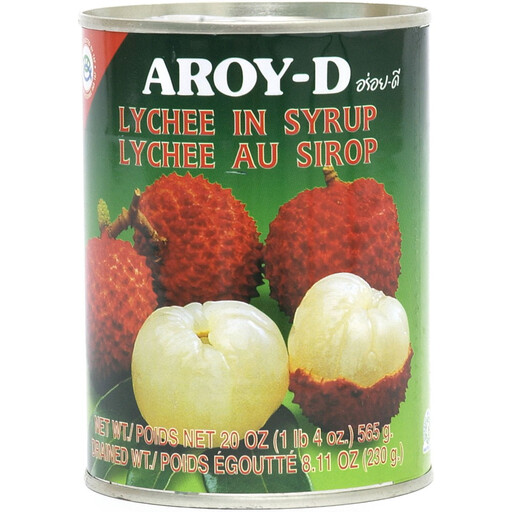 Image unavailable
A tin to consider if you’d like to serve lychees rather than a mix of different fruits.
Check the net drained weight to find out how many lychees you’ll have, and read the nutritional information if you’re comparing recipes.
Use the net drained weight to estimate the amount of fruit without the liquid. The DGCCRF says this weight appears on the label when a product is packed in liquid. Check it for each tin rather than relying on the total weight.
No. Anses explains that sugars naturally present in the ingredients may still be there. To compare two types of fruit in syrup, read the ingredients list and the ‘of which sugars’ line in the nutritional information.
Follow the instructions for the product you’ve bought, as storage times after opening can vary. Auchan’s product details for Pouce fruit cocktail say to transfer it to a suitable airtight container, keep it in the fridge and consume it within two days. Don’t assume the same time applies to other products.