For dinner for two or a small group, a small tin is a good choice if you want to plate the dessert yourself; individual pots work well if everyone is to have their own portion. A large tin makes more sense for several guests or a dessert to share, as long as you have a plan for using up any leftover fruit. Whichever you choose, compare the drained fruit weight rather than relying on the weight shown on the tin.
Who are these sizes suited to?
Couples and small groups
If you’re making dessert for two to four people and don’t want to store a large, opened tin, start with the amount of drained fruit your recipe needs. The smaller sizes listed by Carrefour and E.Leclerc let you compare different quantities.
Hosts who want to serve individual portions
If you’d rather put a sealed portion at each place setting than share fruit from one tin, look at the multipacks of individual pots available from retailers including Auchan and Carrefour. Check how many pots you’ll need.
Anyone making a dessert to share
A 820 to 850 g tin could be a good fit for topping a tart, making a layered dessert or preparing a fruit salad for several guests. Just make sure you have a plan for using the leftovers after opening, and follow the product instructions.
What should you look for?
First, decide how much fruit you need and how you want to serve it. Then compare the ingredients and storage instructions for the products you’re considering.
| What to consider | What to check | Who is this for? |
|---|
| Amount of fruit |
Compare the net drained weight with the number of guests. Don’t assume the tin’s total weight is the same as the amount you can serve. |
If I’m making a one-off dessert for a small group, I want enough fruit without opening a tin and using only part of it. Around 46% of consumers would put getting the quantity right first. |
| Presentation and serving |
Choose a shape that suits your dessert — halves, slices or fruit cocktail — and decide whether you want individual pots or one tin. |
For a plated dessert or a portion at each place setting, I want to serve the fruit as planned without changing the presentation. Serving style would be the priority for around 36% of consumers. |
| Ingredients and storage |
Check the ingredients, the “of which sugars” figure per 100 g and the storage instructions after opening for the product you choose. |
If the recipe and what to do with any leftovers affect my choice, I want to know what to expect before opening the tin. Around 18% of consumers would put this information first. |
Mistakes to avoid
-
Assuming the total weight is the amount of fruit
The total weight of tinned fruit in syrup includes the liquid. The DGCCRF says the net drained weight must be shown on the label when a product is sold in a covering liquid.
Use this weight to plan your portions. If it isn’t shown when you’re shopping online, check the packaging before buying.
-
Judging sugar content by a claim on the front
Recipes vary: the St Mamet “no added sugar” pots listed by Auchan contain naturally occurring sugars, while the 425 g St Mamet fruit cocktail lists 12 g of sugars per 100 g.
Compare the ingredients and the “of which sugars” figure per 100 g for each product, rather than treating “light syrup” and “no added sugar” as equivalent claims.
-
Opening a large tin without planning for leftovers
An 820 to 850 g size may be more than you need for dinner for two. The Auchan and Joybuy listings for some St Mamet products say they can be kept in the fridge for 3 to 4 days in a suitable container after opening.
If you’re considering this size, plan another use for the fruit and follow the instructions on the tin you buy.
Any leftover fruit could go to waste if you can’t use it within the stated timeframe.
-
Relying on a limited-time offer for your menu
Aldi France’s offer on 460 g tins of Martin’s pears was advertised from 29 September to 5 October 2026, while stocks lasted.
Check that a product is available before planning your dessert around it.
Brands to know
Carrefour Classic’
Carrefour stocks tins in different sizes as well as multipacks of individual pots.
- Sizes listed include tins from 412 to 425 g and pots in packs of 4 × 70 g or 4 × 120 g.
- Check the exact product, as the size and recipe vary from one item to another.
Auchan
Auchan stocks both individual pots and tins of fruit in syrup.
- Pots of 4 × 113 g and tins ranging from 410 to 500 g give you the choice of individual portions or one tin to share.
- Ingredients vary depending on the fruit and recipe, so check the label of the product you choose.
Douceur du Verger
This Marque Repère brand, sold by E.Leclerc, offers several small tins of fruit in syrup.
- E.Leclerc lists 230 g tins of peaches, 250 g fruit cocktail and 235 g tins of apricots, among other options.
- The range also includes other pack sizes, so check the weight and shape of the fruit for each product.
St Mamet
Depending on the products listed by Auchan and Joybuy, the range includes individual pots, a 425 g tin of fruit cocktail and larger sizes.
- These pack sizes suit different ways of serving dessert, either in individual portions or from one tin.
- Recipes aren’t interchangeable, so check the ingredients and nutritional information for the product you choose.
Martin’s
Aldi France has listed Martin’s pears in syrup in a 460 g tin.
- This size is worth considering for a dessert served from one tin.
- The offer was advertised for a limited time, from 29 September to 5 October 2026, and was subject to availability.
Tins for dessert
These Joybuy products are tins of fruit in syrup to consider for plating or sharing dessert with a small group. The stated weight doesn’t always refer to the drained fruit, so check this before deciding on portions.
 Image unavailable
St Mamet, peach halves in light syrup, 230 g drained
For plating peach halves in a dessert for a small group, this product lists 230 g of drained fruit. Adjust the quantity to suit the number of portions you’re planning.
View on Joybuy
 Image unavailable
St Mamet, fruit cocktail in syrup, 425 g
For a fruit bowl to share, this tin contains 425 g of fruit cocktail in syrup. Check the net drained weight to work out how much fruit you can serve.
View on Joybuy
 Image unavailable
St Mamet, Williams pear halves in light syrup, 455 g drained
Serve the pear halves on a plate or use them as a topping. This product lists a drained weight of 455 g. Check the weight on the packaging if the exact quantity matters for your recipe.
View on Joybuy
 Image unavailable
AROY-D, mango slices in syrup, 425 g
For a dessert topped with mango slices, this tin has a total weight of 425 g. Check the drained weight to plan your portions, and follow the storage instructions after opening.
View on Joybuy
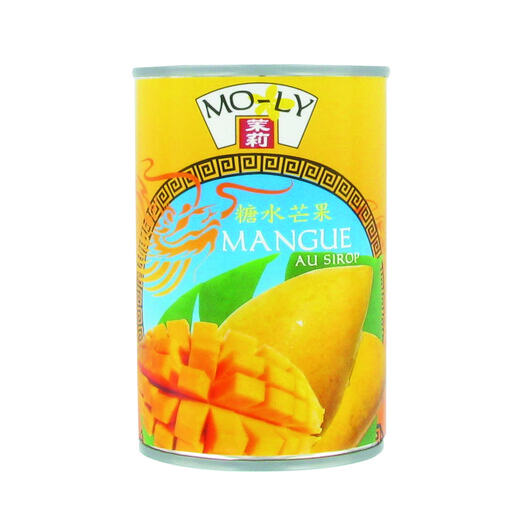 Image unavailable
MOLI, mango in syrup, 425 g
For a mango dessert served from one tin, this product weighs 425 g. Check the drained amount before planning your portions, and organise your serving so you can use the contents as soon as the tin is opened.
View on Joybuy
Frequently asked questions
Is a 425 g tin enough for one person?
Not necessarily: the total weight alone doesn’t tell you how much fruit you can serve or how many portions it will make. For a plated dessert, compare the net drained weight with the amount your recipe needs. If you want a sealed individual portion for each guest, individual pots may be a better choice.
Does “no added sugar” mean an individual pot contains no sugar?
No. The Auchan listing for the St Mamet pots with this claim specifies that they contain naturally occurring sugars. Check the ingredients and the “of which sugars” figure per 100 g for the product you’re considering.
How should you store fruit in syrup after opening?
Follow the instructions on the tin you choose. Listings for some St Mamet products from Auchan and Joybuy say to keep them in the fridge for 3 to 4 days in a suitable container; don’t assume this applies to every brand.
Is the date printed on the tin enough once it has been opened?
No. After opening, follow the product’s storage instructions rather than relying on the printed date alone. The DGCCRF points out that a use-by date shown for unopened packaging no longer applies as a guide once the packaging has been opened.


