People keeping an eye on salt
You want to be able to check the amount of salt declared for the product you’re serving, rather than assuming “light syrup” means less salt.


If salt content is your main priority, compare the “salt” figures per 100 g on the labels of the products you’re considering. “Light syrup” does not mean “reduced salt”. For dinner with friends, choose between a sharing-size fruit cocktail and individual portions based on how you plan to serve dessert, then check the sugars and storage instructions separately.
You want to be able to check the amount of salt declared for the product you’re serving, rather than assuming “light syrup” means less salt.
You’re planning to serve a fruit cocktail in a bowl or use it in a dessert. The drained weight helps you work out how much fruit you’ll have, while the storage instructions matter if you don’t finish the tin.
Fruit cups make it easy to serve individual portions. If you’re also looking for a “no added sugar” recipe, check that wording on the product you choose, as well as its sugar and salt content.
For this dinner, first compare the recipes against your main priority — salt or sugar content — then choose a pack size that suits the way you’ll serve dessert and deal with any leftovers.
| Criterion | What to check | Who is it for? |
|---|---|---|
| Salt | Compare the “salt” figures per 100 g for the products you’re considering. Don’t assume a single figure or the words “light syrup” mean reduced salt. | If I want to limit the salt in the dessert I serve, I need a clear figure to help me choose a product; around 42% of consumers make this their top priority. |
| Sugars and ingredients | Read the ingredients list and the “of which sugars” figure per 100 g; check any “no added sugar” claim separately. | To choose between a recipe in syrup and one with no added sugar, I want to know the composition of the specific product. This is a priority for around 33% of consumers. |
| Pack size and leftovers | Check the net drained weight to work out how much fruit to serve, then read the storage instructions for after opening. | When I’m preparing several desserts, I want serving to be simple without buying far more than I need: around 25% of consumers put pack size and managing leftovers first. |
These claims describe different aspects of a product. An Auchan listing for fruit cocktail in light syrup gives 14 g of sugars and less than 0.01 g of salt per 100 g; Carrefour lists “no added sugar” recipes separately.
Decide which factor matters for your dinner, then check the ingredients and the “of which sugars” and “salt” figures for the product you choose.
A declared salt figure is not, on its own, a comparison with another product. The DGCCRF points out that nutrition claims used on food must be authorised.
Describe the figure shown for the exact product; don’t use a comparative claim unless you can substantiate it.
Instructions vary by product: Auchan says to consume its 500 g fruit cocktail within two days of opening, while the listing for St Mamet’s 425 g cocktail says to keep it in the fridge for three to four days.
Choose a pack size that suits the number of guests and follow the packaging instructions for storing any leftovers.
An opened tin may go to waste if you can’t finish it within the stated time.
E.Leclerc asks customers to check availability with their local store for the Douceur du Verger cocktail shown on its product page.
Check that the product you have in mind is available from the store, Click & Collect or delivery service you plan to use.
The brand offers fruit cocktails in light syrup, including tins designed for sharing.
Carrefour’s range includes various fruits in syrup, including an orchard fruit cocktail labelled “no added sugar”.
St Mamet offers a 425 g fruit cocktail in syrup, which could be worth considering for a dessert to share.
E.Leclerc’s range includes a 250 g fruit cocktail in light syrup.
Aldi sells fruit cocktail in light syrup and fruit cups under this brand.
These products are listed in an order based on how you might serve them: two tins of fruit cocktail to share, followed by a smaller pack. This editorial order isn’t a ranking of quality or salt content; the details listed are taken from the Auchan, Joybuy France and Aldi France product pages named in each row.
| Rank | Product | Features | Why it could suit your dinner | Retailer |
|---|---|---|---|---|
| 1 | Auchan 4-Fruit Cocktail in Light Syrup, 500 g | Fruit cocktail in light syrup; 500 g tin. | The pack shown by Auchan is suitable for serving in a bowl. Follow the storage instructions if you open the tin. | Auchan |
| 2 | St Mamet Fruit Cocktail in Syrup, 425 g | 425 g; according to Joybuy France, less than 0.01 g of salt and 12 g of sugars per 100 g. | This cocktail is another sharing-size option. Its declared salt figure isn’t a “reduced salt” claim. | Joybuy |
| 3 | Baccara 5-Fruit Cocktail, 330 g | Five-fruit cocktail in light syrup; 330 g. | This pack listed by Aldi France could work in a dessert with several components; check its ingredients and how much you’ll need before choosing it. | Aldi |
These St Mamet products offer a choice of fruit cocktail to share or fruit halves to serve as individual desserts. Before deciding how much to serve, compare the salt figure and drained weight shown on each pack.
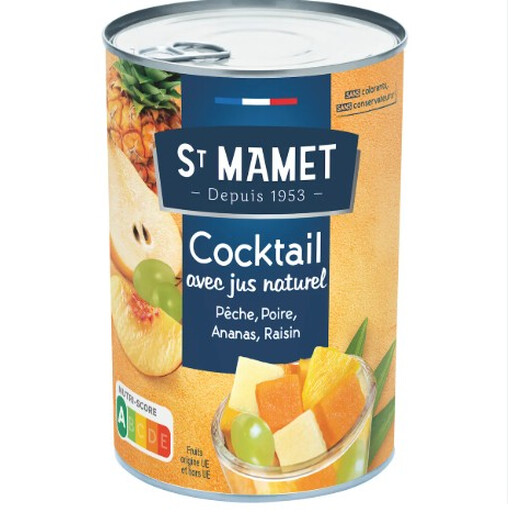 Image unavailable
A cocktail to consider for a fruit dessert to share. Before planning how to serve it, check the pack for its salt content, drained weight and instructions for after opening.
 Image unavailable
This 850 g pack is worth considering for a dessert to share. Check the drained weight to work out how much fruit to serve, then check the salt and storage information for this product.
 Image unavailable
This 425 g cocktail can be served as a dessert to share. Its Joybuy France listing gives less than 0.01 g of salt and 12 g of sugars per 100 g; after opening, it can be kept in the fridge for three to four days in a suitable container. The salt figure doesn’t show that it has reduced salt content.
 Image unavailable
Pear halves are ideal for plated desserts featuring whole fruit portions. The name of this variant gives a drained weight of 455 g; check the salt figure and instructions for after opening on the packaging.
 Image unavailable
Peach halves can be served as individual desserts. The name of this variant gives a drained weight of 230 g; check that this amount is right for your guests, and check the “salt” figure on the label.
No. “Light syrup” is no substitute for the “salt” figure in the nutrition table or a comparative claim about salt. Check the figure per 100 g for the product you plan to serve.
No, not on that basis alone: a single figure doesn’t demonstrate a comparative reduction. As the DGCCRF points out, nutrition claims used on food must be authorised. Use the figure declared on the label without adding a claim of your own.
Follow the storage time and conditions on the product you buy. Auchan says to use its 500 g cocktail within two days of opening, stored in an airtight container in the fridge; the Joybuy France listing for St Mamet’s 425 g cocktail gives three to four days in the fridge in a suitable container.
No. This claim means that no sugars have been added; it doesn’t mean the “of which sugars” figure is zero. Check that figure and the ingredients list for the specific recipe you’re interested in.