People avoiding added sugar
You’re looking for a fruity dessert with no added sugar. However, the claim on the front of the pack isn’t enough to compare total sugar content: check the nutritional information per 100 g.


To avoid added sugar, look for the words ‘no added sugar’. As Anses points out, this does not mean there are no naturally occurring sugars. Also compare the ‘sugars’ per 100 g. For a meal that’s easy to chew, check the shape and firmness of the fruit separately: neither an individual pot nor the words ‘light syrup’ guarantee a suitable texture.
You’re looking for a fruity dessert with no added sugar. However, the claim on the front of the pack isn’t enough to compare total sugar content: check the nutritional information per 100 g.
Look beyond the packaging: diced peaches, pineapple segments and other pieces can vary in size and firmness. If a particular texture has been prescribed, follow the advice of the healthcare professional supporting the person.
You’d rather not open a large tin for a single dessert. The number of individual pots and the drained net weight help you work out how much fruit you’ll be serving.
When choosing, assess the shape of the fruit separately from any claim about sugar. Then check the nutritional information and packaging, based on the portion you plan to serve.
| What to check | Look for | Who is it for? |
|---|---|---|
| Shape and texture | Check whether the fruit is diced, in segments or in pieces. The stated shape alone doesn’t tell you how firm it is. | If large pieces are difficult for me, I need to know whether the fruit will be suitable before serving it. Ease of chewing could be a priority for around 46% of consumers. |
| Added and total sugars | Compare the ‘no added sugar’ claim with the ingredients and the ‘sugars’ per 100 g. | I want to avoid added sugar without confusing this with fruit containing no sugar at all. Around 36% of consumers could put this at the top of their list of priorities. |
| Portion size | Compare the number of individual pots and the drained net weight to work out how much fruit each portion contains. | When I’m preparing a single dessert, I want a container that suits the amount I’ll serve. This could be a priority for around 18% of consumers. |
According to Anses, not adding sugar doesn’t remove the sugars that occur naturally in fruit. So the claim alone doesn’t tell you which product has the lowest total sugar content.
Read the ingredients and compare the ‘sugars’ per 100 g across the products you’re considering.
An individual pot may contain diced fruit or segments. The ready-to-serve format doesn’t, by itself, tell you the actual size or firmness of the pieces.
Check the shape of the fruit. If someone has difficulty swallowing or has been prescribed a particular texture, don’t choose a product containing pieces based on its name alone. Follow the advice of the professional supporting them.
Carrefour’s range includes pots of peach and pear fruit cocktail labelled ‘no added sugar’.
Auchan sells a St Mamet fruit salad labelled ‘no added sugar’.
The retailer offers fruit in light syrup under the Eco+ and Douceur du Verger brands.
ALDI offers BACCARA® individual pots of fruit in light syrup.
This fruit purée in pots is an option outside the fruit-in-syrup category if you’re looking for another way to enjoy fruit. If a specific texture is required, check the product’s texture before serving it.
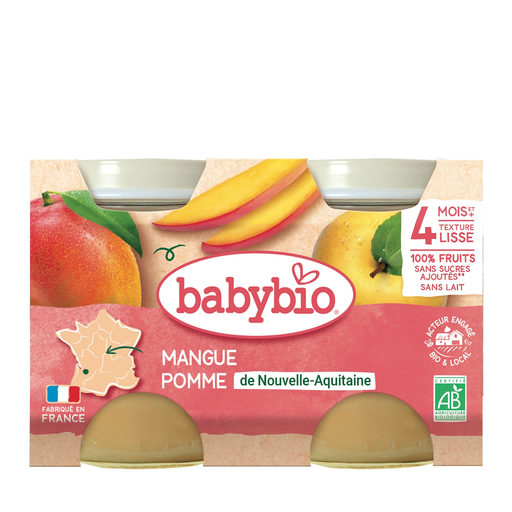 Image unavailable
Consider this purée if you’re looking for something other than pieces of fruit in syrup. It is intended for babies from 4 months.
Apple and mango, with no added sugar, in two 130 g pots. The product name alone doesn’t confirm whether it’s suitable for a prescribed texture.
No. As Anses explains, the sugars naturally present in fruit are still there even when no sugar has been added. Check the ‘sugars’ per 100 g to compare total sugar content.
The per-100 g figure lets you compare products sold in different-sized containers. France’s Directorate-General for Competition Policy, Consumer Affairs and Fraud Control states that nutrition information is given per 100 g or 100 ml. For fruit in syrup, compare the ‘sugars’ figure on the same basis.