Hosts keeping an eye on fat
You want to apply a specific criterion to the buffet dessert. Compare the ‘fat’ value per 100 g for each product, rather than assuming it is low simply because it is made with fruit.


When choosing fruit in syrup for a garden party, start by comparing the fat content per 100 g. Regulation (EC) No 1924/2006 sets 3 g per 100 g as the maximum for a solid food to carry the claim ‘low fat’. Check the sugars and ingredients separately, as ‘light syrup’ does not mean ‘no added sugars’. When planning your buffet, use the drained net weight if it is stated, and check the storage instructions for after opening.
You want to apply a specific criterion to the buffet dessert. Compare the ‘fat’ value per 100 g for each product, rather than assuming it is low simply because it is made with fruit.
You want to tell the difference between a recipe with no added sugars and one that contains sugar. Read the product name and ingredients, then compare the ‘of which sugars’ value: fruit salad in juice with no added sugars can still contain sugars.
You need to plan how much fruit to serve and manage any leftovers. The drained net weight helps you estimate the amount of fruit, while the choice between a large tin and individual pots depends on how you plan to serve it.
| Criterion | What to check | Who it matters to |
|---|---|---|
| Fat | Compare the fat content per 100 g. For a solid food, Regulation (EC) No 1924/2006 sets 3 g per 100 g as the maximum for the ‘low fat’ claim. | I want the buffet dessert to meet this specific criterion, without relying on the recipe name. Around 50% of consumers would make this check a priority. |
| Added sugars | Read the product name, ingredients list and ‘of which sugars’ value per 100 g; don’t confuse ‘light syrup’ with ‘no added sugars’. | If I want to avoid a recipe with added sugar, low fat alone isn’t enough to decide. This would be the main criterion for around 30% of consumers. |
| Serving and leftovers | Compare the drained net weight, packaging and after-opening instructions for the product you choose. | For my buffet, I need to plan how much fruit to serve without opening more packs than necessary. Portion management would come first for around 20% of consumers. |
The words ‘light syrup’ alone don’t tell you that the recipe contains no sugar.
If added sugars matter to your choice, check the product name and ingredients, then look at the amount of sugars per 100 g.
This claim depends on the fat content of the specific product. For solid foods, Regulation (EC) No 1924/2006 sets a maximum of 3 g of fat per 100 g.
Check the nutrition information for the variant you plan to serve.
After-opening instructions vary by product. According to Auchan’s listing for Martin's International fruit cocktail, it should be kept in a sealed food container in the fridge and eaten within three days.
Choose the pack size to suit the number of guests, and follow the packaging instructions for any leftover fruit.
The total weight includes the preserving liquid, so it doesn’t tell you how much fruit you’ll have for the buffet.
Use the drained net weight, if stated, to plan your portions.
The ST MAMET peach, pear and pineapple fruit salad in juice with no added sugars, listed by Auchan, is worth comparing if avoiding added sugars is a priority.
The light-syrup fruit cocktail listed by Auchan is an option to consider for a dessert to share.
If you’re planning a buffet, the products in E.Leclerc’s fruit-in-syrup category offer a useful comparison between sharing packs and individual pots.
ALDI lists a BACCARA five-fruit cocktail in light syrup, worth considering depending on how you plan to serve it.
This selection includes fruit halves, lychees and fruit cocktails in syrup for a buffet dessert. Pack sizes can’t all be compared by the stated weight alone: check the drained net weight to plan how much fruit to serve, as well as the nutrition information for each variant.
 Image unavailable
These pear halves work well for a buffet dessert served in portions. The product name states 455 g drained; check this on the packaging, and compare the sugars and fat per 100 g separately.
 Image unavailable
These peach halves can be served individually or added to a fruit bowl. The product name states 230 g drained; check the label too if added sugars are one of your criteria.
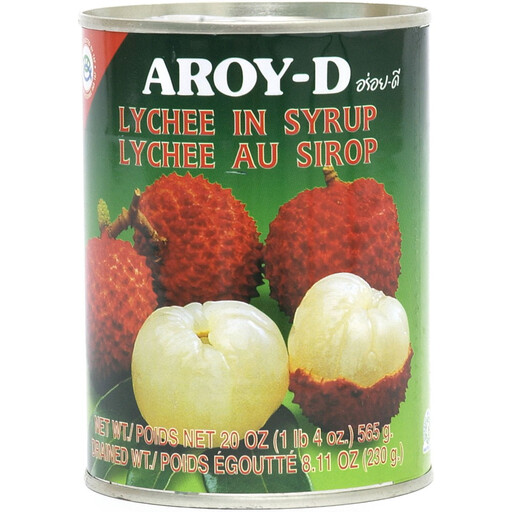 Image unavailable
These lychees add another fruit option to your buffet. Don’t assume the 565 g stated in the product name is the drained net weight: check the packaging to plan portions, and look at the after-opening instructions too.
 Image unavailable
This fruit cocktail can be served in a bowl as a dessert to share. To work out how much fruit you’ll get from this 850 g pack, check the drained net weight on the packaging. Also check the ingredients and storage instructions for after opening.
 Image unavailable
This 425 g pack may suit you if you’d rather open fruit as you need it. Compare its drained net weight with other packs, and check the instructions for storing leftovers.
No. This wording doesn’t tell you the fat content. Check the amount per 100 g: for a solid food, Regulation (EC) No 1924/2006 sets 3 g per 100 g as the maximum for the ‘low fat’ claim.
No. Auchan lists 12 g of sugars per 100 g for ST MAMET peach, pear and pineapple fruit salad in juice with no added sugars. To compare two recipes, check their product names, ingredients and ‘of which sugars’ values.
Follow the instructions for the product you’ve opened, as they may vary. For the Martin's International fruit cocktail listed by Auchan, the instructions say to store it in a sealed food container in the fridge and eat it within three days of opening.
Compare the amount of fruit to serve, the number of portions you need and the instructions for storing leftovers. Drained net weight is more useful than the total weight alone when planning how much fruit you’ll have; individual pots can also work well for serving guests separately.