Hosts putting on a buffet to share
You’re preparing a fruit salad or topping for several people. The drained net weight helps you work out how much fruit you’ll have to serve, without counting the syrup as a portion.


If you’re serving a fruit salad to several guests, compare large tins by drained net weight: the total weight includes the liquid too. A multipack of smaller tins lets you open them as needed, while individual pots are a better choice if you want to give each person a sealed portion. In either case, choose the fruit mix you want and plan how to store any leftovers once opened.
You’re preparing a fruit salad or topping for several people. The drained net weight helps you work out how much fruit you’ll have to serve, without counting the syrup as a portion.
You’re looking for a particular fruit mix or a product labelled ‘no added sugars’. This doesn’t mean ‘sugar-free’, so check the ingredients and nutritional information for the product you choose too.
You’d rather hand out sealed pots than serve from a shared dish. Their size makes it easy to count portions, but check they’re right for your dessert and the number of guests.
First decide whether you’ll serve the fruit in a shared dish or in sealed individual portions. For a fruit salad, start with the amount of drained fruit you need, then choose between one large tin and several smaller ones depending on how you plan to open them.
| What to consider | What to check | Who is this for? |
|---|---|---|
| Amount to serve | Check the drained net weight of each tin, not just its total weight. The Carrefour Classic' product listing gives a drained weight of 500 g for an 825 g tin. | If I’m making a large fruit salad, I want to make sure I have enough fruit rather than counting the liquid it’s packed in; around 33% of consumers put this amount first. |
| Ingredients | Compare the fruit mix and ingredients list, and check whether the specific product is labelled ‘no added sugars’ if that matters for your menu. | If a recipe calls for particular fruits or a specific mix, I can’t choose tinned fruit by format alone; around 25% of consumers put the ingredients first. |
| Multipacks | Check how many tins there are and the stated weight of each one. A multipack of small tins and one large tin aren’t opened in the same way. | When I’m stocking up for a party, I’d rather be able to open the tins as needed; this flexibility is the top priority for around 25% of consumers. |
| Portions and leftovers | Check the size of the individual pots and the storage instructions for tins once opened. | If I’m giving each guest a sealed portion, I want to avoid decanting from a large container; around 17% of consumers prioritise this way of serving or managing leftovers. |
A 825 g tin of Carrefour Classic' fruit cocktail has a drained net weight of 500 g. The rest of the weight isn’t fruit to share between your guests.
To work out how much you’ll need for a shared dish, add together the drained net weights of the products you plan to open.
Sealed portions are handy to hand out individually, but you’d need to open several containers if all the fruit is going into one large salad bowl.
Save individual pots for serving portions separately. For a shared dish, compare tins by the amount of drained fruit you need too.
The product listing for ST MAMET pots labelled ‘no added sugars’ states that they contain naturally occurring sugars.
If this matters for your menu, check the ingredients and the ‘of which sugars’ line in the nutritional information for the exact product.
The Anses advises against eating tinned food if the tin is dented or bulging, or if it gives off a suspicious smell when opened.
Discard the tin without tasting its contents and set aside another one for the buffet.
These ranges offer useful points of comparison for large tins, fruit mixes and individual portions. The features mentioned apply to the specific products listed, not to the entire brand.
A range to consider if you’re choosing between fruit cocktail for a shared dish and individual pots.
The range includes an 850 g tin of fruit cocktail and individual fruit cocktail pots with no added sugars.
An E.Leclerc range that includes fruit cocktails, single-fruit tins and individual pots.
A range that lets you compare fruit cocktail, single-fruit tins and individual pots.
Another fruit cocktail to consider if you’re comparing ingredients and tin sizes.
These products cover a few different ways to prepare your buffet: a case of tins containing a single fruit, a multipack of small tins combining peach and nata de coco, and fruit cocktails in different sizes. To compare how much each will add to a shared dish, check the drained net weight of the variant you choose.
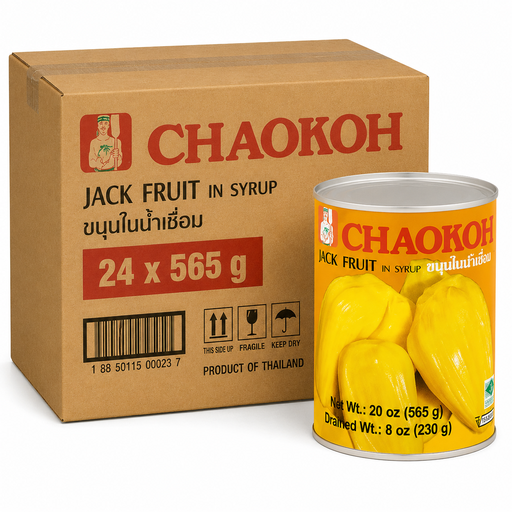 Image unavailable
A choice for serving jackfruit or using it as a topping instead of buying a mixed fruit cocktail. The case contains 24 tins of 565 g; check the drained net weight per tin to work out how much to serve.
Once a tin is open, follow its storage instructions before keeping any leftovers.
 Image unavailable
This multipack is a good choice if you want to open small tins as needed. It combines chunks of yellow peach with nata de coco, so check that this mix, which differs from a classic fruit cocktail, is right for your dessert.
Each tin is listed as 245 g. Check its drained net weight before estimating how much fruit to serve.
 Image unavailable
A handy way to prepare a fruit mix, opening tins as needed instead of all at once. The pack contains three tins of 125 g; check the drained weight if you’re planning a fruit salad for several guests.
After opening, refrigerate any leftovers in a suitable container and follow the storage period given for this product.
 Image unavailable
This 850 g tin is suited to serving in a shared dish. To work out how much fruit it’ll add to your buffet, check its drained net weight rather than relying on the total weight of the tin.
If you don’t serve the whole contents, follow the refrigeration and storage instructions for after opening.
 Image unavailable
This 425 g tin lets you add fruit cocktail to a dessert or shared dish. It’s a single tin, not a multipack, so check its drained net weight and work out how many tins you’ll need for the way you plan to serve it.
Keep leftovers in the fridge, following the instructions on the packaging.
Use the drained net weight for fruit packed in liquid: it tells you how much fruit is left once the liquid has been drained away. For example, the 825 g Carrefour Classic' tin has a drained net weight of 500 g. To work out how many tins to open, also consider the number of guests and how much fruit features in your menu.
No. The product listing for ST MAMET pots with no added sugars states that they contain naturally occurring sugars. Check the ingredients and the ‘of which sugars’ line in the nutritional information for the product you plan to serve.
Follow the storage instructions for the product you’ve bought and put any leftovers in the recommended container in the fridge. The Auchan listings for two different products give different storage periods after opening, so don’t assume the guidance for one tin applies to another.
No. The Anses advises against eating food from a bulging or dented tin, or from any tin that gives off a suspicious smell when opened. Discard it without tasting the fruit.