Parents limiting added sugars
You’re looking for a convenient fruity dessert and want to distinguish the ‘no added sugar’ claim from the total sugar content shown on the packaging.


For a toddler’s dinner, don’t choose fruit in syrup based solely on the words ‘light syrup’. Compare the ingredients, the ‘of which sugars’ line and the texture of the fruit. A pot labelled ‘no added sugar’ may suit your aim of avoiding added sugar, but it still contains naturally occurring sugars. If the pieces aren’t suitable for your child, consider serving fruit prepared in another way that’s appropriate for their abilities.
You’re looking for a convenient fruity dessert and want to distinguish the ‘no added sugar’ claim from the total sugar content shown on the packaging.
You choose the form of fruit according to your child’s chewing abilities. French Health Insurance describes how textures progress during early childhood, rather than recommending one texture for every child.
You’re choosing between individual pots and a family-sized container, looking at the ingredients and the quantity of drained fruit you plan to serve.
Worth considering: if you want an individual portion with no added sugar.
Bear in mind: the fruit and its covering liquid may still contain naturally occurring sugars.
Worth considering: if you prefer a family-sized format and can check the recipe for the specific product you’ve chosen.
Bear in mind: ‘light syrup’ doesn’t, by itself, mean ‘no added sugar’.
Worth considering: if your priority is serving fruit in a texture that suits your child, rather than as pieces in syrup.
Bear in mind: even a smooth preparation should suit your child’s abilities and fit into their dinner.
| Criteria | What to check | Who is it for? |
|---|---|---|
| Added sugars | The claim on the specific product, its ingredients and the ‘of which sugars’ line per 100 g. | I want to avoid adding sugar to dessert without assuming that fruit contains no sugar at all. Around 36% of consumers put this need first. |
| Fruit texture | The size and firmness of the pieces, adapted to your child’s chewing abilities. | If my child is discovering pieces of food, I need to be able to serve the fruit in a form they can manage. This is a priority for around 29% of consumers. |
| Dinner portion | The number of pots, the drained net weight and the quantity of fruit you plan to serve. | For dinner, I’m looking for an easy-to-serve amount while allowing for the other parts of the meal. Around 21% of consumers put this portion format first. |
| Family-sized format | The drained quantity and storage instructions after opening. | If I plan to use a large container over several servings, I want to be able to prepare and store what’s left as instructed on the packaging. Around 14% of consumers make this their priority. |
A St Mamet product listing states that naturally occurring sugars are present. So the claim alone doesn’t tell you the total sugar content.
Read the ingredients and the ‘of which sugars’ line for the product you’re considering.
This phrase doesn’t mean that the product has no added sugar.
Check the ingredients list and nutritional information for the specific product, rather than relying on the name of the syrup alone.
Fruit pots may contain cubes or segments. French Health Insurance reminds parents that children progress to pieces according to their abilities.
Check the fruit before serving, and cut it up or mash it if its shape or texture calls for it.
Carrefour France offers a fruit cocktail in pots labelled ‘no added sugar’.
St Mamet offers fruit cocktail pots and a pineapple and mandarin product labelled ‘no added sugar’.
The Auchan range includes, among other products, pots of peaches in light syrup.
E.Leclerc offers fruit in light syrup in its Eco+ and Marque Repère ranges, in pots and larger containers.
This fruit purée is an option if you’d prefer fruit prepared in a different way from fruit in syrup. For a toddler’s dinner, choose it according to the texture that suits your child, and don’t consider it nutritionally equivalent to a pot of fruit in syrup.
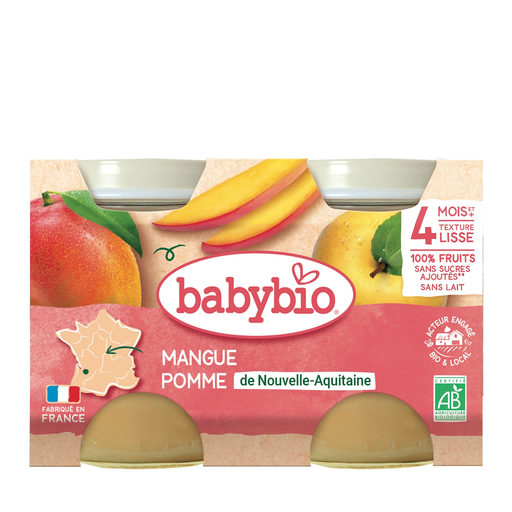 Image unavailable
A fruit preparation to consider if you’d prefer purée to pieces of fruit in syrup.
The 2 × 130 g pack size and ‘from 4 months’ guidance appear in the product title. Check that its texture is suitable for your child.
The title states ‘no added sugar’. Also check the ingredients and the ‘of which sugars’ line on the packaging.
No. A St Mamet product listing states that naturally occurring sugars are still present in its fruit cocktail, despite this claim. Read the ingredients and the ‘of which sugars’ line for the product you’ve chosen.
No. Their shape and texture should suit your child’s abilities. French Health Insurance describes how children progress to small pieces according to their abilities. Check the fruit and prepare it as needed before serving.
First compare the ingredients and the ‘of which sugars’ line on the same basis, for example per 100 g. Then compare the drained net weight if the quantity of fruit matters for your meal. France’s Directorate General for Competition Policy, Consumer Affairs and Fraud Control (DGCCRF) also reminds shoppers that allergenic ingredients must be highlighted on the labels of prepacked foods.