Parents limiting added sugars
You’re looking for a fruit dessert with no added sugars. The words ‘no added sugars’ don’t mean you can skip the ‘of which sugars’ line: fruit and juice naturally contain sugars.


For a toddler’s dinner, don’t choose fruit in syrup based solely on a reduced-salt claim. Check the added sugars, salt per 100 g and the texture of the fruit too. When you’re starting to introduce solid foods, Manger Bouger recommends cooked fruit with no added sugar or salt, blended into a smooth compote or purée. Pieces of fruit should only be considered if your child can already manage that texture.
You’re looking for a fruit dessert with no added sugars. The words ‘no added sugars’ don’t mean you can skip the ‘of which sugars’ line: fruit and juice naturally contain sugars.
Texture matters more than the type of packaging. When introducing fruit, Manger Bouger recommends cooked fruit with no added sugar or salt, blended into a smooth compote or purée. After that, consider what your child can manage when it comes to pieces.
A small pot or cup can make serving dessert at dinner easier. However, the format doesn’t tell you what the ingredients are or how large the pieces are.
For a toddler’s dinner, first choose a texture your child can eat, then compare the ingredients and nutritional information for each product. ‘In light syrup’ doesn’t mean the same as ‘no added sugars’.
Worth considering: when your child is starting weaning or isn’t yet able to manage pieces, in a smooth form with no added sugar or salt.
Bear in mind: this isn’t fruit in syrup; you’ll need to prepare it or buy a separate product.
Worth considering: if your child can manage the texture and avoiding added sugars is important to you.
Bear in mind: naturally occurring sugars are still listed in the nutritional information, and the claim doesn’t guarantee a suitable texture.
Worth considering: if you’re looking for this type of product and its ingredients and pieces suit your needs.
Bear in mind: ‘in light syrup’ doesn’t mean ‘no added sugars’. These claims refer to different characteristics.
| What to consider | What to check | Who is it for? |
|---|---|---|
| Added sugars | The ‘no added sugars’ claim, the ingredients and the ‘of which sugars’ figure per 100 g. | If I want to avoid added sugars in dessert, I need to distinguish this claim from naturally occurring sugars. Around 46% of consumers put this need first. |
| Texture | Whether the fruit is smooth or in pieces, depending on what the child can eat. | When my child is trying fruit for the first time or can’t manage pieces, how it’s served matters more than the packaging. This is the priority for around 36% of consumers. |
| Format | The number and size of the containers, without assuming that one container is a suitable portion for every child. | For a quick dessert, I prefer individual packaging, but I still check what’s inside. Convenience comes first for around 18% of consumers. |
If you’re looking for a lower-salt option, compare the salt per 100 g in the products you’re considering. A claim about salt alone won’t tell you whether sugars have been added or whether the texture is suitable.
On its own, this claim says nothing about added sugars or the form of the fruit. For children under one, Manger Bouger recommends not adding salt to the food you give them.
Compare salt and sugars per 100 g, then read the ingredients and check the texture.
Sugars naturally present in fruit and juice are still included in the nutritional information. For example, a St Mamet product described by Auchan as having no added sugars lists 12 g of sugars per 100 g.
Use the claim to identify products with no added sugars, then check the total sugars in the product you choose.
Individual packaging makes serving easier, but it doesn’t tell you whether the pieces are suitable for your child’s abilities.
Check the form of the fruit. When your child is starting weaning, choose the smooth preparation with no added sugar or salt recommended by Manger Bouger.
These examples refer to specific products. Ingredients, nutritional information and packaging can vary between products from the same brand.
The brand offers, among other things, fruit mixes described as having no added sugars.
Carrefour sells a fruit cocktail with no added sugars under this brand.
Auchan’s range includes pots of peaches in light syrup.
Aldi France offers a Baccara fruit cocktail in light syrup.
The two compotes below are smooth options to consider. The fruit cocktail in syrup is a different choice, and should only be considered if your child can manage pieces and you’re happy with its ingredients.
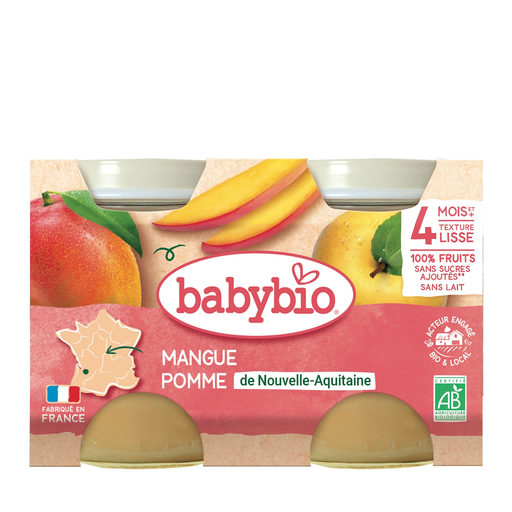 Image unavailable
A compote to consider if you’re looking for smooth fruit for dinner, taking your child’s stage of weaning into account.
This product is described as having no added sugars and being suitable from 4 months. The age guidance doesn’t replace the need to assess your child’s texture needs and requirements.
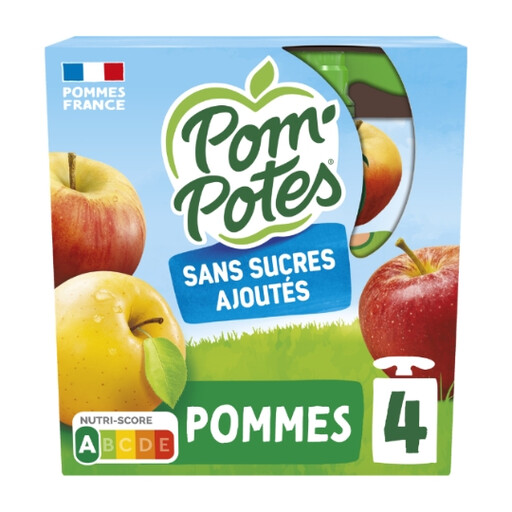 Image unavailable
A compote in pouches to consider if you prefer individual packaging to pieces of fruit in syrup.
The ‘no added sugars’ claim doesn’t mean there are no naturally occurring sugars. Check the pack instructions too before giving it to your child.
 Image unavailable
This cocktail is a fruit-in-syrup product. Before serving it to a toddler, check that your child can manage the pieces.
Sugar is listed as an ingredient in this product, so it isn’t suitable if you’re looking for fruit with no added sugars. Check the nutritional information on the pack too.
No. It doesn’t tell you whether sugars have been added or what texture the fruit is. Compare salt and sugars per 100 g, read the ingredients and check that your child can manage the form of fruit. Manger Bouger recommends not adding salt to food for children under one.
No. Sugars naturally present in fruit or juice are still included in the nutritional information. If you’re comparing products, check the ‘of which sugars’ figure per 100 g.
It depends on whether your child can manage the texture, not just on the product name. When introducing fruit, Manger Bouger recommends cooked fruit with no added sugar or salt, blended into a smooth compote or purée. Then check the pieces in the product you’re considering.
Compare their figures on the same basis of 100 g, particularly for sugars and salt, then read the ingredients. The DGCCRF notes that nutrition declarations on prepacked foods provide information including fat, sugars, protein and salt.