Anyone keeping an eye on salt
You want to compare the salt shown per 100 g and distinguish this figure from any reduced-salt claim on the product.


For a cake, start by choosing the fruit, cut and drained weight to suit your recipe, then check the ingredients and nutritional information for the specific product. A low salt value on the label does not prove that fruit in syrup is “reduced in salt”. If you’re considering fruit in juice with no added sugars, check its sugar content too, and make sure the liquid will work in your recipe.
You want to compare the salt shown per 100 g and distinguish this figure from any reduced-salt claim on the product.
You’re considering fruit in juice if it suits the recipe, and want to check the ingredients, the “no added sugars” claim and the “of which sugars” line separately.
You need a particular fruit, cut and quantity: halves, slices and fruit cocktail won’t be distributed in the same way throughout a cake.
Start with the shape and quantity of fruit required by your recipe. Then compare the liquid it comes in and the sugar content. If salt is your priority, check the declared value per 100 g without mistaking it for a reduced-salt claim.
| Criteria | What to check | Who it matters to |
|---|---|---|
| Declared salt | Compare the “salt” line per 100 g for the specific products. Check separately for any “reduced in salt” claim. | If salt guides my choice, a low figure on the label isn’t enough to prove a reduction compared with another product; around 36% of consumers make this check a priority. |
| Fruit and format | Check the fruit, its cut and the drained net weight when the recipe specifies a quantity of fruit. | To decorate my cake as intended, I need the right cut and enough fruit once drained; this comes first for around 36% of consumers. |
| Sugars and liquid | Read the ingredients and the “of which sugars” line per 100 g; distinguish between syrup, light syrup and juice. | When I choose fruit in juice rather than syrup, I want to know whether the recipe will work with that liquid and what the product contains; around 28% of consumers prioritise this question. |
These claims relate to different characteristics. Auchan’s product information for St Mamet fruit salad states “no added sugars”, 12 g of sugars and less than 0.01 g of salt per 100 g. This salt value does not prove a comparative reduction.
Check the ingredients, “of which sugars” and “salt” lines, as well as the claims on the packaging of the product you choose.
Mixed fruit, fruit halves and slices won’t be distributed in the same way throughout a cake. Your choice depends on the fruit and shape specified in the recipe.
Check the ingredients, cut and quantity of fruit before adapting the recipe.
The total weight includes the liquid the fruit comes in. If the recipe calls for drained fruit, the total weight alone doesn’t tell you how much fruit you can use.
Look for the drained net weight: for example, the St Mamet product described on Auchan’s website has a drained net weight of 475 g.
These examples show different fruits, cuts and liquids. Always check the details of the product you choose for your cake.
The peach, pear and pineapple fruit salad in juice with no added sugars featured by Auchan is worth considering if your recipe allows for mixed fruit.
Its exotic fruit mix in light syrup includes pineapple, papaya and guava.
Carrefour’s range includes peach halves and pineapple slices in juice.
E.Leclerc’s Marque Repère range includes peaches, pears, apricots and fruit cocktails.
These fruits in syrup come in a range of fruit types and cuts to compare with your recipe. Their inclusion here doesn’t mean they carry a “reduced in salt” claim. If this matters to you, check the packaging of each product.
 Image unavailable
Worth considering if your cake recipe calls for pineapple pieces.
The product name states a drained weight of 260 g. If you’re looking for reduced salt content, check that this claim appears on the packaging.
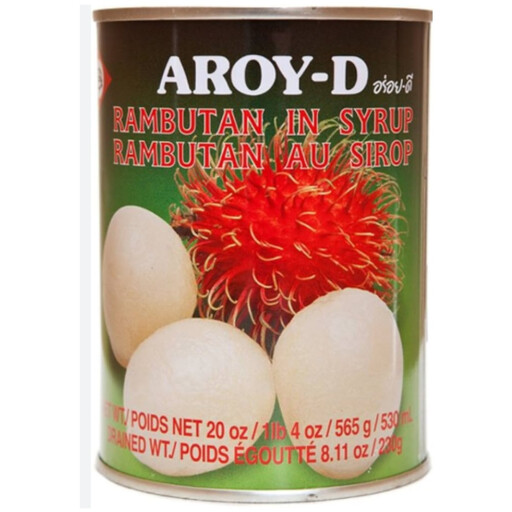 Image unavailable
Consider this only if rambutan suits the fruit your cake recipe calls for.
Check the drained weight to make sure you have the quantity needed for your recipe, and check the packaging for any salt claims.
 Image unavailable
This fruit is worth considering if your recipe allows for longans instead of the fruit it specifies.
Before measuring out the topping, check the drained weight and nutritional information for this product.
 Image unavailable
Worth considering if your cake can use a fruit cocktail rather than a single type of fruit.
Check the ingredients and drained weight to see whether the mix and quantity suit your recipe. This fruit cocktail in syrup is different from the St Mamet fruit salad in juice mentioned above.
 Image unavailable
Mango slices are worth considering if this fruit and cut suit the look you want for your cake.
Check the drained weight and the “salt” line for the specific product if the quantity of fruit or salt value will influence your choice.
No. This figure alone doesn’t prove a reduction compared with a reference product. Auchan’s product information for several prepared fruit products states less than 0.01 g of salt per 100 g. To check whether a reduced-salt claim applies, look at the packaging of the specific product.
Yes, it can still contain sugars. Auchan’s product information for St Mamet fruit salad in juice carries this claim and states 12 g of sugars per 100 g. Check the “of which sugars” line as well as the claim about added sugars.
Follow the storage instructions for the product you buy, as they can vary. Auchan’s product information for its exotic fruit mix says to consume within two days of opening; Martin’s International fruit cocktail should be consumed within three days.