Someone keeping an eye on fat content
You want to compare the ‘fat’ figure per 100 g, without assuming that a recipe intended for the oven is automatically lower in fat.


To choose frozen chips based on their stated fat content, compare the figures per 100 g for products shown in the same state: ‘oven chips’ does not mean ‘lower fat’. For a meal for one, also consider the bag size and the cooking method shown on the pack. For example, E.Leclerc product information lists 2.4 g of fat per 100 g for frozen POM'LISSE classic chips, compared with 3.0 g for their oven chips.
You want to compare the ‘fat’ figure per 100 g, without assuming that a recipe intended for the oven is automatically lower in fat.
You’re looking for a bag you can split into portions, with oven-cooking instructions suited to the product you choose.
You choose the pack size based on how often you eat chips on your own and the storage instructions on the bag.
If fat content guides your choice, start by comparing nutritional values on a like-for-like basis. Then check the pack size and cooking instructions for the amount you’ll actually prepare.
| Criteria | What to check | Who is it for? |
|---|---|---|
| Fat content | The amount per 100 g and the state of the product it refers to; don’t assume ‘lower fat’ just because the pack says ‘oven chips’. | I want to compare recipes based on their stated fat content, rather than how they’re cooked. Around 42% of consumers would put this comparison at the top of their list of concerns. |
| Portion and cooking | The weight of the bag, as well as the quantity, temperature and arrangement specified in the cooking instructions. | I cook a small amount of chips at a time and want instructions suited to my oven. Ease of preparation would come ahead of other criteria for around 33% of consumers. |
| Storage | A pack size suited to how often you eat chips, and storage instructions for after opening. | I eat chips occasionally and prefer a bag that lets me use the portions I need without leaving leftovers. Around 25% of consumers would make managing the bag their priority. |
E.Leclerc product information lists 2.4 g of fat per 100 g for frozen POM'LISSE classic chips and 3.0 g for their frozen oven chips. So the cooking method alone isn’t enough to distinguish between these two recipes.
Compare nutritional information on the same per-100 g basis, and check the cooking instructions separately.
Carrefour Classic' oven chips list wheat and rice flour among their ingredients; McCain lists rice flour and modified starch in its Just au Four Classique recipe.
Check the ingredients list and allergen information on the bag you choose, particularly if you need to avoid wheat.
The POM'LISSE products listed by E.Leclerc include a 2.5 kg bag of classic chips and a 600 g bag of oven chips. The difference in pack size matters when you’re preparing one meal at a time.
Choose a size that suits how often you eat chips, keep the product frozen as directed on the packaging, and don’t refreeze it after thawing.
Anses explains that acrylamide can form when starchy foods are cooked at high temperatures.
Follow the cooking instructions on the pack and avoid letting the chips become very dark brown.
The range includes Just au Four Classique, a product designed for oven cooking.
The oven chips listed by Carrefour are available in a 600 g bag.
E.Leclerc product information lets you compare two classic 9x9 recipes on a per-100 g basis for frozen products.
The retailer sells oven chips under its own brand, as well as products from other brands.
ALDI sells frozen MR FRITES oven chips in a 1 kg bag.
These two McCain products are designed for oven cooking and can be split between several individual meals. Choose a pack size to suit how you’ll use it. To compare their fat content with other chips, check that the nutritional values on the packaging refer to products shown in the same state.
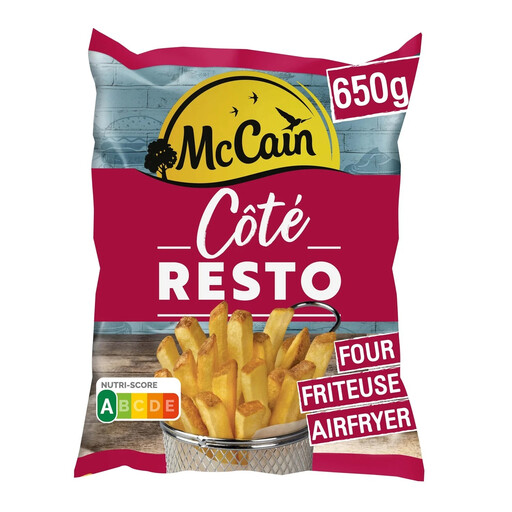 Image unavailable
The 650 g bag can be split into portions if you’re cooking oven chips for one at a time.
If you need to avoid wheat, check the ingredients and allergen information on the packaging. Before comparing nutritional values, also check which state of the product they refer to.
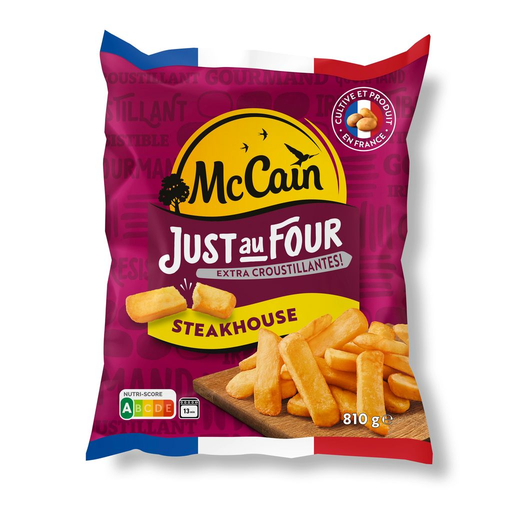 Image unavailable
This oven-cooked variety is a good choice if you’re planning to split an 810 g bag between several meals.
Follow the pack instructions for the amount you’re cooking. Before comparing nutritional values with another product, check which state of the product they refer to.
No: ‘oven chips’ describes a cooking method, not a reduced fat content. E.Leclerc product information even lists 2.4 g of fat per 100 g for its frozen POM'LISSE classic 9x9 chips, compared with 3.0 g for the oven version.
Look for the exact wording on the packaging rather than drawing conclusions from a single figure. In France, nutrition claims are governed by European Regulation (EC) No 1924/2006, as noted by the DGCCRF and EUR-Lex. Also check the nutritional information and any comparison shown on the pack.
Follow the instructions for the product you’ve bought, including the quantity, temperature and arrangement of the chips. For Just au Four Classique, McCain recommends cooking 300 g in a single layer at 220 °C. Don’t apply these instructions to another variety without checking first.
According to Anses, cooking starchy foods at high temperatures for too long can encourage acrylamide to form. Follow the instructions on the bag and avoid cooking the chips until they’re very brown.
Don’t refreeze chips after thawing if the bag advises against it. To plan several individual meals, store the product according to the temperature and time guidance on the packaging.