Parents checking for allergens
If a child needs to avoid an ingredient, the recipe you buy matters more than its format. The DGCCRF reminds shoppers that allergenic ingredients in prepacked foods must be highlighted in the ingredients list.


For dinner for two children, choose a pizza labelled as serving two, two individual pizzas or mini pizzas, depending on their tastes and how much flexibility you want when serving. Then check the allergens in each recipe, compare the nutritional values per 100 g and follow the cooking instructions on the box you choose.
If a child needs to avoid an ingredient, the recipe you buy matters more than its format. The DGCCRF reminds shoppers that allergenic ingredients in prepacked foods must be highlighted in the ingredients list.
You want to make sure there’s enough for two children without relying on the format name alone. The number of slices or individual pieces and the net weight are useful guides to compare with their appetites and any sides you’re serving.
You’re comparing recipes based on your cooking appliance and the time you have available. Nutritional information per 100 g also makes it easier to compare products of different weights before deciding how much to serve.
Choose these if: the children prefer different recipes or you want to give each child their own pizza.
Bear in mind: if you choose two different products, check the ingredients and cooking instructions for each one separately.
Choose this if: both children are happy with the same recipe and the stated number of portions suits the meal you have planned.
A limitation: one shared topping leaves you with less flexibility if their preferences or dietary requirements differ.
Choose these if: you’d like to serve the pieces gradually and adjust how they’re shared.
Bear in mind: count the pieces you serve rather than assuming that one piece is a full portion.
When choosing for two children, start with the factor that matters most to your household, then check the other details of the recipe you choose.
| Factor | What to check | Who is this for? |
|---|---|---|
| Allergens and ingredients | Check the ingredients list, highlighted allergens and any ‘may contain’ statements on the box you buy. | If a child needs to avoid an ingredient, I need to be able to check the recipe before serving it; around 33% of consumers put this check first. |
| Portions for two | Compare the number of slices or pieces and the net weight, taking any sides into account. | To avoid making too much or too little, I want to be able to divide the meal between the two children; getting the portion right comes first for around 27% of consumers. |
| Nutritional information | Compare the values per 100 g, then consider how much you’ll actually serve each child. | When comparing pizzas of different weights, I want to compare their values on the same basis; this is the top priority for around 20% of consumers. |
| Cooking | Check which appliance to use and the product-specific cooking time, temperature or power settings. | When time is short, I want a meal that suits the equipment I have; around 20% of consumers put ease of preparation first. |
Portion details vary: Auchan describes its 390 g Bolognese pizza as containing two portions, while other products come as several pizzas or mini pizzas.
Check the number of slices or pieces in the product you choose, then adjust the amount to suit the sides you’re serving and the children’s appetites.
Two recipes in the same range can have different ingredients. Auchan’s product information for its 390 g Bolognese pizza lists wheat and milk, among other ingredients; this doesn’t tell you about the brand’s other pizzas.
Check the ingredients, highlighted allergens and any ‘may contain’ statements on every pack, even if you’ve bought a recipe with the same name before.
Instructions vary by product and appliance. Auchan gives microwave settings for its 200 g four-cheese pizza, while its 390 g Bolognese pizza comes with oven instructions.
Follow the cooking method on the box you’re using, including the stated time and temperature or power setting.
If shown on a product, the Nutri-Score doesn’t tell you which allergens to avoid or how much each child will get.
Check the ingredients and nutritional values per 100 g too, then consider the portion you’ll actually serve.
Piccolinis may be a good option if you’d rather serve mini pizzas than slice up a whole one.
The Ristorante range includes a pack of two pizzas, an option to consider instead of one pizza to share.
Carrefour Sensation products give you the choice of comparing mini pizzas with larger pizzas, depending on how you plan to serve them.
These ranges let you compare pizzas to share with smaller formats.
Auchan’s products show the difference between a small pizza and one labelled as serving two.
Lidl France has a frozen pizza and snack category, with products to explore depending on what’s available in your local store.
This selection includes two types of mini pizza to share between the children, plus a whole pizza. How many portions to serve will depend on the meal you have planned.
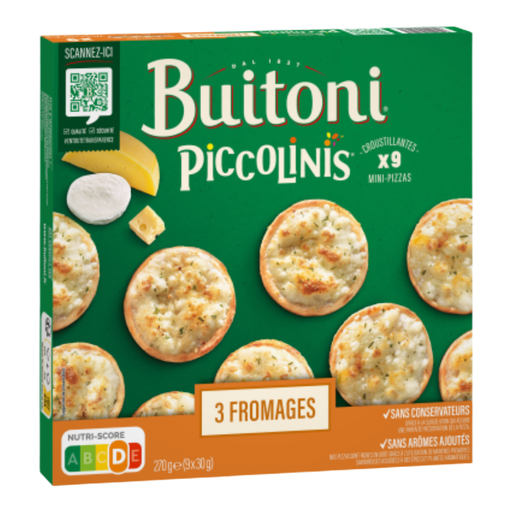 Image unavailable
The pack of nine makes it easy to share the mini pizzas between two children, depending on what else you’re serving and how hungry they are.
If a child needs to avoid gluten or milk, check the ingredients and any ‘may contain’ statements on the pack. Follow the cooking instructions too.
 Image unavailable
This mini format is worth considering if you’d like to share the pack during the meal; check the number of pieces to help plan the portions.
Check the allergens and any ‘may contain’ statements on the pack, as well as the cooking instructions for this product.
 Image unavailable
This 385 g whole pizza could be a good choice if both children want the same recipe; its weight alone doesn’t tell you how much to serve each of them.
Check the ingredients and allergens in this recipe, then look at the portion details and cooking instructions on the box.
No, not if the child needs to avoid gluten. The DGCCRF says that allergenic ingredients in prepacked foods must be highlighted, so check the ingredients list on the box you buy rather than relying on the brand or a previous recipe.
Start with the number of slices or pieces stated for the product you’ve chosen, then take the children’s appetites and any sides into account. As examples for these specific products, Auchan labels its 390 g Bolognese pizza as containing two portions, while Dr. Oetker Ristorante Speciale comes as two pizzas weighing 690 g in total.
Compare the values per 100 g first, as this gives you a consistent basis for comparing pizzas of different weights. The DGCCRF states that nutritional information is given on this basis; then consider how much you plan to serve each child.
No: only use a microwave if the pizza’s packaging says you can. Auchan gives cooking times for its 200 g four-cheese pizza at 750 W and 900 W, while its 390 g Bolognese pizza comes with oven instructions.
For dinner at home, first check the child’s specific dietary requirements and the pizza label. If the meal or any leftovers will be taken to school, ask the school which rules apply there.