For a late-night craving, first decide how much you’re going to eat, then compare the energy content using the values per 100 g. A small pizza or a few mini pizzas don’t automatically make a small portion: check the salt, saturated fatty acids and recipe ingredients too.
Who is this guide for?
Anyone who wants to choose their portion
If you’re only planning to eat some of the pizza or pack, check the weight of that amount rather than just the size of the box. Portion information published by Auchan for Buitoni Piccolinis, for example, helps you make this distinction.
Anyone looking for a quick meal
Cooking method can help you choose between two products, but it doesn’t tell you how much you’ll eat. Auchan, for instance, lists 523 kcal for its 200 g microwaveable four-cheese pizza – the whole pack.
Anyone keeping an eye on salt, saturated fatty acids or allergens
Compare the nutritional values for the amount you plan to eat, and read the ingredients for each recipe. A lower energy value per 100 g doesn’t tell you everything about salt, fat or allergens.
What should you look for?
When choosing a frozen pizza for a late-night craving, kcal per 100 g helps you compare recipes. The weight you serve then determines how much you’ll actually eat.
| What to consider | What to check | Who it matters to |
|---|
| Energy consumed |
Compare kcal per 100 g, then check the weight of the amount you plan to eat. |
If I want to limit the energy in my snack, the value per 100 g isn’t enough unless I’ve decided on a portion. Around 33% of consumers would make the energy they actually consume their priority. |
| Size and portion |
Check the net weight and the number of slices or pieces; decide how much you’ll have before cooking. |
Whether it’s mini pizzas or a large pizza, I prefer to decide in advance how much I’ll eat. For around 25% of consumers, portion control would be the main consideration. |
| Salt and saturated fatty acids |
Check both values per 100 g and, if needed, for the portion you plan to eat. |
If I eat this type of product regularly, I want to compare more than just calories. Around 25% of consumers would focus first on salt and saturated fatty acids. |
| Cooking method and ingredients |
Check which appliance you need, the cooking instructions and the list of ingredients and allergens. |
If I don’t have the right appliance or some ingredients aren’t suitable for me, I need to rule out that recipe. This compatibility would be the priority for around 17% of consumers. |
Common pitfalls to avoid
-
Assuming a small pack makes a small snack
Auchan’s 200 g microwaveable four-cheese pizza contains 523 kcal, 9.8 g of saturated fatty acids and 2.1 g of salt per pack.
Before choosing a compact format, check the values for the whole pack or work them out for the amount you’ll eat.
-
Confusing a calorie comparison with a ‘low energy’ claim
In the European Union, Regulation (EC) No 1924/2006, published on EUR-Lex, sets a limit of 40 kcal per 100 g for this claim on solid foods. The pizzas mentioned here all exceed this limit, even when their value is lower than that of another product.
Compare the figures and specific portion sizes rather than describing these pizzas as ‘low in calories’.
-
Looking at calories alone
E.Leclerc lists 235 kcal, but also 6.1 g of saturated fatty acids per 100 g, for its Turini Montagnarde pizza. The first figure doesn’t tell you everything about the recipe’s nutritional profile.
Compare salt and saturated fatty acids too, taking the amount you plan to eat into account.
-
Assuming every Nutri-Score on a pack is based on the same calculation
E.Leclerc says that the Nutri-Score printed on the packaging for its Turini cheese mini pizzas uses the old calculation.
When comparing two packs, check for any information about how the score was calculated and look at the nutritional information too.
Brands to compare
Buitoni
The products mentioned include a Four à Pierre pizza, Piccolinis and a 195 g Air Fryer format.
- Auchan lists 211 kcal per 90 g for vegetable and pepperoni Piccolinis: how many pieces you eat matters just as much as the pack size.
- The 330 g Four à Pierre four-cheese pizza was listed as unavailable on its Carrefour product page. Check the recipe and allergens for each variant.
Dr. Oetker
The Ristorante range includes thin-crust pizzas, including a 340 g four-cheese pizza.
- Joybuy lists 257 kcal, 5.6 g of saturated fatty acids and 1 g of salt per 100 g for Ristorante four-cheese pizza. These values let you work out the figures for your planned portion.
- The product information for this recipe lists gluten, milk and soya, and says it may contain mustard. Don’t assume these details apply to other recipes.
Carrefour
The Carrefour Bio and Carrefour Extra ranges include the Margherita and four-cheese pizzas considered here.
- Carrefour lists 249 kcal per 100 g for its 310 g Margherita Bio and 271 kcal per 100 g for its 340 g Carrefour Extra four-cheese pizza.
- The organic label alone doesn’t tell you the energy value of a pizza. Compare the recipe and the weight of your portion.
Auchan
The products considered include a 200 g microwaveable pizza and a 390 g four-cheese pizza to cook in the oven.
- These two formats let you choose according to the appliance you have and the amount you want to serve.
- Auchan lists 523 kcal for the whole 200 g microwaveable pizza. Its low weight doesn’t necessarily make it a small snack.
Turini / Marque Repère E.Leclerc
The Turini products mentioned include a 450 g Montagnarde pizza and cheese mini pizzas.
- E.Leclerc publishes the values per 100 g for its Montagnarde pizza, which are useful for working out the amount you’ll serve.
- The Montagnarde contains 6.1 g of saturated fatty acids per 100 g. For its cheese mini pizzas, E.Leclerc notes that the Nutri-Score printed on the pack uses the old calculation.
Lidl
The retailer has a category for frozen pizzas and snacks.
- When choosing a product, compare its weight and the nutritional information on the packaging in store.
- Don’t assume anything about a pizza’s ingredients or portion size based only on the category it appears in.
Frozen pizzas to consider on Joybuy
These pizzas include individual formats, mini pizzas you can portion out, and larger pizzas where you’ll need to decide how much to serve. Choose the recipe and amount first, then compare what you’ll actually eat.
 Image unavailable
Dr. Oetker Ristorante Vegetable Pizza 385 g
With this vegetable pizza, decide how much you plan to eat before relying on the values per 100 g.
Net weight: 385 g. Check the cooking instructions for your appliance.
View on Joybuy
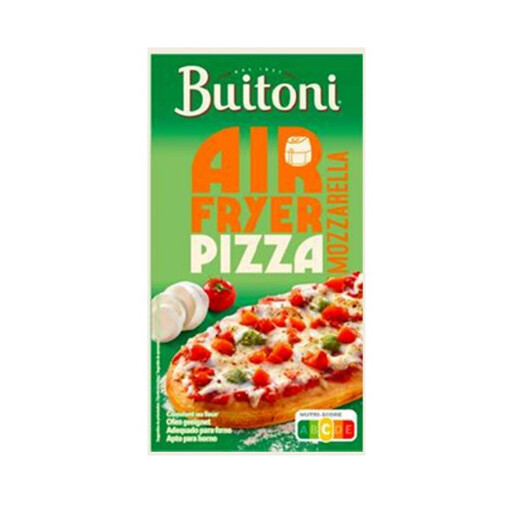 Image unavailable
Buitoni Air Fryer Pesto Mozzarella 195 g
This individual format tells you the pack weight before you decide whether to eat the whole thing.
Net weight: 195 g. Check the cooking instructions for the Air Fryer variant.
View on Joybuy
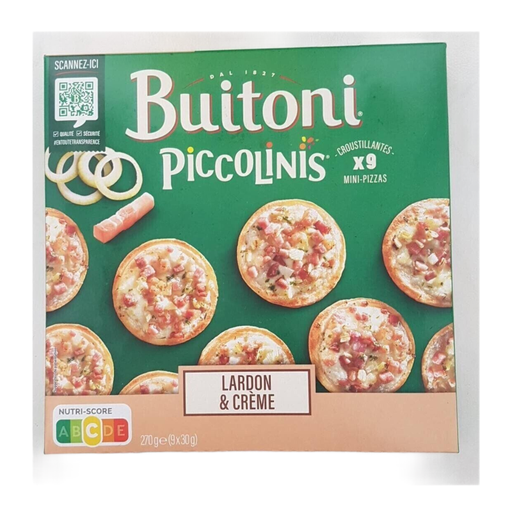 Image unavailable
Buitoni Piccolinis cream and bacon, 9 pieces, 270 g
The individual pieces let you choose how many mini pizzas to cook instead of preparing the whole pack.
The pack contains 9 pieces with a total weight of 270 g; check the ingredients for this recipe.
View on Joybuy
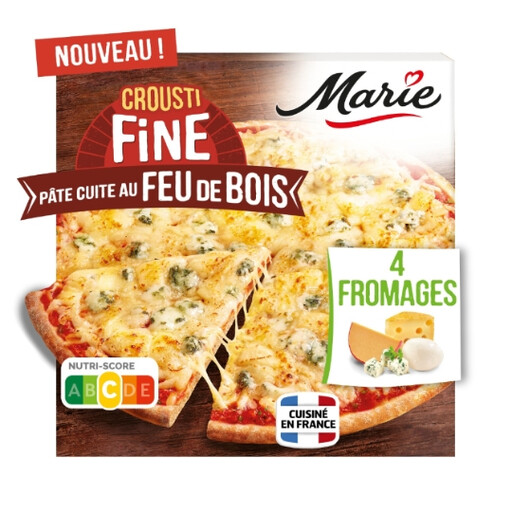 Image unavailable
Marie four-cheese, wood-fired thin crust, 390 g
With this larger pizza, decide how much to serve rather than treating the total weight as a single portion.
Net weight: 390 g. It’s described as a thin-crust four-cheese pizza.
View on Joybuy
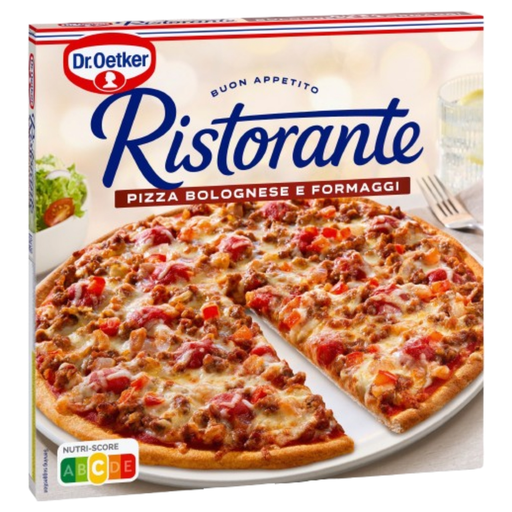 Image unavailable
Dr. Oetker Ristorante Bolognaise 375 g
If you choose this Bolognese pizza for a snack, decide how much to serve before cooking.
Net weight: 375 g. Compare the nutritional values for this recipe on the packaging.
View on Joybuy
Frequently asked questions
Can these pizzas be described as ‘low in calories’?
Not the products with figures given here: they exceed the 40 kcal per 100 g limit for the ‘low energy’ claim on solid foods in the European Union, set by Regulation (EC) No 1924/2006 and published on EUR-Lex. A pizza can have a lower value than another without meeting this requirement.
Should you compare kcal per 100 g or for the whole pizza?
Compare both: the first value helps you compare recipes of different weights, while the second shows what’s in the pack if you eat the whole thing. For example, Auchan lists 523 kcal for its entire 200 g four-cheese pizza.
Do mini pizzas make it easier to choose a portion?
They let you decide how many pieces to have, as long as you don’t mistake that number for the whole pack. For the vegetable and pepperoni Piccolinis mentioned by Auchan, the nutritional information lists 211 kcal per 90 g, while the pack weighs 270 g.
How should you store and cook a frozen pizza?
Follow the storage and cooking instructions for the product you choose. The product information mentioned here includes storage instructions at −18 °C and different cooking methods for different pizzas. Check the packaging before choosing between the oven and microwave.


