Organisers with a strict calorie limit
You need to set how much pizza each attendee receives and check that it stays below 500 kcal. A set number of pieces or a weighed portion makes this easier to manage.


To serve every attendee a portion of pizza containing less than 500 kcal, choose a format you can count or weigh rather than handing out a whole pizza without doing the sums. According to Carrefour France’s product information for Sensation 3 Cheese mini pizzas, six pieces weigh approximately 180 g and contain 471.6 kcal in theory. If the limit is strict, check the weight of the portion served and the label on the batch. This calculation is for the pizza alone, excluding drinks, sides and dessert.
You need to set how much pizza each attendee receives and check that it stays below 500 kcal. A set number of pieces or a weighed portion makes this easier to manage.
You want to serve consistent portions without holding up the break. Counted mini pizzas or pre-cut slices can help keep things moving, provided you check how much each person actually receives.
You need to be able to check the allergen information for the batch being served, and organise cooking and, where necessary, keeping the pizzas hot in line with your service requirements.
First, decide whether the 500 kcal limit applies to the pizza alone or the whole meal. If it applies to the pizza alone, compare its energy value with the amount you actually plan to serve, then consider how you’ll portion and serve it.
| Criteria | What to check | Who is this for? |
|---|---|---|
| Limit per portion | Check the kcal per 100 g and weigh the amount served, or use a value given for the exact portion size. | If I need to keep the pizza served to each person strictly within 500 kcal, the weight of the portion matters more than how big the product looks. Around 42% of consumers would prioritise this calorie check. |
| Consistent buffet portions | Set a number of mini pizzas or a weight of slices per person before serving. | When the break is short, I want to serve everyone the same amount without deciding how to cut it at the last minute. Around 33% of consumers would make consistency their priority. |
| Allergens and serving | Check and keep the batch label; organise cooking and serving to suit your operation. | If I’m serving pizza to attendees, I need to be able to give them relevant allergen information and manage hot food safely. Around 25% of consumers would prioritise these serving requirements. |
According to Carrefour France’s product information, a 400 g Royale at 199 kcal per 100 g contains around 796 kcal as a whole pizza. A 400 g 4 Stagioni at 179 kcal per 100 g contains around 716 kcal. So the per-100 g figure alone doesn’t mean you can serve a whole pizza while staying under 500 kcal.
To work out the amount served, multiply the kcal per 100 g by the number of grams served, then divide by 100.
Auchan France’s product information for its 200 g 4 Cheese pizza gives an energy value of 523 kcal for the whole product. So even an individual-sized pizza can exceed 500 kcal.
If you plan to give each person a whole pizza, check the value for the entire pack.
Once the pizzas are laid out on a buffet, the packaging may no longer be within reach of attendees. Ingredient and allergen information needs to remain available for the batch being served.
Keep the packaging and prepare allergen information from the labels, in line with the requirements that apply to your service.
For catering in collective settings, the Loire Prefecture states that hot food must be kept above 63 °C. Cooking well in advance therefore requires arrangements suited to the service in question.
Plan cooking batches and hot-holding equipment to suit your operation and food safety procedures.
Carrefour France offers Sensation 3 Cheese mini pizzas, as well as 400 g Extra whole pizzas.
Auchan France offers, among other products, a 200 g frozen 4 Cheese pizza.
The Auchan France catalogue includes Ristorante Piccolissima mini pizzas, as well as other Ristorante products.
The Auchan France catalogue includes, among other products, 3 Cheese Piccolinis in a box of nine pieces weighing 270 g.
This selection includes mini pizzas to portion by piece or weight, as well as a whole pizza to cut into slices. For each one, check whether the portion actually served meets the 500 kcal limit, using the nutritional information on the batch you buy.
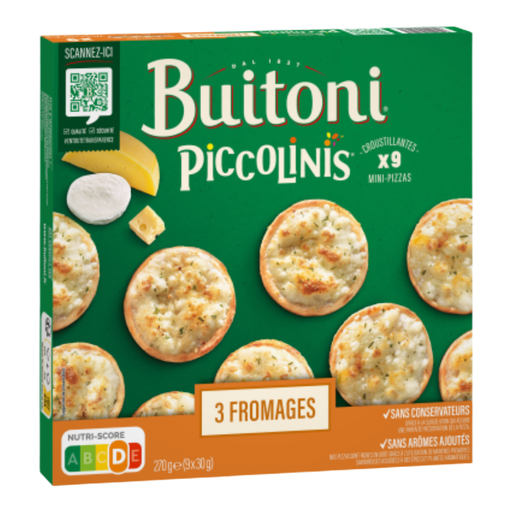 Image unavailable
The pack of nine makes it easy to plan a set amount for each attendee.
If the limit is strict, also check the weight and kcal of the portion served on the batch packaging.
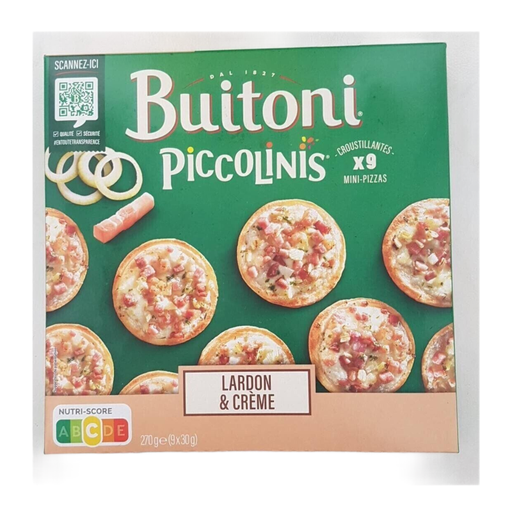 Image unavailable
The nine pieces make it easy to prepare counted portions for the buffet.
Check the nutritional and allergen information for the batch; the number of pieces alone doesn’t tell you how many kcal are served.
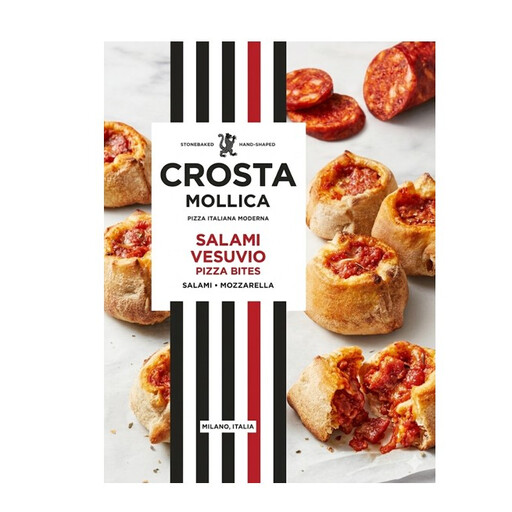 Image unavailable
This pack of mini pizzas can be divided into weighed portions rather than cut into slices.
Set the amount each person receives and calculate the kcal using the product label.
 Image unavailable
To serve comparable portions to several attendees, allow the same weight of mini pizzas per person.
Check the kcal per 100 g and allergen information on the batch packaging.
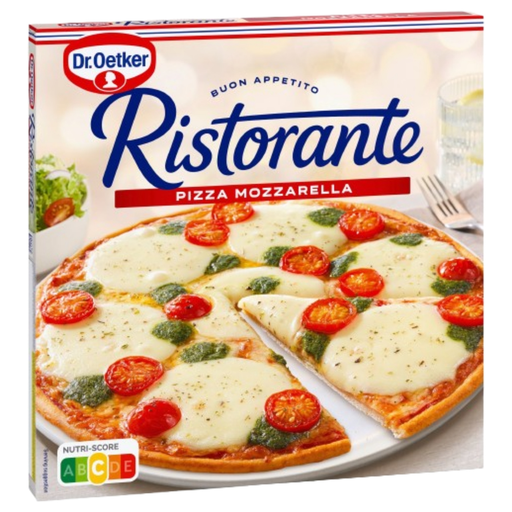 Image unavailable
This whole pizza can be served in slices if you can set and weigh the amount each person receives.
Don’t use the pack weight as the weight of a portion: check the nutritional label and cooking instructions before serving.
Weigh the pizza actually being served and use its kcal per 100 g value, or use a value given for that exact portion. For Carrefour Sensation 3 Cheese mini pizzas, Carrefour France’s product information gives nine pieces weighing 270 g and 262 kcal per 100 g. Six pieces weigh approximately 180 g and contain 471.6 kcal in theory. Check the weight served if the limit must be observed strictly; calculate drinks and sides separately.
No. Auchan France’s product information for its 200 g 4 Cheese pizza gives 523 kcal for the whole product. Check the energy value for the exact product before planning to give each attendee a whole pizza.
Keep the packaging for the batch being served and prepare accessible information based on its labels. In France, the Consumer Code provisions on non-prepacked food on display require information about substances or products that cause allergies or intolerances in the situations to which they apply. Present this information in a way that suits your service.
Yes, as long as your arrangements allow you to serve them afterwards at a temperature appropriate to your operation. For catering in collective settings, the Loire Prefecture states that hot food must be kept above 63 °C. Plan the cooking batches and equipment you need rather than leaving cooked pizzas to stand at room temperature.