People planning to have an individual pizza
You want to count a whole pizza as your portion. A 200 g pizza is easy to assess, but only its energy value for the full weight will tell you whether it stays within the 500 kcal limit.


To keep to 500 kcal or less at a drinks party with food, base your choice on how much each person will eat, not just the size of the pizza. A 200 g individual pizza can make it easier to work out the calories, but it doesn’t guarantee you’ll stay within the limit. Mini pizzas are easier to share, but the whole box may take you over. Check the nutritional information for the recipe you choose, along with the ingredients and the cooking and storage instructions.
You want to count a whole pizza as your portion. A 200 g pizza is easy to assess, but only its energy value for the full weight will tell you whether it stays within the 500 kcal limit.
You’d rather share several pieces between guests. Decide how much each person will have: a box of mini pizzas won’t necessarily provide a portion under 500 kcal.
You may need to take allergens or the equipment you have available into account. Check the ingredients list and the storage and cooking instructions for your chosen product before planning how to serve it.
If you’re serving a whole pizza to each person, start by calculating its total energy value. For a sharing platter, decide how much each person will have by weight or number of pieces before comparing recipes.
Worth considering: when each person will eat a whole pizza and the label lets you check the total for that weight.
Keep in mind: 200 g tells you the portion size, not how many kcal it contains.
Worth considering: when you’ll divide the pieces between several people before serving.
Keep in mind: eating the whole box may take you over 500 kcal, even if each pizza is small.
Worth considering: when you can decide how much each person’s slice weighs.
Keep in mind: base your calculation on the slice you’ll eat, rather than assuming the whole pizza is within the limit.
| What to consider | What to check | Who is it for? |
|---|---|---|
| 500 kcal limit | Check the kcal per 100 g and the weight you’ll actually serve; multiply the two values, then divide by 100. | If I’m eating a whole pizza or a set portion, I want to know the total before choosing it. Around 36% of consumers would make this their top priority. |
| Portioning | Compare the number of pieces, the weight of the box and the amount planned for each person. | When serving several guests, I’d rather portion out the mini pizzas before they reach the table. Sharing would be the top priority for around 29% of consumers. |
| Ingredients and storage | Read the ingredients list and allergen information; check the storage instructions on the packaging. | If there are ingredients to avoid, I need to be able to choose a suitable recipe and store the product as directed. These checks would come first for around 21% of consumers. |
| Preparation | Check which appliances can be used, along with the stated cooking temperature and time. | If I’m putting the food together at the last minute, I want a pizza I can cook with the equipment I have in the time available. Around 14% of consumers would put this constraint first. |
The total goes up with the amount you eat. Match Drive lists 293 kcal per 100 g for Buitoni Piccolinis 3 Fromages, which weighs 270 g, working out at around 791 kcal for the whole box.
Calculate the kcal for the amount you actually plan to serve, whether that’s a whole pizza or just a few pieces.
Smaller pizzas are easier to share, but the size doesn’t determine how much you eat. Based on the figures listed by Auchan, a 216 g box of Dr. Oetker Ristorante 3 Fromages mini pizzas contains around 512 kcal in total.
Decide how many pieces each person will have and check the corresponding energy value before serving.
A 200 g pizza isn’t automatically under 500 kcal: the result depends on the energy value of its recipe.
Use the weight to work out a portion, then check the kcal on the packaging of the product you’re buying.
Keeping frozen food cold matters, as Anses reminds us. Cooking instructions can also vary from one pizza to another.
Follow the storage and cooking instructions on the packaging, particularly those about defrosting and which appliance to use.
The Piccolinis range includes mini pizzas in boxes of nine, weighing 270 g.
The Ristorante Piccolissima range offers mini pizzas, including a 12-piece, 288 g box; the 216 g 3 Fromages pack contains nine pieces.
Carrefour offers Sensation mini pizzas as well as larger pizzas.
Auchan stocks mini pizzas as well as a 200 g individual 4 Fromages pizza.
E.Leclerc stocks, among others, a 200 g Turini 4 Fromages pizza.
This selection includes mini pizzas to share and a pizza to cut into slices for a drinks party with food. Their inclusion here doesn’t mean the whole box or pizza is under 500 kcal: decide on your portion and check its nutritional information before buying.
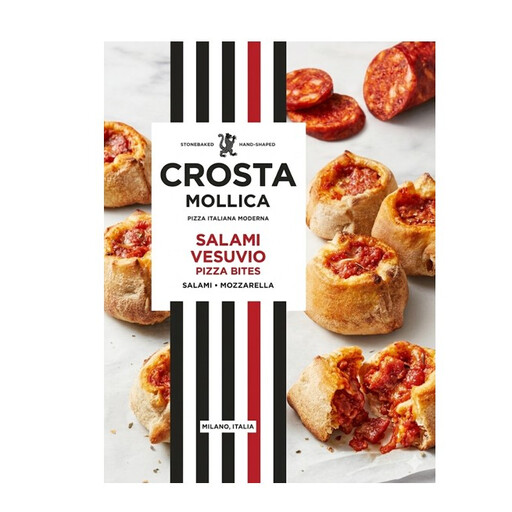 Image unavailable
These mini pizzas can be shared between several guests.
Decide how much to serve each person, then check the kcal and cooking instructions on the packaging.
 Image unavailable
The mini size makes it easy to plan several portions for a sharing platter.
Don’t count the whole box as one portion without working out its kcal; check the cooking instructions too.
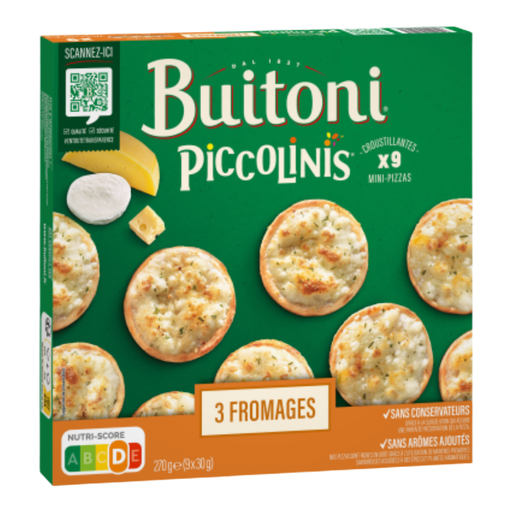 Image unavailable
The nine pieces are easy to portion out before serving.
For this recipe, Match Drive lists 293 kcal per 100 g, which works out at around 791 kcal for the 270 g box. Calculate how much you’ll actually serve each person and follow the cooking instructions on the packaging.
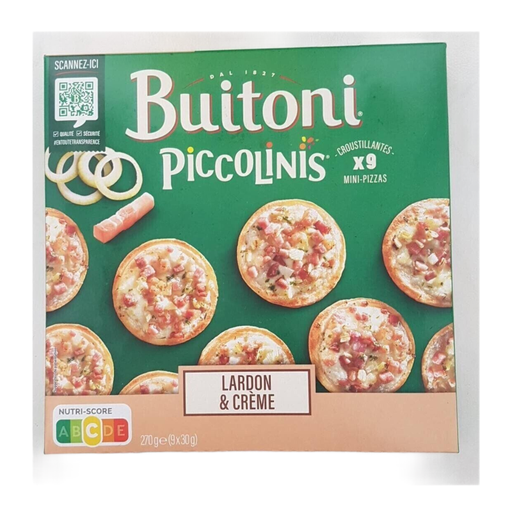 Image unavailable
This box of nine mini pizzas can be divided into set portions.
Check the kcal for this recipe and how much each person will have; don’t use the figures for the 3 Fromages version for this variant.
 Image unavailable
This pizza could work well served in slices of a set size.
Use the label to calculate the kcal for the slice you plan to serve; don’t assume the whole pizza is within the 500 kcal limit. Check the cooking instructions before preparing it.
Multiply the kcal per 100 g by the number of grams you’ll eat, then divide by 100. Use the full net weight if you’re eating the whole pizza; for shared mini pizzas, calculate only the amount you’ll be served.
Not automatically. According to the figures listed by Match Drive, a 270 g box of Buitoni Piccolinis 3 Fromages contains around 791 kcal; figures published by Auchan put a 216 g box of Dr. Oetker Ristorante 3 Fromages at around 512 kcal. For these recipes, check the kcal for the number of pieces you actually eat.
Only use a microwave if the instructions for the product you’ve bought say you can. Some pizzas need to be cooked in the oven: Auchan’s product information for its 390 g chorizo pizza strongly advises against using a microwave.
Read the ingredients list and allergen information for the specific recipe, as well as any relevant ‘may contain’ warnings. Don’t assume one pizza has the same ingredients as another variant in the same range.
Keep it cold and follow the packaging instructions until you’re ready to prepare it. Anses reminds consumers that storing food at a low temperature slows the growth of micro-organisms; Auchan’s product information for its 200 g 4 Fromages pizza states that it should be stored at −18 °C and not refrozen once defrosted.