Families planning several lunches
If you’re organising several meals over the school holidays, the weight of the dish and the number of portions stated on the pack can help you choose an amount your household will use.


For a family lunch during the school holidays, choose a sharing dish with enough portions for everyone. If people are eating at different times, individual portions mean you won’t have to open a large dish for just one person. In either case, check the ingredients, nutritional information and storage instructions for each product.
If you’re organising several meals over the school holidays, the weight of the dish and the number of portions stated on the pack can help you choose an amount your household will use.
If everyone doesn’t eat together, individual portions can make serving easier and save you from opening a sharing dish for just one person.
The ingredients list, allergens and nutritional information let you check each recipe. You can also look at the Nutri-Score if it appears on the packaging.
First, decide whether you’ll be having lunch together or separately. Then check that the quantity and information on the packaging suit the meal you have in mind.
| Criteria | What to check | Who is it for? |
|---|---|---|
| Planning several lunches | Net weight and how many meals you can make with the quantity provided. | If I’m planning several lunches, I want to choose quantities we’ll actually use; around 33% of consumers would make this their priority. |
| Portions for a shared meal | The number of portions stated and how much food the people eating will need. | When we eat together, I look for a size that suits the meal without leaving an opened dish behind; around 27% of consumers would put this fit first. |
| Different mealtimes | The quantity in each tray and the preparation instructions. | If someone is having lunch later, I’d rather be able to serve them their own meal; around 20% of consumers would favour individual portions. |
| Ingredients and labelling | Ingredients, allergens and nutritional information, particularly salt. | Before choosing a recipe, I want to be able to check its ingredients and any listed allergens; this would be the main criterion for around 20% of consumers. |
A 900 g or 1 kg pack won’t necessarily be right for the lunch you have planned. The number of portions stated and how much each person wants to eat matter too.
For a shared meal, match the stated portions to the number of people eating. If you need to keep some of the dish, follow the storage instructions on the packaging.
The Nutri-Score, if shown, doesn’t tell you the ingredients or allergens in a recipe.
Compare it with similar products, then read the ingredients list, highlighted allergens and nutritional information.
Carrefour offers individual and sharing frozen meals, including products in its Classic’, Original and Extra ranges.
The retailer offers frozen meals including Côté Table and Tables du Monde products, with collection available from participating shops.
The frozen food range includes individual meals, family-sized dishes and quick-preparation options.
Lidl offers frozen ready meals as part of a range that includes time-limited offers.
Aldi’s frozen food range includes pizzas and ready meals.
Picard offers individual and sharing frozen ready meals.
This frozen gimbap could work for a lunch eaten separately, provided its quantity and preparation suit the meal you have planned.
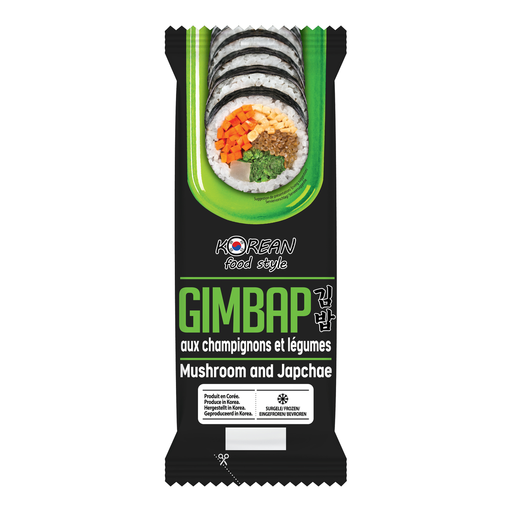 Image unavailable
Worth considering for a lunch at a different time from the rest of the household; check whether 230 g is the right amount for you.
Frozen gimbap with sautéed mushrooms and vegetables. Check the packaging for ingredients, allergens and defrosting instructions before serving.
Choose based on how many people will be having lunch together and how much they want to eat. Check the net weight and stated portions: a large dish could leave food unused if people’s schedules or plans change.
No. Its use is voluntary in France, as the Ministry of the Economy explains. If it appears on two comparable dishes, you can use it as a guide, but it doesn’t replace checking the ingredients and nutritional information.
Check the ingredients list, highlighted allergens, net quantity and nutritional information. The DGCCRF notes that these are among the details required on prepacked food in France. Also follow the product’s storage and preparation instructions.
Pick them up at the end of your shop, keep their time in transit to a minimum and put them away promptly, following the temperature stated on the packaging. In its advice on the cold chain, the DGCCRF explains that food which has been defrosted must not be refrozen.