Parents who want to serve lunch quickly
An individual meal gives you a set portion for a school-holiday lunch. Just remember to check the tray’s weight and nutritional information.


When choosing a frozen lunch for the school holidays, first compare the calories in the amount you’ll actually serve. You can then use the Nutri-Score to compare similar meals, but it won’t tell you how many calories are on your plate. An individual meal makes serving simple; combining frozen vegetables with other ingredients lets you adjust the quantities, but takes more preparation.
An individual meal gives you a set portion for a school-holiday lunch. Just remember to check the tray’s weight and nutritional information.
If the calories in your meal matter to your choice, start with the amount you’ll actually eat rather than relying on the Nutri-Score or figures per 100 g alone.
A meal to share can suit different appetites, as long as you distinguish between the pack’s total weight and the amount served to each person.
Choose between a ready-to-heat meal and ingredients you can combine, depending on how much time you have. Then check how much you’ll serve. To compare two meals in the same category, look at the Nutri-Score alongside the nutritional information; don’t treat it as a guide to the calories on your plate.
| What to consider | What to check | Who is it for? |
|---|---|---|
| Calories in your meal | Check the kcal per 100 g and the weight you’ll serve. For an individual tray, consider whether you plan to eat the whole thing. | If I’m keeping track of my lunch, I need to know the calories in my own portion, not just those in 100 g of the product; around 36% of consumers prioritise this. |
| Speed and nutritional guidance | Check the format and preparation instructions. Compare the Nutri-Score of similar meals, then look at the energy and other nutritional values. | When lunch needs to be ready quickly, I want to choose an individual meal without mistaking a Nutri-Score A or B for a small portion; around 29% of consumers put this convenience ahead of other criteria. |
| What’s in your lunch | Read the ingredients and nutritional information. If you’re combining several products, take the quantities and any added sauces into account. | If I’m putting a meal together with frozen vegetables, I want to decide what else to serve and how much; around 21% of consumers prioritise having control over what goes into their meal. |
| Format for sharing | Check the total weight, the stated number of portions and the storage instructions. Divide the meal before working out the calories in each serving. | When I’m having lunch with others, I need a convenient format without treating the whole pack as one portion; around 14% of consumers prioritise sharing. |
According to Manger Bouger, the Nutri-Score is designed in particular to help compare products in the same category. It doesn’t tell you how many calories are in the portion you’ll eat.
Check the energy value and the weight of the tray or the portion you’ll serve, too.
Two recipes with similar values per 100 g can add up to different amounts once served.
To work out the calories in your meal, apply the per-100 g value to the weight you’ll actually serve. Don’t count a family-sized meal as an individual portion.
A recipe’s name doesn’t list all its ingredients or declared allergens. The DGCCRF highlights the importance of the information shown on prepacked food labels.
Read the label for the exact product and check the packaging you receive again if an item has been substituted in your order.
The Anses says keeping food at a low temperature limits the growth of micro-organisms. Getting your shopping home and putting it away are therefore part of planning lunch.
Pick up frozen food last, use an insulated bag if needed and follow the storage instructions on the packaging.
Picard offers a selection of prepared meals with a Nutri-Score of A or B, including individual and sharing formats.
Carrefour’s frozen prepared meals section includes individual meals, meals to share and plant-based meals.
Auchan lists individual and family-sized frozen prepared meals separately, and offers a Nutri-Score filter in this section.
This frozen vegetable mix can be the base for a lunch where you choose the other ingredients and portion sizes. It isn’t a complete individual meal that’s ready to serve.
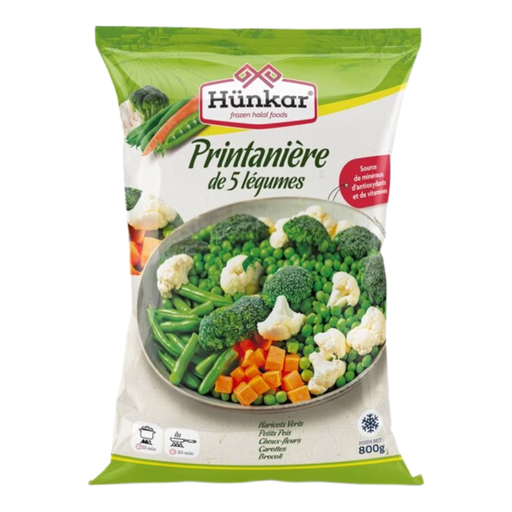 Image unavailable
Consider this if you’d like to put your own lunch together and choose how much veg to serve, rather than buying a complete individual meal.
800 g pack. Check the packaging for the nutritional information, allergens and preparation instructions for this product.
No. Manger Bouger presents the Nutri-Score as a way to compare the nutritional value of similar products, not as the number of calories in your meal. Check the energy value and the weight you’ll eat as well.
They answer different questions: kcal per 100 g lets you compare recipes on the same basis, while the kcal for the weight you serve tells you what’s in your meal. The DGCCRF states that the nutritional declaration on prepacked foods includes the energy value.
Check the ingredients and allergens for the exact product on its label, then check the packaging you receive. A meal’s name doesn’t confirm that it’s free from a particular allergen.
Pick them up last and put them away promptly, following the storage instructions on the packaging. An insulated bag can be useful for the journey. The Anses stresses the importance of keeping food at a low temperature to limit the growth of micro-organisms.