Guests keeping an eye on portion sizes
You want to know the energy content of the whole plate, not just the figure given per 100 g.


To choose a frozen meal for a French National Day gathering, compare its energy per 100 g with that of the portion you’ll actually serve. A single-serve tray makes it easier to gauge your portion, while a sharing format means checking how many servings it contains. A vegetable base gives you more control over how you put the plate together. In every case, check the ingredients, allergens and storage instructions too.
You want to know the energy content of the whole plate, not just the figure given per 100 g.
You’re looking for a sharing format that you can divide between your guests.
You need to check the ingredients and allergens, or compare sugars, saturates and salt as well as energy.
First, decide whether you’ll serve a single-serve tray, a sharing dish or a plate made with frozen vegetables. Then compare the portions you actually plan to serve: packs of the same weight don’t necessarily provide the same number of servings.
Choose this if: you want to know the energy content of the tray you plan to eat.
Bear in mind: a set portion isn’t necessarily lower in energy. For example, Picard lists 513 kcal for a 350 g serving of its Bibimbap.
Choose this if: several guests will be eating the same dish and you can divide it up when serving.
Bear in mind: you’ll need to relate the pack’s nutrition information to the amount served on each plate.
Choose this if: you’d rather portion out the vegetables and other parts of the meal separately.
Bear in mind: this option takes more preparation, and a vegetable base may not be enough on its own to make the meal you have in mind.
| Criterion | What to check | Who is it for? |
|---|---|---|
| Energy per portion | Compare the kcal per 100 g, then check the weight and energy content of the amount you’ll actually serve. | I want to know what’s on my whole plate, especially if I might eat a large tray by myself. Around 50% of consumers are said to put the energy content of their portion at the top of their list of concerns. |
| What makes up the meal | Read the ingredients and nutrition information, especially the sugars, saturates and salt; check the Nutri-Score if one is shown. | For a main meal, I want to be able to choose what goes on my plate rather than focus only on the calorie total. Around 30% of consumers are said to prioritise the meal’s composition. |
| Serving and practical considerations | Check the number of servings, allergens, and preparation and storage instructions. | If I’m hosting several people, I need to be able to serve the planned portions and take account of allergens before the meal. Around 20% of consumers are said to focus first on these practical considerations. |
When comparing two packs of different sizes, the per-100 g figure gives you a common starting point. The DGCCRF explains that presenting nutrition information this way makes comparisons easier; it doesn’t replace working out the portion you’ll eat.
This figure won’t necessarily tell you the energy content of the whole tray. For its Bibimbap, Picard lists 147 kcal per 100 g and 513 kcal for a 350 g portion.
Check the energy per portion if it’s provided. For a sharing dish, take into account how much you’ll put on each plate.
Nutri-Score alone doesn’t tell you how many kcal are in the portion you’ll serve.
Use it as an extra piece of information, and check the nutrition information and portion size too.
Ingredients and allergens may be crucial for your guests, regardless of the meal’s energy content.
Check the ingredients list and any allergens highlighted, then compare the other nutrition information that matters to you.
Transport and storage matter too when you’ve bought frozen meals ahead of a gathering.
The Anses advises buying frozen food at the end of your shopping trip and carrying it in an insulated bag. Then follow the storage and preparation instructions on the packaging.
These retailers offer frozen food in a range of formats. Compare the products themselves: a product range or aisle name won’t tell you the energy content of your portion or what’s in the product you choose.
Picard offers single-serve frozen meals and sharing formats, as well as a section dedicated to nutrition and specific dietary needs.
Carrefour categorises its frozen ready meals into options including single-serve, sharing and vegetarian dishes.
Auchan offers single-serve and family-size frozen ready meals, with a filter for the number of servings.
E.Leclerc offers Marque Repère frozen meals in several formats and displays the Nutri-Score on its Drive service when this information is available.
This 800 g vegetable mix suits the option of putting a plate together yourself and dividing the quantities between guests. On its own, it isn’t a complete ready meal.
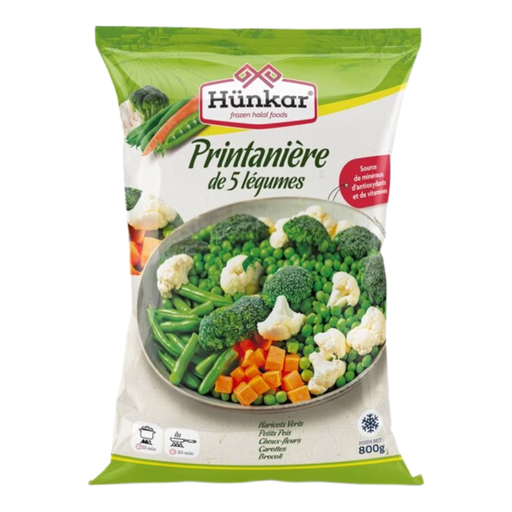 Image unavailable
This vegetable mix can be served as a base or side dish as part of a meal for several guests.
Size: 800 g. Decide how much to serve per person and check the preparation instructions before planning your meal.
First compare their energy per 100 g, then check the energy content of the amount you plan to eat. According to the DGCCRF, presenting information per 100 g makes it easier to compare products. However, a larger tray may contain more kcal if you eat it all.
No. Nutri-Score doesn’t tell you the energy content of the portion you’ll serve. Check the kcal per 100 g, the weight of your portion and the other nutrition information before comparing two meals.
Check the product name, ingredients, any allergens highlighted and its nutrition declaration. The DGCCRF lists these as part of the labelling for pre-packed food. Also read the storage and preparation instructions for the meal you’ve chosen.
Buy them at the end of your shopping trip and carry them in an insulated bag, as recommended by the Anses. Put them away promptly, following the instructions on the packaging, and follow the product’s defrosting or reheating instructions.