Two people who want to share a meal
You’d prefer one recipe for dinner: look for ‘serves 2’ or ‘2 portions’, then check the net weight against what you plan to serve alongside it.


For a winter dinner for two, choose a meal labelled ‘serves 2’ if you want to share one recipe, a larger pack if you’re happy to have leftovers, or two individual portions if you have different tastes. In each case, check the number of portions, net weight, ingredients and cooking instructions: the size of the tray alone won’t tell you how much there’ll be for each person.
You’d prefer one recipe for dinner: look for ‘serves 2’ or ‘2 portions’, then check the net weight against what you plan to serve alongside it.
You’re considering a larger tray, such as the 600 g to 1 kg sizes offered by Carrefour and E.Leclerc. The number of portions and storage instructions matter just as much as the stated weight.
Two individual trays let you choose different recipes. If either of you needs to avoid an ingredient, check the ingredients and allergens for each meal separately.
Start by choosing a size that suits how you want to serve the meal. Then check the label to confirm the portions, ingredients and cooking instructions.
Choose this if: you want to share one recipe with a stated number of portions.
Bear in mind: ‘serves 2’ doesn’t, on its own, tell you whether there’ll be enough for each of you; check the net weight and what you plan to serve alongside it.
Choose this if: you want a meal to share and are happy to have some left over.
Bear in mind: a 600 g to 1 kg tray isn’t necessarily intended for two people. Follow the storage instructions if you don’t finish it.
Choose this if: you’d both like different recipes.
Bear in mind: you’ll need to check the ingredients, allergens and cooking instructions for both trays.
| Factor | What to check | Who is this for? |
|---|---|---|
| Quantity for two | The stated number of portions and net weight, taking any sides into account. | If I want to share one meal, I look for a quantity that suits both of us without leaving unwanted leftovers. Around 33% of consumers would put portion size first. |
| Meal budget | The price per kilo, how much will be served and any sides. | When comparing different sizes for dinner, I want to consider what we’ll actually eat, not just the size of the tray. Around 27% of consumers would prioritise keeping to budget. |
| Ingredients | The ingredients and allergens in each recipe; use the values per 100 g to compare nutritional information. | If our dietary preferences differ, I need to be able to choose a suitable recipe for each of us and check its exact ingredients. Around 20% of consumers would make this compatibility their top priority. |
| Cooking and storage | The appliance and cooking time specified, as well as the transport and storage instructions. | For an easy-to-organise hot meal, I want to know how to cook it and keep it frozen until it’s time to prepare it. Around 20% of consumers would put this need first. |
A family-size tray and a meal labelled ‘serves 2’ don’t tell you the same thing about how many people it serves. Weight alone also doesn’t tell you whether you’ll be having a side dish.
Start with the stated number of portions, then compare the net weight with the recipe and the rest of your meal.
Two similar-looking meals can have different ingredients. The DGCCRF reminds shoppers that allergenic ingredients must be highlighted in the ingredients list on pre-packed foods.
Read the label for every product you choose, even if a recipe is described as plant-based.
Frozen food needs to stay at a suitable temperature until you get home. Anses recommends buying frozen food at the end of your shopping trip and keeping any break in the cold chain to a minimum.
Plan how you’ll transport it and follow the storage and defrosting instructions on the packaging; don’t refreeze food once it has defrosted.
A good place to look for meals specifically labelled ‘serves 2’.
A retailer where you can compare lasagne, cottage pie and other meals in trays.
Another place to look for lasagne, cottage pie and sharing-size gratins.
Worth a look if you’d prefer to pair two different individual meals.
A retailer to check for frozen ready meals available from time to time.
Another place to browse the frozen ready meals aisle.
This 300 g tray of lasagne is an individual portion. To serve two people, add a second portion chosen to suit the other person’s tastes.
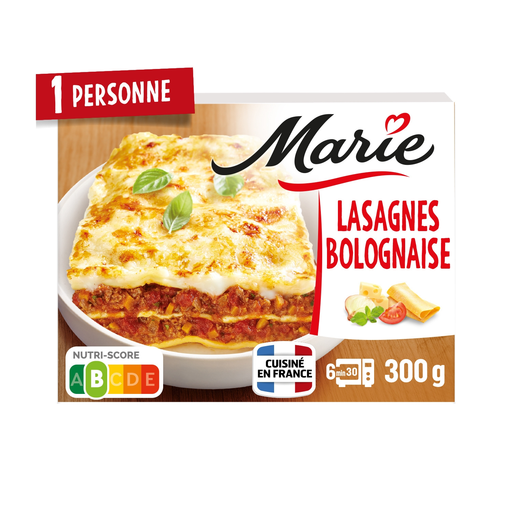 Image unavailable
This tray can be served as one of two separate portions at dinner; on its own, it isn’t a meal for two.
Check the packaging for allergens, nutritional information and cooking instructions for the product you choose.
There’s no single weight that suits every dinner for two, so start by checking the stated number of portions. A meal labelled ‘serves 2’ is a useful starting point. For a larger tray, also consider the recipe, any sides and whether you’re happy to have leftovers.
Read the ingredients list for the exact product, even if you recognise the recipe name. The DGCCRF says allergenic ingredients must be highlighted on pre-packed foods. If you’re buying two different portions, check both labels.
No. If shown, the Nutri-Score doesn’t replace the ingredients list or nutritional information. To compare meals on the same basis, check the values per 100 g; the DGCCRF states that nutritional information is given per 100 g or 100 ml. Also consider the portion you’ll serve.
Pick up frozen food at the end of your shopping trip, as Anses recommends, then keep the journey home as short as possible. An insulated bag can help. At home, follow the product’s storage and preparation instructions; don’t refreeze food once it has defrosted.