For anyone who wants to use every portion
If you can plan several meals around the same dish, compare its weight and stated number of portions with the amount you’ll actually eat.


For a solo dinner in front of the TV, an individual tray means you won’t have to deal with multiple portions. If you’re eating with others, a family-size option works well if you can finish the dish while following the storage instructions. Before choosing, check the number of portions, cooking method, ingredients and allergens.
If you can plan several meals around the same dish, compare its weight and stated number of portions with the amount you’ll actually eat.
An individual tray can help you avoid leftovers. Check that the portion size suits you and that you have an appliance suitable for cooking it.
When choosing between meals, check the ingredients, allergens and nutritional values per 100 g. If the Nutri-Score appears on the packaging, it can offer an additional point of reference.
For dinner in front of the TV, start by working out how many portions will be eaten. Then check the cooking instructions and any information that matters to your dietary choices.
| What to consider | What to check | Who is it for? |
|---|---|---|
| Using all the portions | Net weight and stated number of portions, compared with how much you plan to eat. | I want to finish the dish without leaving portions I hadn’t planned to eat. Around 36% of consumers would prioritise using every portion. |
| Dining alone | Tray size and the cooking appliance specified on the packaging. | When I’m eating alone, I’d rather cook a single tray and avoid dealing with leftovers. A simple solo meal would be a priority for around 29% of consumers. |
| A dish to share | Number of portions, freezer space and storage instructions for any portions left over. | If we’re eating together, I want a dish everyone can have a portion of. Serving several people would come first for around 21% of consumers. |
| Ingredients and allergens | Ingredients, highlighted allergens and nutritional values per 100 g; Nutri-Score, if shown. | I want to compare what’s in the meals before choosing, especially if I need to keep an eye on a particular ingredient. Around 14% of consumers would prioritise checking the label. |
Two dishes may contain different numbers of portions, even if their packaging looks similar in size.
Check the net weight and stated portions, then work out how much you’ll actually use.
A dish to share only helps you avoid leftovers if several people eat it or you’ve planned what to do with the remaining portions.
Before buying, check the storage instructions and make sure you’ll be able to follow them.
Retailers’ ranges can change depending on the date and the store.
If you need a particular recipe for dinner, check that it’s available before planning your meal.
The logo is no substitute for checking the ingredients, allergens and nutritional values.
Compare this information on the packaging, whether or not it displays a Nutri-Score.
Carrefour offers frozen meals, including Carrefour Classic’ products and sharing-size options.
Marque Repère frozen meals include Côté Table and Tables du Monde products, in both individual and family sizes.
Auchan categorises its frozen meals into individual and family options, among others.
Picard offers individual frozen meals and dishes to share.
Lidl offers frozen ready meals in ranges that may only be available for a limited time.
ALDI’s frozen food range includes pizzas and ready meals, among other products.
This selection features a 300 g frozen lasagne to consider for a solo dinner, if the portion size suits you. Check the cooking instructions and product label before choosing.
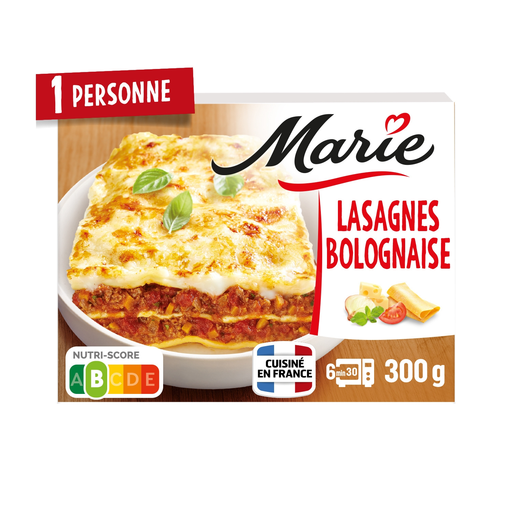 Image unavailable
This 300 g pack may suit a solo dinner if the portion size meets your needs. Check the packaging for cooking instructions, ingredients, allergens and storage guidance.
Yes, if you plan to use the other portions and follow the product’s storage instructions. Otherwise, an individual size means you won’t have to deal with leftovers.
Compare their nutritional values per 100 g and their ingredient lists. The DGCCRF states that the nutrition declaration for relevant prepacked foods is given per 100 g or 100 ml. The absence of a Nutri-Score isn’t enough to judge a meal.
Read the ingredients list and any other information on the packaging before choosing. The DGCCRF states that allergenic ingredients must be highlighted on the labels of prepacked foods.
Pick it up at the end of your shop, keep the journey home as short as possible and put it away promptly, following the instructions on the packaging. The Ministry of Agriculture states that the reference temperature for frozen storage is −18 °C.