People who eat lunch alone and are short on time
A ready-to-heat portion means you don’t have to divide up the meal or store leftovers. Auchan, for example, offers individual meals weighing 300 to 450 g, including some labelled as one portion.


If you’re having lunch on your own and don’t want to store leftovers, choose a frozen meal labelled as one portion. A 900 g to 1 kg pack is better suited to sharing or planning several meals, provided you follow the storage instructions and compare the recipe labels.
A ready-to-heat portion means you don’t have to divide up the meal or store leftovers. Auchan, for example, offers individual meals weighing 300 to 450 g, including some labelled as one portion.
A sharing-size pack can be a good option if you know how you’ll use and store the rest. Carrefour, E.Leclerc and Picard offer frozen meals in both individual and larger pack sizes; check the recipe and number of portions for each product.
To compare recipes, check the ingredients, allergens and nutritional values per 100 g. If shown, the Nutri-Score can offer an additional point of reference, but it doesn’t replace this information.
For a quick lunch, first work out how much you’ll be able to use. Then check how to prepare the meal, its label and its storage instructions.
| Criteria | What to check | Who it matters to |
|---|---|---|
| Amount you can use | Net weight and stated number of portions; whether you can use the whole meal. | If I’m having lunch alone, I want to avoid leaving part of a larger meal unused. Around 33% of consumers would put this question of quantity first. |
| Convenience at lunchtime | Whether it’s labelled as one portion and whether the cooking instructions suit the equipment you have. | When my lunch break is short, I prefer a portion that’s already defined and can be heated using the appliance I have. This convenience would come first for around 27% of consumers. |
| Ingredients and allergens | Ingredients, highlighted allergens and nutritional values per 100 g. | If I’m comparing two recipes or need to check for an allergen, the label matters more than the pack size. Around 20% of consumers would put this information first. |
| Storage | The temperature stated on the packaging and instructions for storage after defrosting. | If I’m planning several meals from the same pack, I need to be able to store the remaining portions according to the product instructions. Storage would be the top priority for around 20% of consumers. |
A meal containing several portions is only convenient for one person if you can use and store the leftovers according to the packaging instructions.
For a one-off meal, look for products labelled as one portion. Choose a larger pack for a shared meal or several planned lunches.
Without a plan for the remaining portions, some of the meal may go uneaten.
Manger Bouger explains that displaying the Nutri-Score is voluntary. If it appears on a meal, it doesn’t replace the ingredients list, nutritional values or a check of the allergens.
Compare the values per 100 g of similar recipes and read the label on the product you’re buying.
The DGCCRF says that a rise in temperature speeds up microbial growth and can make food unsafe.
Pick up frozen food at the end of your shop, keep it out of the freezer for as little time as possible, and follow the temperature and instructions on the packaging.
Carrefour’s frozen ready-meal range includes individual and sharing-size packs, including Carrefour Classic' recipes in 600 g and 1 kg packs.
E.Leclerc offers ECO+ and Marque Repère frozen meals, including Côté Table, in pack sizes ranging from 300 g to 1 kg, depending on the product.
Depending on the product, Auchan offers individual meals weighing 300 to 450 g and labelled as one portion, as well as 900 g to 1 kg meals stated to contain several portions.
Picard offers frozen meals in 300 g individual trays as well as larger packs of up to 1 kg, depending on the recipe.
Lidl features frozen ready meals among its supermarket offers, which are linked to specific dates.
ALDI has a frozen food range for everyday meals.
This frozen lasagne is a single portion, making it a good option for lunch on your own. Check that the cooking instructions suit the equipment you have.
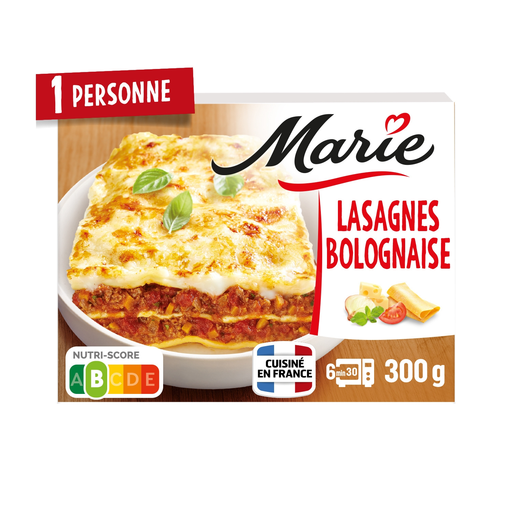 Image unavailable
This individual portion is ideal for lunch on your own if you have a microwave or oven to cook it from frozen.
The product information states that it should be stored at −18 °C and not refrozen after defrosting. Follow the cooking times on the packaging.
The product contains wheat, milk and celery, and may contain traces of other allergens. If you have an allergy, check the label on the product you receive.
Compare their nutritional information per 100 g and their ingredients lists, whether or not a Nutri-Score is displayed. Manger Bouger explains that displaying it is voluntary. For similar recipes, it can help you assess the label, but it shouldn’t replace reading it.
Read the ingredients list on the exact product you’re buying. The DGCCRF reminds consumers that allergens are highlighted on the labels of pre-packed food. Check for any warnings about possible traces too, as another recipe from the same brand may be different.
Keep it out of the freezer for as little time as possible and follow the storage temperature and instructions on the packaging. The DGCCRF reminds consumers that a rise in temperature speeds up microbial growth. The product information for the MARIE lasagne featured here states that it should be stored at −18 °C and not refrozen after defrosting.