Route managers keeping an eye on fat content
You need to be able to justify your choice using the value per 100 g shown for the dessert you’re actually delivering, not just because it looks fruity.


For meal delivery, start with the nutrition information for the dessert you’ve chosen rather than relying on the word “sorbet” alone. Under European Regulation (EC) No 1924/2006, the claim “low fat” for a solid food means it contains no more than 3 g of fat per 100 g. Compare the sugar content and allergens too, then choose between individual portions, a tub to portion out or frozen fruit to prepare, depending on what your service can accommodate. Make sure the cold chain stays intact.
You need to be able to justify your choice using the value per 100 g shown for the dessert you’re actually delivering, not just because it looks fruity.
You’re looking for individually wrapped portions or a format that’s easy to divide, while keeping each dessert at the specified temperature until it’s handed over.
If your kitchen can manage thawing and preparation, plain frozen fruit lets you choose which ingredients to add to the finished dessert.
The right format depends largely on where portions are served: an ice lolly can be handed out individually, a tub needs to be served on site, and plain fruit needs preparing. In every case, check the ingredients and storage requirements separately.
Consider these: when each recipient needs a pre-set portion.
Bear in mind: individual packaging doesn’t remove the need to keep the product frozen throughout the entire delivery round.
Consider these: if your team can portion them out at the time of serving.
Bear in mind: opening the tub and portioning it out requires an approach that follows the product’s storage instructions.
Consider this: when you have a kitchen that can prepare the dessert and manage thawing.
Bear in mind: this isn’t ready to serve; any added ingredients will change the composition of the dessert you deliver.
| Criteria | What to check | Who is it for? |
|---|---|---|
| Fat and sugar | Compare the fat and sugar content per 100 g. For the claim “low fat” on a solid food, European Regulation (EC) No 1924/2006 sets a maximum of 3 g of fat per 100 g. | I want to choose a dessert based on a specific nutritional value, without assuming that sorbet is also low in sugar. This check is the top priority for around 33% of consumers in this group. |
| Cold chain | Check the specified temperature and whether you can keep the dessert frozen until it’s handed over, then put it away straight afterwards. The DGCCRF reminds consumers that thawed food must not be refrozen. | My delivery round includes a transport stage, and I need to know where the desserts will stay frozen until they reach the recipient. Around 25% of consumers in this group put these arrangements at the heart of their choice. |
| Portion format | Check the number of items or the quantity to be divided up, and decide whether portioning can be done at the time of serving. | I need to hand each recipient a portion without having to open a large tub during the delivery round. Format is therefore the main consideration for around 25% of consumers in this group. |
| Fruit to prepare | Check the ingredients list, thawing instructions and the ingredients in any accompaniments you add. | Our kitchen can prepare a dessert using plain fruit, and we want to choose the added ingredients ourselves. This is the top priority for around 17% of consumers in this group. |
The name of the dessert is no substitute for its nutrition information: European Regulation (EC) No 1924/2006 governs this claim for solid foods.
Check the fat content per 100 g for the product you’ve chosen, and compare its sugar content too.
Picard’s apple, guava and raspberry lollies have less than 0.5 g of fat, but 18 g of sugar per 100 g, according to the product information. A low figure for one nutrient doesn’t tell you anything about the other.
Check the nutrition information per 100 g and take into account the portion actually planned for the menu.
Transport is only one part of keeping food frozen: you also need to be able to store the dessert as directed once it has been handed over.
Use an insulated container and check before setting off that the dessert can be put away straight after delivery. Do not refreeze thawed food, in line with DGCCRF guidance.
Choosing a specific flavour or format can make delivery more difficult if the product isn’t available at the collection point or delivery address.
Before finalising the menu, confirm availability, delivery arrangements and the nutrition information for the product you’ll be ordering.
These retailers offer different places to start your search. Their inclusion here doesn’t guarantee local stock or the same ingredients across all their products.
A frozen food retailer offering products including sorbet lollies and plain frozen fruit.
The retailer offers tubs of Marque Repère sorbet and frozen fruit.
The retailer’s tub sorbet range includes a variety of flavours and formats.
Some of the retailer’s sorbet product pages give details of ingredients, nutrition information and storage.
The MUCCI range includes ice cream and sorbet, with fruity flavours to consider depending on what’s available in store.
These two sorbets illustrate two ways to organise service: individual lollies to hand out or a tub to portion. Before choosing either for a delivery round, check the nutrition information and instructions on the product you actually order.
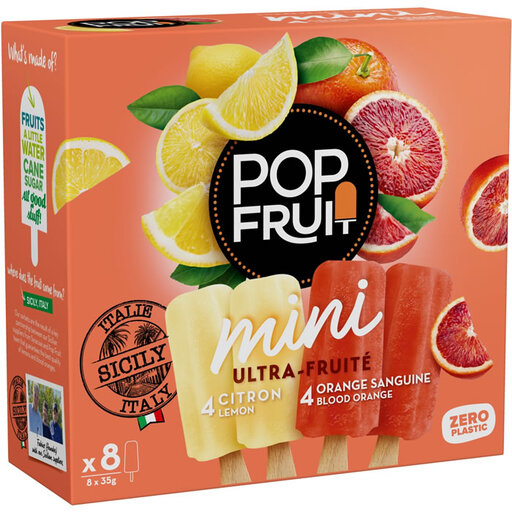 Image unavailable
The lolly format may suit delivery by the individual item, provided you keep the products at the specified temperature.
Compare fat and sugar per 100 g, and check the allergen information on the packaging before adding them to the menu.
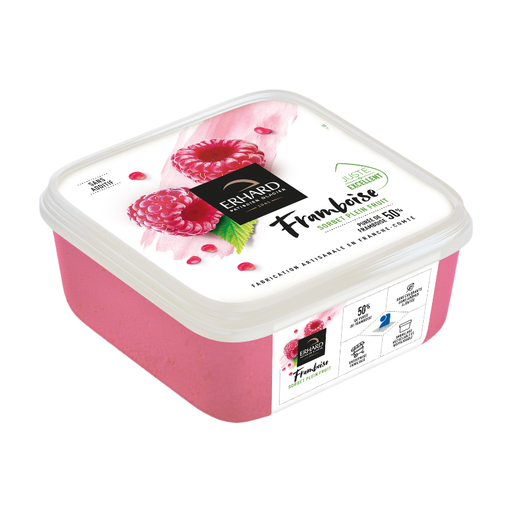 Image unavailable
This tub of raspberry sorbet is suited to a service that can prepare portions on site while following the storage instructions.
Before deciding on portion sizes, check the product’s fat and sugar content per 100 g, as well as the allergen information.
For a solid food, European Regulation (EC) No 1924/2006 sets a maximum of 3 g of fat per 100 g for this claim; for a liquid food, the limit is 1.5 g per 100 ml. Check the category and nutrition information for the specific dessert.
No. The word “sorbet” doesn’t mean it contains less sugar. Compare the “of which sugars” figure per 100 g for the products you’re considering, then check the amount you plan to serve.
Keep the product at the storage temperature shown on the packaging during the journey, and make sure it can be put away as soon as it’s handed over. The DGCCRF reminds consumers that thawed food must not be refrozen.
Check the ingredients list and allergen information for the product you’ll be delivering, and repeat the check if the product changes. A fruity appearance isn’t enough to establish whether a dessert meets recipients’ dietary requirements.
You’ll need to confirm that the address, time slot and products you want are covered. E.Leclerc says, for example, that home delivery through its Drive service depends on postcode eligibility. Check the arrangements offered by your chosen retailer before planning your delivery round.