
Livraison le jour même ou le lendemain

Qualité garantie

Débloquez vos offres de bienvenue: Livraison GRATUITE | Jusqu'à -80 % | 30 jours d'essai gratuits à JoyPlus
Téléchargez l'application
A hit-and-run in a car park? A dispute over liability after an accident? These are stressful situations that many drivers are all too familiar with. The front and rear dash cam has become an indispensable ally for recording reliable visual evidence and driving with peace of mind, both on the road and when parked.
Faced with the overwhelming number of models available, choosing the right in-car camera can quickly become a headache. This guide is here to help you cut through the noise. We'll break down the criteria that truly matter and present a selection of standout models to help you make the right choice, without all the unnecessary marketing jargon.
Before you dive in, here are a few technical criteria to consider to find the model that will meet your real-world needs.
Good resolution is essential for identifying crucial details like a license plate. While 1080p (Full HD) is the bare minimum today, a 4K dash cam will offer far superior clarity, day or night. One point not to be overlooked is night vision technology. High-performance sensors (like Sony STARVIS) and an HDR (High Dynamic Range) function help balance dark and bright areas, ensuring clear images even when facing dazzling headlights or in tunnels.
A dash cam with built-in GPS does more than just film. It also records your speed and geographical coordinates—information that can make all the difference in contextualizing an incident.
The parking mode is the other key feature for 24/7 protection. Using motion or impact sensors (accelerometer), the camera automatically activates to record any suspicious activity (vandalism, a bump in a car park) while your vehicle is parked. Note: this feature typically requires a specific hardwire kit for continuous power.
A wide viewing angle (usually between 140° and 170°) allows you to cover multiple lanes of traffic and reduce blind spots. For storage, most models use microSD cards. Check the maximum supported capacity and opt for "high endurance" cards, which are designed for intensive write cycles. Some newer models offer integrated eMMC storage, which is more reliable and requires no additional purchase.
Here are a few models that stand out for their features and design, catering to every type of user and budget.
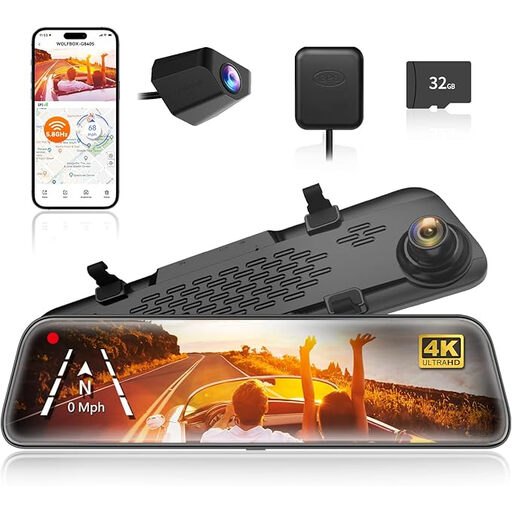
Why this model stands out: The WOLFBOX G840S sets itself apart with its innovative form factor. It replaces your interior rear-view mirror with a large 12-inch touchscreen that displays real-time footage from the front and rear cameras. This design offers a discreet integration and an unobstructed rear view, also turning the device into a highly effective reversing camera, complete with parking assistance guidelines.
Key Features:
Who is it for? For drivers looking for a discreet, all-in-one solution who want to modernise their vehicle with a large screen that doubles as a digital mirror and a parking aid.
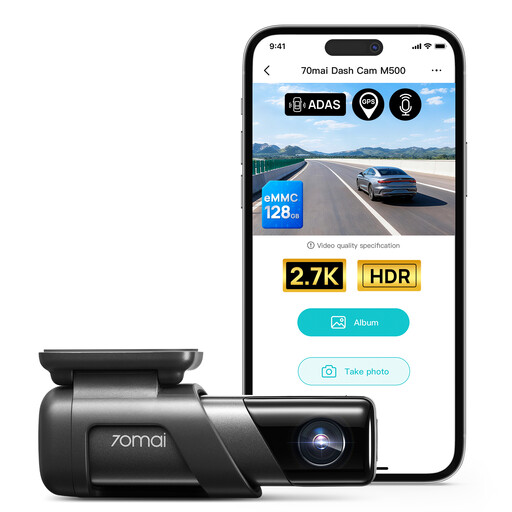
Why this model stands out: The greatest strength of the 70mai M500 is its built-in 64GB eMMC storage. No more worrying about choosing a compatible or reliable SD card. This internal memory is designed for better longevity and stable read/write speeds, preventing recording errors. Although it's a front-only model, its image quality and simplicity make it a top choice.
Key Features:
Who is it for? For those who prioritise simplicity and reliability. It's the ideal "plug-and-play" solution for daily commutes, offering a hassle-free experience without worrying about a memory card.
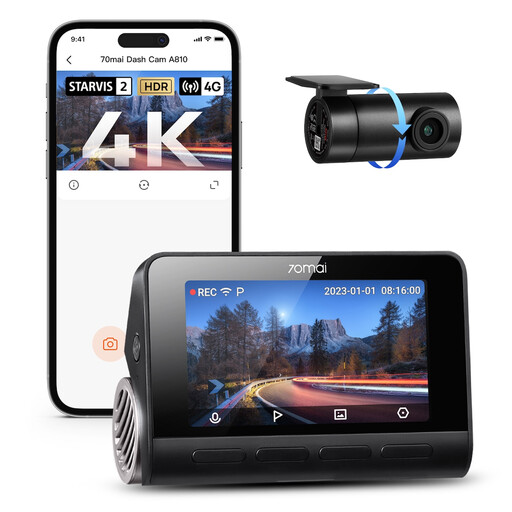
Why this model stands out: The 70mai A810-2 is a true front and rear dash cam built for performance. It's equipped with two Sony STARVIS 2 image sensors, the absolute gold standard for video quality, especially in low-light conditions. The front camera records in true 4K, while the rear camera provides 1080p surveillance, all enhanced by HDR technology on both channels.
Key Features:
Who is it for? For demanding drivers and tech enthusiasts who refuse to compromise on video quality and security. It's the ideal choice for those seeking maximum protection, including when the vehicle is parked.
Our selection covers several common use cases, but your needs might be more specific. If you're looking for a model with different features or for a particular budget, other solutions are available.
? Explore our full selection of dash cams to find yours.
Yes, using a dash cam is legal in most countries, including the UK, US, and across Europe. The footage can be used as evidence in the event of an accident. However, publishing this footage online is subject to privacy laws. It is imperative to blur faces and license plates if you share a video publicly.
Parking mode allows the camera to monitor your vehicle even when the engine is off. It is typically activated in two main ways: either by a shock sensor (G-sensor) that triggers recording upon impact, or by motion detection. For this feature to be operational 24/7, the dash cam must be continuously powered via a hardwire kit connected to the car's fuse box.
A 1080p (Full HD) resolution is the bare minimum for obtaining usable footage. A higher resolution, such as 1440p (QHD) or 2160p (4K), offers significantly better clarity, making it easier to read license plates and identify other details from a distance. The choice depends on your budget and how much importance you place on sharp details. Just remember that larger files will require more storage space.