
Livraison le jour même ou le lendemain

Qualité garantie

Débloquez vos offres de bienvenue: Livraison GRATUITE | Jusqu'à -80 % | 30 jours d'essai gratuits à JoyPlus
Téléchargez l'application
A front and rear 4K dash cam can prove invaluable after a minor collision, a failure to give way or an incident in a car park. But the resolution shown on the product page is not enough to make the right choice. Between optional accessories, unsuitable memory cards and sometimes optimistic claims about night vision, some purchases can quickly become expensive — or frustrating to use every day.
Here are the criteria to consider before choosing a front and rear car dash cam, along with a selection of models suited to different types of driver.
The term ‘4K dash cam’ often applies only to the front camera. At the rear, the sensor may be limited to 1080p. This resolution is still perfectly usable, but naturally does not offer the same level of detail. Always check the resolutions separately — for example, 4K at the front and 1080p at the rear — as well as the recording frame rate.
A 60-frames-per-second mode makes movement smoother, but it can also reduce the available resolution or significantly increase the amount of space used on the memory card.
On many models, 24-hour parking mode requires a hardwire kit sold separately. This connects to the fuse box and must be compatible with your vehicle. It generally powers the camera when the ignition is switched off, while monitoring the voltage to help reduce the risk of draining the battery.
Before placing your order, check that the kit is available, along with the connector type and installation instructions. Professional installation may be preferable if the cable needs to run near airbag-related components.
4K videos take up considerably more space than Full HD recordings. For high-definition footage, a microSD U3, Class 10 card is generally recommended, provided it is compatible with the maximum capacity supported by the camera.
Built-in Wi-Fi lets you view or download footage through a mobile app without removing the card. A 5 GHz Wi-Fi or Wi-Fi 6 connection can speed up short-range transfers, but it does not replace a mobile internet connection. Remote-access features sometimes require a 4G module sold separately.
When choosing a dash cam with night vision, do not focus solely on the number of pixels. The lens aperture, handling of bright highlights and processing of dark scenes also have a direct impact on the result. HDR helps balance very bright and very dark areas, such as when leaving a tunnel or facing headlights.
The term Sony STARVIS 2 dash cam refers to a family of sensors used by some manufacturers. It indicates which component is integrated, but does not by itself guarantee identical performance in every situation.
A front viewing angle of between 130° and 145° generally covers a wide section of the road. However, an excessively wide field of view can increase distortion around the edges of the image. The rear camera should be installed so that it does not obstruct the driver’s visibility. Its cable should also be neatly concealed along the trim.
A GPS dash cam can associate the vehicle’s location, speed and route with the recorded videos. The G-sensor detects sudden changes, such as an impact, and protects certain files from being automatically overwritten. Once the memory card is full, loop recording replaces the oldest sequences that have not been locked.
These features are useful, but take the time to check how the files are exported and played back. If you need to prepare a file for your insurer, always keep the original video and avoid editing the footage.
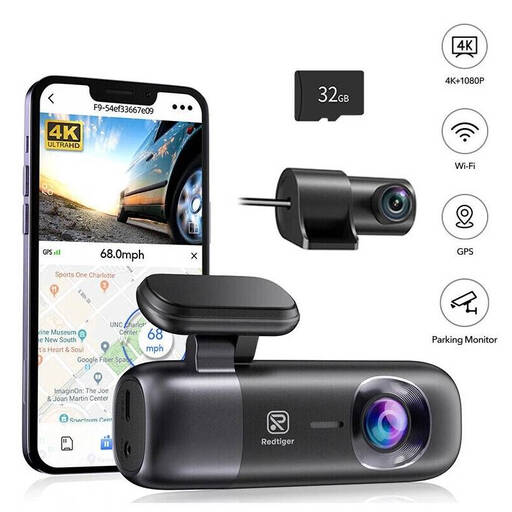
Why this model suits this type of driver : This setup combines a 4K front camera with a 1080p rear camera, GPS, Wi-Fi, an advertised 64 GB memory card and app control. It is aimed at drivers looking to equip their vehicle with their first dual-channel video recorder.
Both resolutions are clearly stated, so you will not assume that the rear camera also records in 4K. However, parking mode and compatibility with a card of up to 256 GB should still be checked against the exact contents of the offer.
Advertised 4K front recording, 1080p rear camera, GPS, Wi-Fi and mobile app.
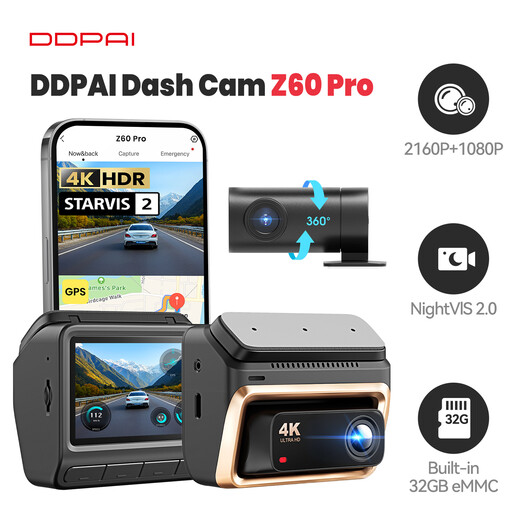
Why this model suits this type of driver : This model features a Sony IMX678 sensor at the front and an IMX662 at the rear, along with HDR, a 3-inch IPS display, GPS and 5 GHz Wi-Fi. It is suitable for drivers looking for a fully featured front and rear 4K dash cam.
The product details clearly distinguish 4K recording at the front from 1080p at the rear. They also specify that the hardwire kit required for 24-hour parking mode and the 4G module are available as optional extras.
HDR on both channels, 32 GB internal eMMC storage, advertised support for a microSD card of up to 512 GB and 5 GHz Wi-Fi transfers.
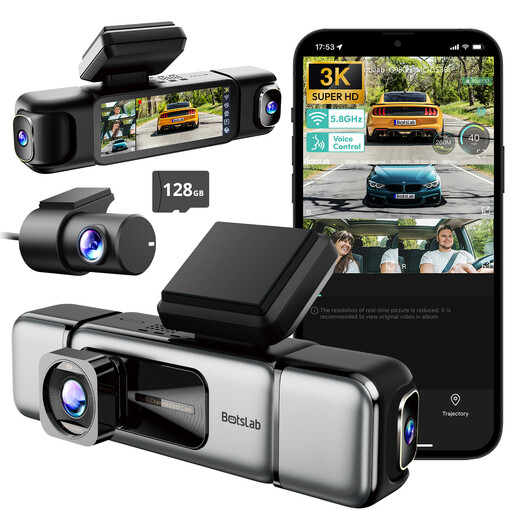
Why this model suits this type of driver : With a 3K front camera, two side views and a rear camera, this system covers more of the area around the vehicle than a simple front and rear car dash cam. It can therefore meet the needs of drivers who want to monitor several angles.
The product details list the viewing angles and resolutions of all four channels separately. They also state that a hardwire kit is required to activate monitoring features during extended parking.
Advertised 560° field of view, built-in GPS, 5.8 GHz Wi-Fi, 3.18-inch touchscreen and included 128 GB memory card.
We have put together a complete, real-time-updated selection of products that meet these demanding criteria, as well as the applicable European safety requirements.
Install the front camera behind the interior rear-view mirror, without encroaching on the driver’s field of vision. Where possible, attach the rear camera in the centre of the rear windscreen, then conceal its cable in the trim. Before setting off, check both camera angles to ensure they cover the road properly.
In France, recorded footage may contain data that can identify people or vehicles. Avoid publishing recognisable video without taking the necessary precautions, particularly on social media. In the event of an incident, keep the original file and ask your insurer or the relevant authorities about the required transmission procedures.
No. When videos are recorded locally on a microSD card, they do not use any mobile data. Transferring footage to a phone uses the camera’s direct Wi-Fi connection. Data is only used if you use a 4G feature or a remotely accessible service, where the camera and its accessories support this.
Choose a microSD card designed for continuous video recording, generally U3 and Class 10, while observing the maximum capacity supported by the camera. Remember to format it regularly using the device, and replace it if recording errors occur.
Not necessarily. You need a vehicle-compatible hardwire kit and correct installation on the fuse box. Also check the voltage management system and the operating conditions specified by the manufacturer before enabling extended monitoring.