For a snack eaten with a spoon, choose plain fromage frais in a pot. If you’re making a sandwich, look for plain spreadable cheese instead. Ricotta has a different, slightly grainy texture. Before sending a product to nursery, check its rules on serving and storage, as well as the instructions for your child, particularly if they need to avoid milk.
Who is this guide for?
Parents following a PAI or avoiding milk
The priority is to follow your child’s instructions and the setting’s procedures, rather than relying on a product’s mild taste. An individualised welcome plan (PAI) can set out a special diet for a child in a group-care setting, as explained by the French Ministry of National Education and Éduscol.
Parents of children who are sensitive to taste and texture
Fromage frais eaten with a spoon, smooth spreadable cheese and slightly grainy ricotta are suited to different uses. Carrefour France describes Philadelphia Nature as mild and creamy, while Galbani describes its ricotta as mild but slightly grainy. Whether your child likes it will depend on them.
Parents looking for an easy-to-serve snack
The format needs to suit what the nursery accepts and can serve: an individual pot with a spoon, cheese to spread on bread or an individual portion. Also ask how the product needs to be stored before snack time.
What should you check before buying?
For a snack brought to nursery, first check your child’s dietary instructions and the setting’s arrangements. Then choose a texture and format that work for how the snack will be served.
| Criterion |
What to check |
Who is this relevant to? |
| Allergies and care instructions |
Read the ingredients and allergen information on the packaging you’ve chosen, then confirm with the nursery which instructions apply to your child. |
If my child needs to avoid milk proteins, a mild taste or pasteurisation doesn’t make a dairy product suitable for them. Around 33% of consumers would put this compatibility first among their concerns. |
| Taste and texture |
Choose between plain fromage frais to eat with a spoon, a smooth spreadable cheese and ricotta, which Galbani describes as slightly grainy. |
If my child refuses grainy textures, a mild flavour alone isn’t enough to guide my choice. Around 27% of consumers would prioritise taste and texture. |
| Format and serving |
Check that the setting accepts the format you’re bringing and can follow the product’s storage instructions. |
If the snack needs to be handed out without making sandwiches on site, I look for a format the nursery can serve. Around 20% of consumers would put these practical arrangements ahead of other criteria. |
| Nutrition information |
Compare the values per 100 g for specific products, particularly fat and salt, and take the serving size into account. |
For a regular snack, I want to distinguish fromage frais in a pot from spreadable cheese, without assuming they have the same nutritional make-up. Around 20% of consumers would make this comparison their priority. |
Common mix-ups to avoid
-
Confusing a mild taste with being milk-free
The dairy products mentioned here are still unsuitable if your child needs to avoid milk proteins. The Philadelphia Nature recipe listed by Carrefour France contains whole milk and cream; Galbani ricotta contains whey.
If your child has an allergy or a medically prescribed diet, check the packaging of the exact product and follow the PAI and the setting’s instructions.
-
Assuming spreadable cheese is the same as fromage frais in a pot
They can differ in how they’re used and in their nutritional values. For the products listed by Carrefour France, Carrefour Classic’ plain fromage frais has 3.8 g of fat per 100 g, compared with 21 g for Philadelphia Nature.
First decide whether the snack will be eaten with a spoon or served on bread, then compare the nutrition information for the products you’re considering.
-
Choosing a product without planning how to store it
Storage instructions aren’t interchangeable: Galbani says its 250 g Ricotta should be kept between +4 °C and +8 °C, while Bel Foodservice France says its Boursin Nature portions can be kept at room temperature for two hours.
Ask the nursery what kind of food it accepts and follow the instructions on the packaging of the product you buy.
-
Judging the milk used by how fresh the product looks
For children under 5, Manger Bouger recommends avoiding raw milk and cheeses made with raw milk.
Check the milk information on the label: the brand, taste and texture won’t tell you how the product was made.
Brands to know for these uses
These products show a range of formats and textures; the features of one product don’t apply to every product in its brand’s range.
Carrefour Classic’
Plain fromage frais with 3.8% fat, in 60 g pots, is suited to serving with a spoon.
- Carrefour France lists 87 kcal and 3.8 g of fat per 100 g for this product.
- Its recipe includes milk and cream, so it isn’t suitable if your child needs to avoid milk proteins.
Philadelphia
Plain spreadable cheese is suited to making sandwiches, rather than being eaten with a spoon from a pot of fromage frais.
- Carrefour France describes the 150 g product as mild and creamy.
- This product contains whole milk, cream and salt. Carrefour France lists 21 g of fat per 100 g.
St Môret
The Bio product listed by Carrefour France is a spreadable cheese made with pasteurised milk and cream.
- The labelling shown by Carrefour France states that the milk and cream used in this product come from France.
- It contains milk proteins and may contain nuts, so check the packaging if you need to avoid any allergens.
Galbani
The 250 g Ricotta has a different texture and can be used on bread or in a recipe, hot or cold.
- Galbani describes it as very mild and slightly grainy.
- It contains whey and should be kept between +4 °C and +8 °C, according to Galbani.
Boursin
Boursin Nature is available in individual 16 g portions in the range shown by Bel Foodservice France.
- Bel Foodservice France says these portions can be kept at room temperature for two hours. Check with the setting that they’re suitable to serve.
- This product contains milk and isn’t a substitute for an option that meets the requirements of a milk-protein-free diet.
An option on Joybuy for a snack eaten with a spoon
This selection is for plain fromage frais in individual pots. Consider it when the snack will be served with a spoon and the nursery accepts this format.
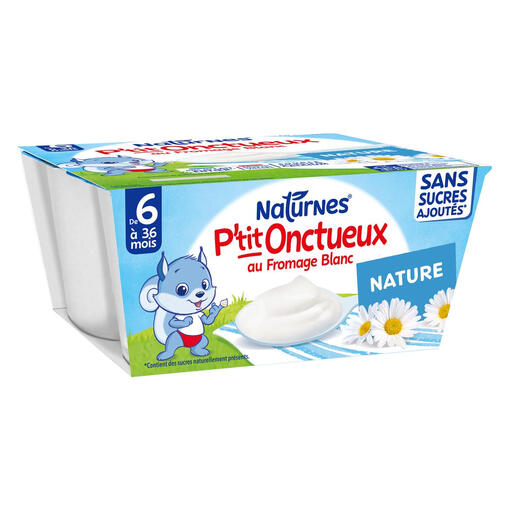 Image unavailable
Nestlé P'Tit Smooth, plain fromage blanc, 4 × 90 g, from 6 months
The individual pots are suited to a snack served with a spoon, subject to the nursery’s arrangements.
The product contains milk: follow your child’s instructions if they need to avoid it. For a child under 5, also check the packaging for information about raw milk and storage conditions.
View on Joybuy
Frequently asked questions
Can a child under 5 have fromage frais made with raw milk?
Manger Bouger recommends that children under 5 avoid raw milk and cheeses made with raw milk. Check the packaging of the product you’ve chosen to see what type of milk it contains; appearance alone isn’t enough to tell.
Is pasteurised fromage frais suitable for a child with a milk allergy?
No. Pasteurisation doesn’t make a product containing milk suitable for someone who needs to avoid milk proteins. Check the ingredients of the exact product and follow the PAI and the setting’s instructions.
What is the role of a PAI for a snack in a group-care setting?
An individualised welcome plan can set out a child’s diet and any adjustments needed to support them in a group-care setting. The French Ministry of National Education and Éduscol explain how it is used in group-care settings. Ask the nursery how your child’s instructions apply to a snack brought from home.
Should you choose fromage frais in a pot or spreadable cheese?
Choose according to how the snack will be served: plain fromage frais in a pot for eating with a spoon, or plain spreadable cheese for bread. Then compare the nutrition information for the exact products. For 100 g, Carrefour France lists 3.8 g of fat for its Carrefour Classic’ fromage frais with 3.8% fat, and 21 g for Philadelphia Nature.


