If “4 pint” does mean four portions, individual pots of plain fromage frais are a more direct match than a spreadable cheese or ricotta, but you should confirm the quantity with the nursery. Before buying, check that the nursery accepts the product, that it meets the children’s dietary requirements, and that the format, use-by date and storage conditions are suitable for the planned snack.
Who is this option for?
Anyone organising a group snack
If you need to serve several children, first ask the nursery which foods you can bring and whether any individual requirements apply. The French Ministry of National Education says that an individualised support plan (PAI) can set out arrangements for a child with a food allergy, among other needs.
Anyone looking for four portions to hand out
The number of pots should match the number of children and the portions needed, rather than being based on an automatic interpretation of “4 pint”. As a comparable format, Carrefour lists Carrefour Bio plain fromage frais in four 100 g pots.
Anyone choosing between different types of cheese
Small pots of plain fromage frais, spreadable cheese and ricotta are not necessarily served in the same way. Carrefour and Auchan product pages, for example, list different recipes and pack sizes for Philadelphia, Boursin and Galbani.
What should you check before buying?
Confirm the quantity and the nursery’s rules before comparing recipes. Then check allergens, serving requirements and storage conditions for the product you’ll actually be bringing.
| Criteria |
What to check |
Who is it for? |
| Allergens and requirements |
Ask whether you can bring dairy products, and check the ingredients and allergens on the packaging of the product you buy. |
If a child needs to avoid milk or has specific dietary requirements, I need to know whether this snack can be offered to them. For around 46% of consumers, this would be their main concern. |
| Portions and storage |
Confirm the number of children, then check the number of pots, net weight, use-by date and storage instructions. |
To serve the group the right amount, I need suitable portions and to be able to store them correctly until snack time. Around 36% of consumers would put this need first. |
| Type of product |
Before choosing a substitute, compare the product description, ingredients, and fat and salt values per 100 g. |
If the nursery expects a plain snack, I want to distinguish fromage frais from a seasoned recipe or a product intended for cooking. This would be the priority for around 18% of consumers. |
What mistakes should you avoid?
-
Assuming “4 pint” already defines the quantity
This expression doesn’t specify either the number of pots or the portion expected for each child. The mention of 2-litre bottles doesn’t clarify the requested fromage frais format either.
Before ordering, ask the nursery how many children will be served and what quantity or packaging it would like.
-
Assuming a dairy product is suitable for the whole group
The products mentioned here contain milk or ingredients derived from milk. The French Ministry of National Education says that an individualised support plan (PAI) can include adjustments for a child with a food allergy, among other needs.
Ask the nursery what requirements apply to the children concerned, and check the allergens on the label of the product you buy before handing it out.
-
Replacing small pots of plain fromage frais with just any cheese
The Boursin Garlic & Fine Herbs listed by Auchan contains garlic and fine herbs, among other ingredients. A pot of Philadelphia spreadable cheese or Galbani ricotta also needs to be served differently from four individual pots.
Compare the recipe, packaging and intended use with the nursery’s requirements rather than relying on the word “cheese” alone.
-
Overlooking the date and storage conditions
The DGCCRF lists fromage frais among highly perishable foods. In February 2026, Carrefour also announced a recall of a specific batch of its Carrefour Bio plain fromage frais 4 × 100 g because of an incorrect use-by date. This does not mean that other batches are affected.
Check the date and batch number of the product you have, look for any recalls that may apply to it, and follow the storage instructions on its packaging.
Brands and products to compare
These examples show different formats and uses: the brand alone isn’t enough to determine whether a product is right for the planned snack.
Carrefour
Carrefour lists Carrefour Bio plain fromage frais in four 100 g pots, a format worth considering if four individual portions are requested.
- The Carrefour product page lists organic pasteurised skimmed milk, organic pasteurised cream, lactic cultures and rennet.
- A Carrefour recall on 23 February 2026 concerned a specific batch of this product because of an incorrect use-by date. Check the batch and date of the product you buy; the recall does not apply to other batches.
Philadelphia
The Philadelphia Original listed by Carrefour is a 500 g tub of spreadable cheese, not a pack of four small pots.
- Its spreadable texture makes it suitable for serving on a base accepted by the nursery.
- The Carrefour product page lists milk and cream, as well as 21 g of fat per 100 g. You’ll need to organise the portions and serving yourself.
Boursin
Boursin Garlic & Fine Herbs is a seasoned spreadable cheese, unlike plain fromage frais in individual portions.
- The Auchan product page lists milk, cream, garlic and fine herbs, so you can compare the recipe with the one requested.
- Auchan recommends storing it between +2 °C and +6 °C. Before considering it as a substitute, check that the seasoning and packaging are suitable for the snack.
Galbani
The Galbani ricotta listed by Auchan comes in a 250 g tub for cooking, rather than as four portions ready to hand out.
- The Auchan product page lists pasteurised whey and milk cream, among other ingredients.
- The recommended storage temperature is +4 °C to +7 °C. For a group snack, you’ll need to plan preparation and serving in a way the nursery accepts.
Auchan
Auchan’s ricotta and Boursin product pages make it easy to compare their ingredients and storage requirements.
- The Auchan ricotta product page lists whey and milk.
- A tub of ricotta isn’t automatically a substitute for four portions of plain fromage frais: check the preferred packaging and serving method.
E.Leclerc DRIVE
E.Leclerc DRIVE lets you search for fresh products and choose collection or delivery options.
- Your chosen shop or drive can help you compare the available packaging locally.
- Before choosing a product, check its listing, ingredients and number of portions with the retailer you’re using.
Joybuy product for this snack
This product comes in four pots and may be worth considering if individual portions are needed. It is labelled as suitable from 6 months: confirm the required format, the age of the children concerned and whether the nursery accepts it before choosing.
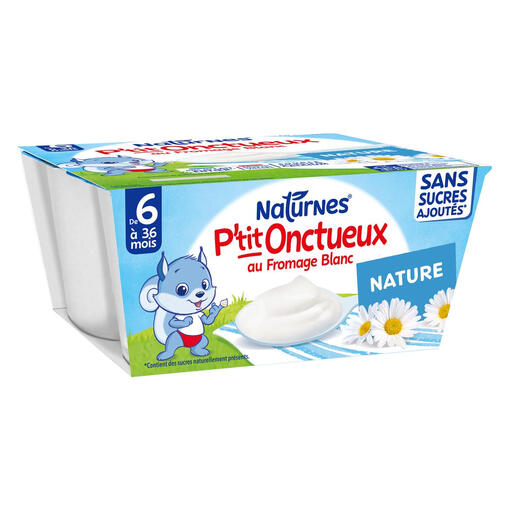 Image unavailable
Nestlé P'Tit Smooth plain fromage frais, from 6 months, 4 × 90 g
The four individual pots may be suitable for serving individual portions if the nursery confirms that this format is appropriate. The product is labelled as suitable from 6 months and contains fromage frais: check the children’s ages, any requirements relating to milk, and the date and storage instructions on the packaging you buy.
View on Joybuy
Frequently asked questions
Should you check for milk before bringing fromage frais?
Yes. Check the ingredients and allergens on the packaging of the product you’ll be serving. The DGCCRF says that allergens in pre-packed foods must be clearly highlighted in the ingredients list. The fromage frais, spreadable cheese and ricotta products mentioned here all contain milk or ingredients derived from it.
What should you do if a child has a declared food allergy?
Before choosing or handing out the product, ask the nursery what requirements apply to that child. In France, the Ministry of National Education says that an individualised support plan (PAI) can include adjustments, particularly in the case of a food allergy. A product accepted for other children may not be suitable for them.
How should you store fromage frais until snack time?
Follow the temperature and instructions on the packaging of the product you buy, both during transport and before serving, and check its use-by date. The DGCCRF classifies fromage frais as highly perishable and explains that higher temperatures encourage microbial growth.


