For individual portions, choose plain fromage frais in pots. For toast or a recipe, compare spreadable or cooking cheeses according to the flavour you’re looking for. Check the ingredients, the milk allergen, the use-by date and the weight in grams. For a child under 5, also check the type of milk, in line with guidance from Assurance Maladie. If your shopping list says ‘6 pint’, clarify whether it means six pots or a quantity measured in pints before choosing a pack size.
Who are these formats suitable for?
Parents serving individual portions
If fromage frais is served alongside dinner rather than used in a recipe, small pots make it easy to choose a portion for each child. Carrefour, for example, lists a pack of six 60 g pots; check that this gives you the number of portions you need.
Families adding cheese to a dish
For pasta, a filling or a sauce, start with the flavour you want: plain if you don’t want to add seasoning, or garlic and herbs if that suits the meal. Carrefour lists a Boursin cooking cheese, while Galbani says its ricotta can be used cooked or uncooked.
People checking ingredients and children’s ages
Read the ingredients for the specific product if milk is an allergen you need to take into account. For children under 5, Assurance Maladie advises against consuming raw milk or raw-milk cheeses, with the exception of emmental and comté.
What should you check before buying?
First decide whether you’ll serve the cheese as it is, spread it on toast or add it to a dish. Then compare the ingredients and the amount you can actually use.
| Criteria |
What to check |
Who it matters to |
| How it will be used at dinner |
The product description and flavour: plain fromage frais in pots, a spreadable cheese or a cooking cheese. |
If I’m making a recipe, I want to know whether the cheese will be mixed into the dish or served on the side, and avoid confusing a seasoned version with a plain one. Around 40% of consumers would put how the cheese will be used at dinner at the top of their list of priorities. |
| Milk and age |
The ingredients list, the milk allergen and whether the chosen product is labelled as made with raw or pasteurised milk. |
When dinner is for a young child or a milk allergy needs to be taken into account, I need to be able to read the label carefully before serving the product. Checking the milk would be a priority for around 30% of consumers. |
| Format and storage |
The number of pots, the net weight and storage instructions after opening. |
For several meals, I look for an amount the household can use while following the manufacturer’s instructions, rather than choosing a large container based on size alone. Quantity and storage would come first for around 30% of consumers. |
Mistakes to avoid
-
Assuming all fromage frais works the same way
Plain fromage frais in small pots, spreadable cheese and cooking cheese don’t necessarily give a meal the same flavour or result.
First decide whether you need a portion to serve, a spread for toast or an ingredient for a recipe. Then compare products for that use.
-
Forgetting to check the type of milk
According to Assurance Maladie, children under 5 should not consume raw milk or raw-milk cheeses, except emmental or comté, because of the risk of infection.
For a child of this age, check the milk information on the exact product packaging. If an allergy needs to be taken into account, check the ingredients list separately.
-
Choosing a large pot without planning how to use it
An opened container needs to be handled differently from portions that are still sealed: Anses explains that the use-by date printed on the pack no longer applies once the product has been opened.
Compare the amount you need with the meals planned, and follow the storage instructions on the packaging after opening.
-
Assuming ‘6 pint’ means a specific pack size
‘Six pots’ and ‘six pints’ don’t describe the same quantity. Carrefour, for example, lists six 60 g pots: this format should not be confused with a volume measured in pints or litres.
Decide how many portions you want, then check the net weight shown on the product before buying.
Brands to compare by format
Philadelphia
Plain spreadable cheese to consider for toast or a dish where you want this texture. Carrefour lists 150 g, 300 g and 500 g formats.
- The choice of weights makes it easier to match the amount you buy to what you plan to use for the meal.
- Spreadable cheese isn’t automatically a substitute for plain fromage frais in small pots; compare the ingredients of the product you choose.
Boursin
Carrefour lists a 240 g pot of Boursin garlic and herb cooking cheese.
- Its seasoned flavour may suit a recipe that calls for garlic and herbs.
- This isn’t a plain option, so consider the seasoning before adding it to a children’s meal.
Galbani
Galbani describes its 250 g ricotta as a cheese that can be used cooked or uncooked, with a slightly grainy texture.
- This ricotta could be considered as an ingredient in a savoury dish.
- Galbani’s published ingredients list includes whey and whey cream derived from milk; check the packaging if this allergen needs to be taken into account.
Carrefour
Carrefour lists plain fromage frais in pots under its own brand, including packs of six 60 g pots, as well as plain spreadable cheese.
- Small pots give you a set number of portions to serve.
- Fromage frais in pots and spreadable cheese have different recipes, so read the ingredients for each product.
E.Leclerc
E.Leclerc lists, among other products, a 1 kg faisselle under the Nos Régions ont du Talent brand, as well as fresh products from its Marque Repère range.
- A large-format faisselle can be compared with what you need for a family recipe.
- Faisselle isn’t a pack of small fromage frais pots, and E.Leclerc says availability depends on the store you choose.
Auchan
Auchan lists, among other products, plain fromage frais in four 100 g pots, as well as faisselle and spreadable cheeses.
- With four pots, it’s easy to compare the number of portions with the total weight.
- Check the product category and ingredients: these products aren’t interchangeable in every recipe.
A Joybuy product for serving individual portions
This product in pots is presented as a dessert or snack from 6 months. It could be considered for serving as individual portions at dinner, but not as an established ingredient for a savoury dish.
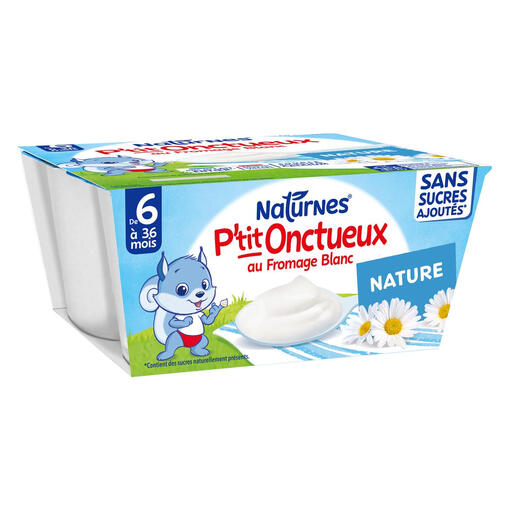 Image unavailable
Nestlé P'Tit Smooth plain fromage frais, from 6 months, 4 × 90 g
Worth considering for serving as an individual dessert portion, rather than for cooking a savoury dish.
Four 90 g pots, 360 g in total. Before serving it to a young child, check the packaging for milk-containing ingredients and how the dairy ingredients in this product have been processed.
View on Joybuy
Frequently asked questions
Can you serve raw-milk cheese to a child under 5?
Assurance Maladie advises against giving raw milk or raw-milk cheeses to children under 5, with the exception of emmental and comté, because of the risk of infection. Check the type of milk used in the specific cheese before serving it.
How can you check whether pre-packed fromage frais contains milk?
Read the ingredients list and allergen information on the packaging of the product you buy, rather than relying on the category name alone. The DGCCRF reminds consumers that an ingredients list is among the information that must be provided for pre-packed food.
Is the use-by date enough once a pot has been opened?
No. Anses explains that the use-by date no longer applies once the product has been opened. Follow the storage instructions on the packaging after opening.


