One person in a studio or small flat
If your kitchen has limited space and you shop frequently, compare the usable capacity with the space you’ve measured. Check separately how much room there is for frozen food if you buy it.


For your first home, start by measuring the space and the delivery route, then choose the capacity to suit the number of people in your household and how you shop. UFC-Que Choisir suggests allowing 100 to 150 litres of usable capacity for one person, then around 50 litres for each additional person. A table-top fridge may suit a small space if you shop frequently; if you keep a stock of frozen food, consider the capacity of a separate freezer instead. In a fitted kitchen, only choose a built-in model once you’ve checked the housing, fixing and ventilation requirements for that model.
If your kitchen has limited space and you shop frequently, compare the usable capacity with the space you’ve measured. Check separately how much room there is for frozen food if you buy it.
If you want to store both fresh food and frozen supplies, check the capacity of each compartment, not just the total capacity listed.
Check whether the kitchen unit requires a built-in appliance or can accommodate a freestanding model. Then measure the housing or space, the door clearance and the delivery route.
Start with the space available and how much food you need to store. Then check the model’s features to make sure it’s the right choice.
Consider it: for a studio or a space under a worktop, if its capacity suits your shopping habits.
The trade-off: its compact size limits the space available for food. Check the freezer compartment if you need one.
Consider it: if you mainly store fresh food and keep little frozen food.
The trade-off: don’t assume it has a freezer compartment that’s big enough for your needs; check its configuration.
Consider it: if a separate freezer compartment is something you regularly need.
The trade-off: check the overall dimensions, the space in each compartment and the route to your kitchen.
| What to consider | What to check | My needs |
|---|---|---|
| Usable capacity | Compare the fridge capacity with the number of people in your household and how often you shop. UFC-Que Choisir suggests allowing 100 to 150 litres of usable capacity for one person, then around 50 litres for each additional person. | I do a big shop less often, so I need enough room to last until the next one. If I buy a little but shop frequently, I could consider a smaller capacity. |
| Space and access | Measure the width, height and depth of the space, then check doors, hallways, stairs and lifts along the delivery route, as recommended by Darty. For a built-in model, also check the housing and fixing. | The fridge needs to fit through to my kitchen, fit in its space and have enough room for the door to open without catching on other units. |
| Freezing | Check whether it has a separate freezer and its usable capacity, rather than looking only at the total capacity. Check the configuration of a table-top or single-door model before relying on its freezer compartment. | I regularly keep frozen food in stock, so the space set aside for it matters as much as the space for fresh food. |
| Energy, noise and ventilation | Compare the stated annual energy consumption and noise level in dB(A) of appliances with a similar type and capacity. Follow the clearance requirements for the model: Whirlpool recommends 5 cm above and 10 cm behind its freestanding fridges. | In a studio or open-plan kitchen, I want to compare the stated noise level and energy consumption without overlooking the space needed for installation. |
An appliance may fit in its intended space but not through a doorway, hallway or stairwell. Darty also recommends measuring the lift if it’s part of the route.
Measure every point along the route and compare it with the appliance dimensions, as well as the packaged dimensions if available. Check with the retailer how far the delivery service covers and whether installation is included in the service you’ve chosen.
The presence of a freezer compartment alone doesn’t tell you how much room there is for the frozen food you usually keep.
Think about how much frozen food you buy, then compare the type and usable capacity of the freezer compartments in the models you’re considering.
A freestanding model needs the clearance specified for installation; a built-in model must fit the unit and its fixing system.
Follow the model’s instructions. As a guide for its freestanding appliances, Whirlpool recommends 5 cm above and 10 cm behind. For a built-in model, check the housing dimensions, fixing, door clearance and ventilation requirements for that specific model.
The letter doesn’t tell you whether the capacity, the split between compartments or the noise level will suit your home.
Compare appliances of a similar type and capacity, and check their stated annual energy consumption and noise level too. The energy label and the European EPREL database can help you look up details for a specific model.
These models combine refrigeration and freezing. Compare the space available for each use and check how each one is installed. The selection includes a built-in model, which needs compatible housing.
 Image unavailable
Worth considering if you want to store fresh and frozen food in one appliance that’s 54 cm wide.
The title lists a height of 176 cm and a 70/30 split. Also measure the depth, required clearance and delivery route before choosing this size.
 Image unavailable
The listed split lets you compare the space for fresh food and frozen food separately, which is useful for a small kitchen.
The title lists 153 L for the fridge, 74 L for the freezer, a width of 54 cm, a reversible door, a 4-star freezer rating and an E energy rating. Check the height, depth and delivery access.
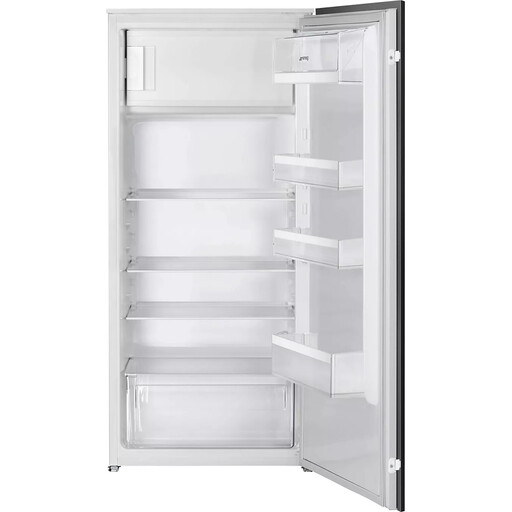 Image unavailable
Consider this model for a fitted kitchen only if the housing and fixing system are compatible.
The title lists a single door, a top-mounted freezer and an E energy rating. Before buying, confirm the housing dimensions, ventilation requirements and which way the door can open on this model.
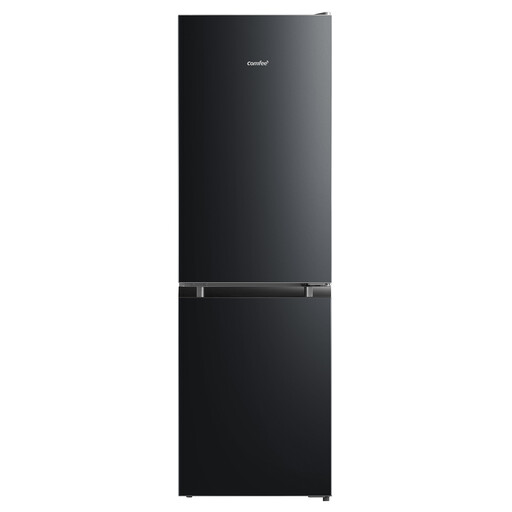 Image unavailable
This freestanding model may be worth considering if you’re looking for both fridge and freezer space in your first home.
The title lists Low Frost, an adjustable thermostat, LED lighting and a reversible door. Check its dimensions, installation clearances, annual energy consumption and stated noise level to see how it compares with your space and other models.
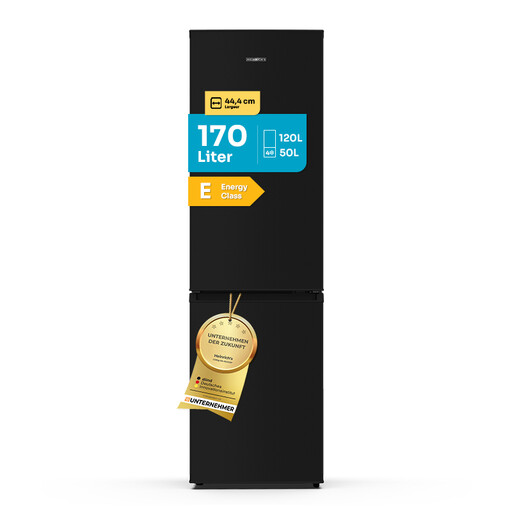 Image unavailable
The listed capacity split can help you decide whether the freezer space suits your usual shopping habits.
The title lists 120 L for the fridge, 50 L for the freezer, 40 dB and an E energy rating. Check the dimensions, delivery route and annual energy consumption before comparing this model with another.
UFC-Que Choisir recommends starting with 100 to 150 litres of usable capacity for one person, then allowing around 50 litres for each additional person. Adjust this guide to how often you shop, and check the freezer capacity separately.
Yes, if its usable capacity suits your shopping habits and its dimensions fit the space available. If you keep frozen food, check the type and capacity of its freezer compartment before choosing this compact style.
Measure the width, height and depth of the space, then check the whole route to the kitchen: doorways, hallways, stairs and lifts. Darty recommends these checks for large items. Also compare the packaged dimensions if available, and confirm the delivery arrangements with your chosen retailer.
Follow the clearance requirements for the model and its installation type. Whirlpool recommends 5 cm above and 10 cm behind its freestanding fridges. For a built-in model, check the ventilation requirements for the housing and appliance.
First compare appliances of a similar type and capacity, then check their energy rating and stated annual consumption. The European energy label and EPREL database let you look up information for a specific model. Check usable capacity and noise level separately to decide whether it’s right for your home.