Buying priorities
Start by working out how much storage you need for fresh and frozen food, then check that the appliance will fit your kitchen before comparing the energy use of models in the same size category.
| Priority |
What to check |
Your needs |
| Usable capacity and layout |
Compare the fridge and freezer capacities separately. UFC-Que Choisir suggests starting with 100 to 150 l for one person, then adding around 50 l per additional person for the fridge compartment. |
I want to keep fresh food until my next shop without sacrificing the space needed for portions and frozen food. A large total capacity does not guarantee that the freezer compartment will suit my usual stock levels. |
| Size and installation |
Measure the height, width, depth, delivery access and door-opening clearance. Check the housing dimensions for a built-in model and the ventilation gaps specified in the instructions. |
My appliance must fit into the kitchen, open without hitting a wall or unit, and retain the ventilation specified by the manufacturer. |
| Annual energy use |
Compare kWh/year between models with similar capacities and dimensions, as well as their energy rating and noise level. The European Commission lists this information in EPREL for registered models. |
As refrigeration runs continuously, I want to choose a suitable capacity without adding space or features that I will not genuinely use. |
| Cold-air circulation |
Check the temperature controls, storage zones and air circulation. Anses recommends a temperature of between 0 and +4 °C at the coldest point. |
After a big shop, I want to be able to put food away without completely filling the fridge or blocking the flow of cold air. |
Joybuy products
Joybuy options for less frequent shopping, including built-in and freestanding fridge freezers, as well as larger formats where space allows.
 Image unavailable
Hisense RB3B250SAWC 252 l built-in
A built-in fridge freezer for comparing fresh and frozen storage separately in a fitted kitchen.
176 l of fridge space and 76 l of freezer space; No Frost, Multi Air Flow, reversible door and stated consumption of 150 kWh/year.
Check the housing, ventilation, fixing method and door clearance before installation. Compare the 76 l freezer capacity with the amount of portions and frozen food you actually keep.
Joybuy
 Image unavailable
CHiQ JR263LGE 262 l Low Frost
A freestanding fridge freezer for a household that divides its shopping between fresh and frozen food in a compact kitchen.
187 l of fridge space, 75 l of freezer space, width of 54 cm, height of 176 cm, three freezer drawers and stated consumption of 215 kWh/year.
The Low Frost freezer requires manual defrosting approximately once or twice a year. Also check the ventilation gaps and suitability for an ambient temperature of 16 to 38 °C.
Joybuy
 Image unavailable
AEG NSC6M18FES 249 l built-in
A built-in fridge freezer for keeping fresh food and a supply of frozen items without installing two separate appliances.
186 l of fridge space and 62 l of freezer space; TwinTech Total No Frost, MultiFlow, three freezer drawers, reversible doors and sliding-hinge installation.
Check the model’s product page for its kWh/year consumption, housing dimensions, ventilation requirements and compatibility with your units. The 62 l freezer capacity should match the amount you usually store.
Joybuy
 Image unavailable
Sonlu CC-520WE 444 l side-by-side
A large side-by-side model to consider when both the total capacity and kitchen space are genuinely sufficient.
Stated total capacity of 444 l, Total No Frost, rapid cooling, energy rating E and stated consumption of 289 kWh/year.
Check the exact split between fridge and freezer, along with the width, depth, ventilation, door opening and delivery access.
Joybuy
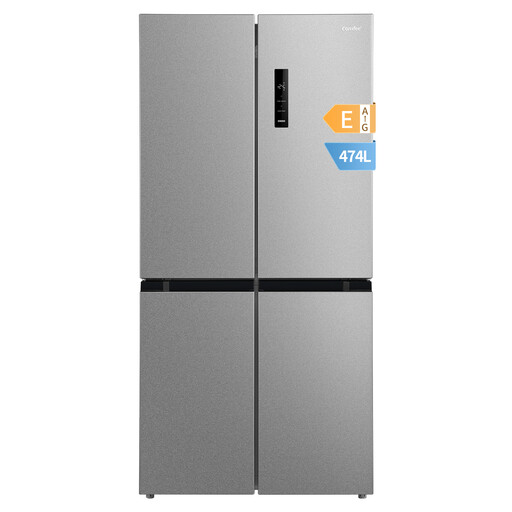 Image unavailable
COMFEE RCF470LS2EU(E) four-door 474 l
A four-door fridge freezer for households that need plenty of space and flexible fresh-food storage.
Stated total capacity of 474 l, dimensions of 838 × 653 × 1775 mm, Vario Box, a three-temperature vegetable drawer and flexible freezer drawers.
Compare the exact capacity of each compartment and check the energy label. Also check the opening of all four doors, ventilation gaps and delivery access.
Joybuy
Frequently asked questions
How can I estimate the fridge capacity I need for less frequent shopping?
UFC-Que Choisir suggests starting with 100 to 150 l for one person, then adding around 50 l per additional person. Increase this baseline if you keep lots of prepared meals, bulky fresh food or drinks, and assess your freezer needs separately.
When should I choose a separate freezer rather than a fridge freezer?
A separate freezer becomes worthwhile when frozen food and frozen portions make up a substantial stock distinct from your fresh food. According to UFC-Que Choisir, standard freezers can be useful for larger families; then choose an upright or chest freezer based on the available floor space and how you organise your food.
What should I measure before ordering?
Measure the height, width, depth, depth with the doors open, delivery access routes and the position of the socket. For a freestanding model, Beko recommends at least 5 cm on each side and at the back; for a built-in model, the housing dimensions and ventilation specified in the model’s instructions take priority.
Which energy information should I compare in France?
Compare kWh/year, the usable capacity of each compartment, noise level and energy rating between like-for-like appliances. European regulations govern the labelling of refrigeration appliances, and the European Commission’s EPREL database brings together data for registered models.
Is a multi-door model automatically suitable for a large family?
No. It must meet a genuine need for capacity while remaining compatible with your kitchen and access routes. UFC-Que Choisir states that an American-style or multi-door model can offer around 400 l, compared with around 300 l for a standard fridge freezer, but its size and energy consumption should be compared with those of appliances offering a similar capacity.


