Households preparing meals several days in advance
If you cook portions for dinners, lunches or leftovers, compare the litres allocated to fresh and frozen food separately rather than looking only at the total capacity.


Start by choosing according to the balance you actually need between fresh food and frozen portions. A fridge freezer is suitable when both uses are regular and you have one main space, while a fridge with a small freezer compartment meets an occasional need. Two separate appliances require enough room for installation, and you’ll need to compare their combined energy consumption.
If you cook portions for dinners, lunches or leftovers, compare the litres allocated to fresh and frozen food separately rather than looking only at the total capacity.
When organising packed lunches, food containers and leftovers, usable capacity and access to storage areas matter more than choosing a compact format without checking its layout.
Measure the available width, height and depth before choosing a format: a fridge freezer, an integrated appliance with a freezer compartment and two separate appliances will not take up the same amount of space.
Choose this if: you regularly store fresh food and frozen portions but only have one main space available.
Keep in mind: the space allocated to the fridge and freezer is fixed for each model.
Choose this if: chilled storage is your priority and freezing is only occasional or limited.
Keep in mind: check the freezer capacity, star rating and exact fit for your alcove.
Choose this if: frozen food permanently takes up a lot of space and you can install two appliances.
Keep in mind: you’ll need to add together the footprint and kWh/year of both models you’re considering.
| Priority | What to check | Your needs |
|---|---|---|
| Capacity split | Compare the fridge and freezer capacities separately. Also check the drawers and internal layout of the exact model. | I want to store prepared dishes, fresh food and frozen portions without discovering too late that one compartment is too small. |
| Preparing lunches | Compare the fresh-food capacity with the number of containers and meals stored at the same time. Check the freezer capacity if you prepare portions in batches. | My homemade meals need to remain accessible between working days without disrupting my everyday storage. |
| Stated energy consumption | Compare kWh/year between appliances with similar capacities and intended uses. The energy label also shows the class and the capacity of each compartment. | I want to assess the stated energy use of an appliance that runs continuously, without assuming that a better letter rating alone is enough to distinguish between two different formats. |
| Installation and noise | Measure H × W × D, check the installation type and confirm the required clearances. Check the dB(A) rating and noise class, especially in an open-plan kitchen. | The appliance must fit in my kitchen and remain suitable for use near the living area. |
Usable capacity is split between the fridge and freezer sections. A tall appliance may therefore lack space exactly where you need it most.
For one or two weeks, note what actually takes up space in your fridge and freezer. Then compare the capacity of each section with the appliance’s external dimensions.
The energy class and annual consumption are two different pieces of information. ADEME points out that refrigeration appliances run continuously, and that size or extra features can affect consumption.
Compare kWh/year and usable capacities between appliances designed for the same storage needs, then check the information for the exact model in EPREL.
An upright freezer can significantly increase the available capacity, but you must add its dimensions and energy consumption to those of the main fridge.
Measure two possible locations and add together the kWh/year of both models before comparing them with a fridge freezer.
Two appliances may also mean two deliveries or installations, as well as two after-sales service processes.
In France, the statutory legal guarantee of conformity applies for two years to new and second-hand goods bought from a professional seller, according to the Ministry of the Economy. A commercial warranty may cover elements that are already protected or come with different conditions.
Ask for the terms in writing: total duration, parts, labour, call-out charges, exclusions, whether a loan appliance is available and the procedure for reporting a fault.
Worth considering if you’re looking for a range of formats, including fridge freezers, integrated models with freezer compartments and upright freezers.
Worth considering if you’re looking for large-capacity fridge freezers, integrated models or features such as NoFrost and freshness compartments.
Worth considering if you want to compare a wide range of fridge freezers and features focused on air circulation or storage.
Joybuy fridge freezer options for storing fresh food and prepared portions in one appliance.
 Image unavailable
At 54 cm wide, this model may suit a kitchen with limited width while still providing separate fridge and freezer compartments.
262 L, 70/30 configuration, 54 cm wide and 176 cm high. Manual defrosting of the freezer is still required; the manufacturer states that it is not suitable for use where the ambient temperature falls below 16 °C.
 Image unavailable
With the freezer at the bottom, this fridge freezer is suitable for regular use combining fresh food, leftovers and portions to freeze.
282 L, energy class E and a NoFrost freezer. Check the stated clearances: at least 5 cm at the rear, 2 cm at the sides and 10 cm above.
 Image unavailable
Its total capacity suits households storing both weekly shops and large quantities of prepared meals at the same time.
495 L, black finish, energy class E and No Frost technology. At 81.7 cm wide and 71.5 cm deep, measure the space and check the installation requirements for the water and ice dispenser.
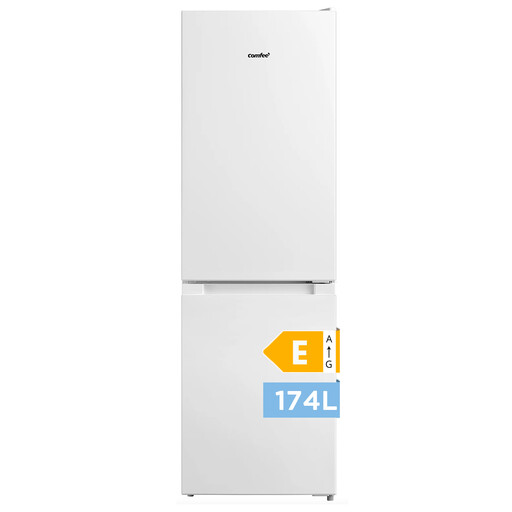 Image unavailable
At 50 cm wide, this model may meet moderate storage needs in a small kitchen.
174 L, 150 cm high, 4-star freezer, Low Frost, 39 dB and energy class E. Compare the freezer capacity with your usual portion sizes before choosing this format.
 Image unavailable
This compact fridge freezer keeps fresh food and frozen portions separate when space is limited.
227 L, 153 L fridge capacity, 74 L freezer capacity, 54 cm wide, 4-star freezer and energy class E. Check that 74 L of freezer space matches how often you prepare meals in batches.
Compare the class from A to G, kWh/year, the capacity of each compartment and the noise emissions. The European Commission states that this information appears on the label; when comparing two sizes or designs, the separate capacities and kWh/year are more useful than the letter rating alone.
Yes. It links to EPREL, the European Commission’s public database for comparing the main specifications of different models. However, check the exact model reference and the version sold.
Yes. According to the Ministry of the Economy, the statutory legal guarantee of conformity applies for two years to new goods sold by a professional seller to a consumer. The seller is responsible for the goods’ conformity, including in certain cases relating to installation when this falls within the seller’s responsibility or instructions.
No. A commercial warranty is optional and comes in addition to statutory guarantees, according to the Ministry of the Economy. Before taking one out, check its duration, exclusions, cover for labour and call-out charges, and who to contact in the event of a fault.