Which format and features should you prioritise?
How much space your usual shopping takes up can help you choose a format. Then compare the fresh and frozen capacities listed separately on the energy label, as set out in the product information described by the European Commission.
Fridge with a small freezer compartment
Consider this if: your meals are mainly based on fresh food and you keep only a few frozen items.
Bear in mind: check how many litres are actually available for freezing before relying on the compartment for pre-prepared portions.
Fridge-freezer
Consider this if: you regularly store both fresh food and frozen portions, but only have room for one appliance.
Bear in mind: two fridge-freezers with similar total capacities can allocate their litres very differently between compartments.
Separate fridge and freezer
Consider this if: your frozen food takes up a lot of space on a regular basis, in addition to your fresh shopping. If you’re looking at a separate freezer, compare the easy access of an upright model with the storage space of a chest freezer.
Bear in mind: you’ll need space for two appliances, and should check the annual energy consumption of each one.
| What matters to you |
What to check |
What consumers say |
| Capacity split |
Compare the fridge and freezer capacities in litres with a typical week’s shopping and meals. |
When my meals include fresh food, leftovers and a few frozen portions, I need enough room for each. Around 33% of consumers prioritise this balance. |
| Frozen portion storage |
Check the freezer capacity, the number and size of the drawers, and whether a separate appliance might be useful. |
If I prepare several meals in advance, I need to be able to store and find portions without filling the freezer to capacity. This is the top priority for around 27% of consumers. |
| Kitchen space and access |
Measure the space and check that the doors can open fully. For an integrated model, check the niche, door fixing and ventilation requirements in the instructions. |
With a fitted or small kitchen, I need to be able to install the appliance and reach its contents. Around 20% of consumers prioritise how well it fits their space. |
| Energy use and noise |
For similar formats and capacities, check the kWh/year and dB(A) ratings on the energy label. |
In an open-plan kitchen, I pay attention to noise. I also consider the energy use of an appliance that stays on all the time. These factors are a priority for around 20% of consumers. |
Fridge-freezers available on Joybuy
These fridge-freezers combine fresh and frozen compartments in one appliance, and are available as freestanding or integrated models depending on the product. Compare them based on the space available and the capacity you need for each type of food.
 Image unavailable
Candy CFQQ5T817EPS, 467 L, four doors
Worth considering if you’re looking for a multi-door fridge-freezer to organise fresh and frozen food separately.
Listed total capacity of 467 L, Total No Frost technology and an E energy rating. Check the space needed to open the doors and the capacity of each compartment.
View on Joybuy
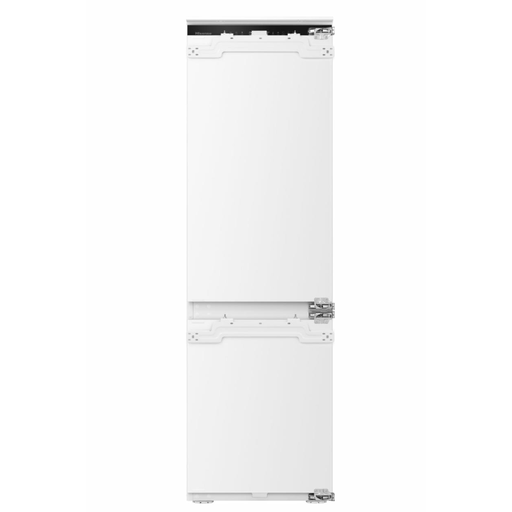 Image unavailable
Hisense RB3B250SAWC integrated, 252 L
Worth considering if your kitchen has space for an integrated appliance to store fresh and frozen food in one place.
Listed total capacity of 252 L, No Frost and a C energy rating. Before ordering, check the instructions for the required niche dimensions, door fitting and ventilation.
View on Joybuy
 Image unavailable
Samsung RF50C530EB1 multi-door, 495 L
Worth comparing if you need a large-capacity fridge-freezer and your kitchen can accommodate a multi-door model.
Listed total capacity of 495 L and an E energy rating. Measure the space and check that the doors can open fully. Check the capacity and layout of each compartment against your usual storage needs.
View on Joybuy
 Image unavailable
AEG NSC6M18FES integrated, 249 L
Worth considering if you want to organise fresh food and frozen portions in an integrated fridge-freezer.
Listed total capacity of 249 L, TwinTech No Frost and an E energy rating. Confirm the capacity of each compartment in the model documentation, then check the niche, door system and kWh/year on the energy label.
View on Joybuy
 Image unavailable
Bosch KGN33NLEB, bottom freezer, 282 L
Worth considering if you prefer a fridge-freezer with the freezer at the bottom, keeping fresh shopping and frozen portions in one appliance.
Listed total capacity of 282 L and an E energy rating. Compare the capacity of each compartment and check the dB(A) rating if noise matters in your kitchen.
View on Joybuy
Frequently asked questions
What should I compare on a fridge-freezer’s energy label?
As well as the energy rating, compare kWh/year, fridge and freezer capacities, and noise levels. The European Commission says these details appear on the labels for refrigeration appliances. For a fair comparison, choose models with similar capacities and formats.
How do I choose a capacity if I prepare meals in advance?
Work out separately how much space you need for fresh shopping and portions to freeze. UFC-Que Choisir suggests starting with 100 to 150 l for one person, then adding 50 l for each additional person. Adjust this guideline to suit how often you shop and how much food you actually store.
Chest or upright freezer for storing frozen portions?
Choose according to how much you need to store and how often you’ll access it. A chest freezer can offer plenty of capacity, while the drawers in an upright model make it easier to find food. UFC-Que Choisir lists chest freezers with capacities of up to 600 l. Before choosing one, also check the space available and how easy it is to reach items at the bottom.
What should I check before ordering an integrated fridge-freezer?
Measure the niche and check the model’s instructions for door fitting, ventilation and required clearances. Dimensions vary between models: for example, Liebherr specifies a niche measuring 194–195 × 56–57 × 55 cm for its ICNSd 5603.


