Which households does this choice matter most to?

Households that regularly cook and freeze food

You prepare portions in advance, store ingredients and keep frozen food: compare fridge and freezer capacity separately so you can keep a suitable stock without needing multiple appliances. UFC-Que Choisir points out that usable capacity should be matched to the household’s habits.

Households mindful of ongoing energy use

When replacing an appliance that runs 24 hours a day, compare kWh/year and the energy efficiency class between appliances with similar capacities and configurations. ADEME highlights that fridges and freezers operate continuously.

People with small kitchens

In a tight space, a narrow kitchen or where access is difficult, the exact dimensions, door opening and usable capacity of each compartment matter more than the headline total capacity.

Buying priorities for organising meals at home

Fridge freezer

Choose this if: you store both everyday fresh produce and a regular, but not dominant, amount of frozen food.

Bear in mind: freezer capacity is fixed by the model, so check the litres of both compartments, not just the total.

Separate fridge and freezer

Choose this if: frozen meals, bulk shopping or frozen-food reserves consistently require more space.

Bear in mind: this configuration takes up more room and means comparing the annual energy use of two appliances.

Compact model

Choose this if: the available width, height, depth or doorway limits installation.

Bear in mind: the space-saving design reduces capacity, so you will need to accept more limited storage or shop more frequently.

Priority What to check Your needs
Usable capacity Compare fridge and freezer capacity separately. UFC-Que Choisir suggests using 100 to 150 L for one person as a guide, then adding 50 L per extra person, adapted to your shopping and meal-preparation habits. I want enough space for fresh produce without running out of room for frozen portions and ingredients.
Annual energy use Read the kWh/year alongside the energy efficiency class, capacities and noise level. The European Commission states that this information appears on the energy label for refrigeration appliances. I compare appliances of a similar size and capacity because the fridge runs all year round.
Food storage and maintenance Check the temperature at the coldest point: Anses recommends between 0 and +4 °C. Also check the cooling system and the maintenance instructions for the specific model. I want to organise food without overloading the shelves or restricting the circulation of cold air.
Installation and noise Measure the height, width and depth, the required clearances and the delivery route. Compare the noise level in dB(A) if the kitchen opens onto a living area. My appliance must fit through the available access and allow the door to open without getting in the way of the kitchen.

Mistakes to avoid before buying

  • Choosing based solely on the energy efficiency class letter

    The class does not tell you everything about the appliance’s performance: the label also shows kWh/year, storage capacities and noise level. A larger appliance may meet a genuine need, but it cannot be compared directly with a compact model based on the letter alone.

    Compare kWh/year with the usable fridge and freezer capacities, using configurations and dimensions that are as similar as possible.

  • Buying a large capacity “just in case”

    An appliance runs continuously, so capacity that is rarely used will not improve your everyday organisation. UFC-Que Choisir’s capacity guideline is a useful starting point to adjust to your shopping and meal-preparation habits.

    Assess your fresh and frozen storage needs separately over one or two typical weeks, then allow a reasonable margin for larger shops.

  • Confusing fridge capacity with freezer capacity

    Total capacity can hide a small freezer compartment that is not large enough for portions prepared in advance. A fridge freezer divides its capacity between two compartments, while a separate freezer specifically increases your frozen-food storage.

    Set a desired minimum capacity in litres for each compartment before comparing models.

  • Overlooking installation, your old appliance and food safety

    An appliance that is not suited to your kitchen can be difficult to install. After installation, an unsuitable temperature or an overfilled fridge can compromise food storage.

    Measure the space and delivery route, check the installation instructions, arrange collection of your old appliance and make sure the coldest point remains between 0 and +4 °C.

    Changing the door opening direction, installation, disconnection or collection may be offered separately: check which services are included before ordering.

Relevant brands to consider

Bosch

A range of freestanding fridge freezers, including Total No Frost models with specifications showing capacities, dimensions, energy efficiency class and noise level.

  • According to Bosch Électroménager France, the KGN33NWDA offers 189 L of fridge capacity, 90 L of freezer capacity, 40 dB(A), a D energy efficiency class and Total No Frost.
  • These specifications apply to this specific model and do not describe the entire Bosch range.

Liebherr

A range of freestanding and built-in freezers and fridge freezers to consider when your freezer needs exceed those of a standard fridge freezer.

  • The brand offers NoFrost freezers in different capacities, including a 260 L model featured on its French website.
  • According to Liebherr, NoFrost reduces frost build-up and makes the appliance easier to use; check this feature and its scope on the specification sheet for the model you are considering.

Whirlpool

A range of freestanding and built-in fridge freezers, with different cooling technologies and storage options depending on the model.

  • Whirlpool’s range includes No Frost, fan-assisted and static-cooling fridge freezers, as well as built-in and freestanding formats.
  • The presence of a feature or configuration must be confirmed for the exact model, as it is not common to every appliance.

Joybuy options for storing fresh and frozen food

This Joybuy selection brings together fridge freezers suited to the everyday storage of fresh and frozen food, with several capacities and compact formats to compare according to the space available.

CHiQ JR263LGE, 262 L fridge freezer

CHiQ JR263LGE, 262 L Low Frost fridge freezer

Worth considering for weekly shops and portions to freeze, with separate fridge and freezer capacities of 187 L and 75 L.

54 cm wide and 176 cm high, with a reversible door, 39 dB(A), three freezer drawers and a stated energy consumption of 215 kWh/year.

The 75 L freezer may be limiting if frozen meals become the main part of your stock. The specification states that it can be used between 16 and 38 °C: check the intended location.

Joybuy
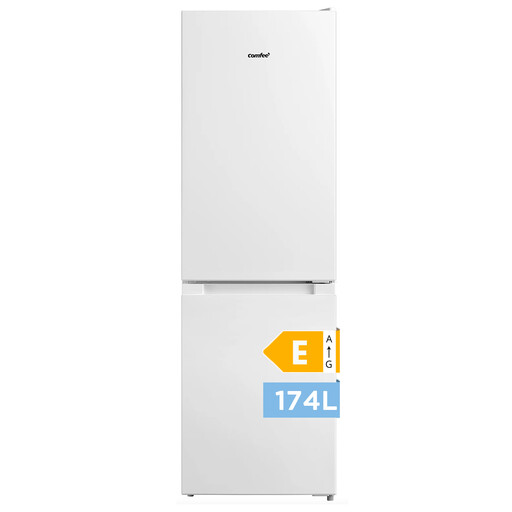
Comfee RCB169WH2(E), 174 L fridge freezer

Comfee RCB169WH2(E), 174 L 70/30 fridge freezer

This compact format is suitable for a small household with regular but limited fresh and frozen storage needs.

115 L of fridge capacity, 59 L of freezer capacity, 50 cm wide, dimensions of 50 × 55 × 150 cm, reversible door, LED lighting and a stated noise level of 39 dB.

The 59 L freezer is better suited to a moderate stock. Check the kWh/year on the energy label for the exact model before comparing.

Joybuy

CHiQ JR227LSE, 227 L fridge freezer

CHiQ JR227LSE, 227 L Low Frost fridge freezer

This compact option combines 153 L of fridge space with 74 L of freezer space for everyday storage and a few frozen portions.

54 cm wide, 55 cm deep and 176 cm high, with a reversible door, adjustable feet, a 4-star freezer and a stated noise level of 39 dB.

A stock consisting mainly of prepared meals or frozen food may exceed the available 74 L. Check the kWh/year on the energy label before comparing running costs.

Joybuy
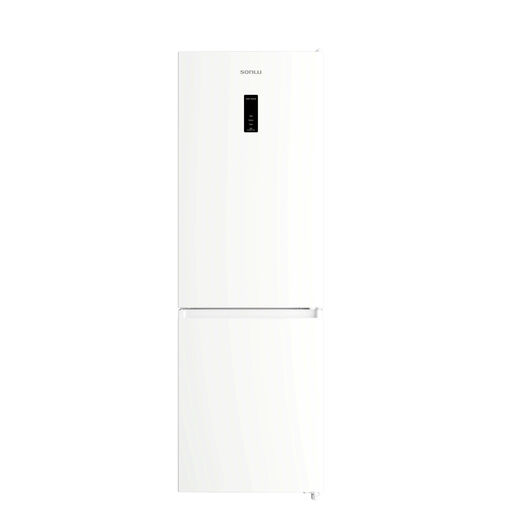
Sonlu CD-350RW, 310 L fridge freezer

Sonlu CD-350RW, 310 L fridge freezer

Consider this model if you regularly store frozen portions or food and would like more freezer space in a fridge freezer.

211 L of fridge capacity, 99 L of freezer capacity, 60 cm wide, with a reversible door, electronic controls and a stated Full Frost-Free system.

Check the height, depth, installation clearances and kWh/year before buying. An E energy efficiency class and an inverter compressor alone are not enough to compare annual energy use.

Joybuy
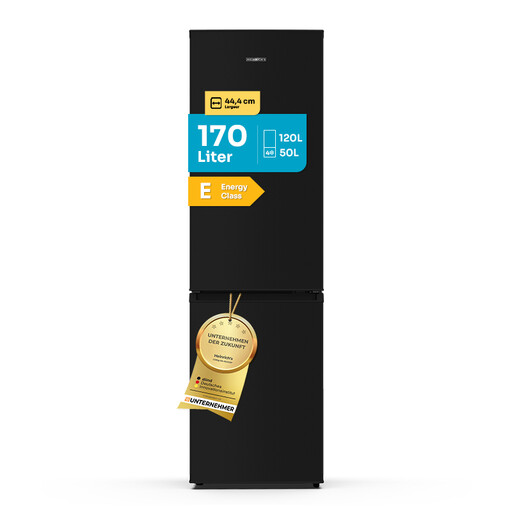
Heinrich’s, 170 L fridge freezer

Heinrich’s, 170 L fridge freezer

This fridge freezer is designed for moderate household storage needs for fresh and frozen food.

120 L of fridge capacity, 50 L of freezer capacity, three freezer drawers, a 4-star compartment, LED lighting and temperature adjustment.

The 50 L freezer may be restrictive for several prepared portions. Check the dimensions, kWh/year and defrosting system on the technical specification sheet.

Joybuy

Frequently asked questions

What should you check first on a fridge freezer’s energy label?

The European label shows the energy efficiency class, energy consumption, storage capacities, freezer compartment and noise emissions. Compare kWh/year and the litres of each compartment between appliances with comparable capacities and formats; according to the European Commission, the QR code provides access to the model’s data in EPREL.

What temperature should you aim for in the fridge to keep food fresh?

Anses recommends a temperature between 0 and +4 °C at the coldest point. Check it regularly, for example with a thermometer, and avoid overfilling the fridge to help cold air circulate.

Is a No Frost appliance essential?

No, it is a matter of convenience and maintenance, not a necessity. According to information from Bosch and Liebherr, their No Frost systems are designed to prevent or reduce frost build-up and manual defrosting; check that the feature applies to the compartment or compartments you need on the specification sheet for the exact model.

Does the seller have to take back my old fridge in France?

In France, for household electrical appliances, “1-for-1” take-back applies without a floor-space threshold when buying a product of the same type, according to the Ministry for Ecological Transition. Take-back without a purchase depends in particular on the sales area of the shop concerned.