Buying priorities
Start by working out how much capacity you need for your shopping, then check the actual installation requirements and the space reserved for frozen food before comparing labels and features.
Table-top
Choose this if: the appliance needs to fit under a worktop, you shop frequently and frozen food is not normally part of your storage needs.
Bear in mind: a smaller footprint can also limit the space available for several days’ worth of fresh food.
Single-door with freezer box
Choose this if: you mainly store fresh food but want to keep a few frozen items occasionally.
Bear in mind: capacity, star rating and freezing capacity vary between models.
Compact fridge freezer
Choose this if: frozen food is a regular part of your shopping and you need a separate compartment.
Bear in mind: this format generally requires more height than a table-top model.
| Priority |
What to check |
Your needs |
| Net capacity |
Compare the total capacity with that of the fridge section. For a main appliance intended for one person, use the 100 to 150 L UFC-Que Choisir benchmark as a guide. |
I want to keep several days’ worth of fresh food without turning the fridge into a spare appliance. |
| Installation |
Measure the height, width and depth of the space, the delivery route and the door swing. Also check the ventilation clearances in the exact model’s manual. |
My kitchenette is narrow and I need to be able to open the door without blocking the walkway. |
| Noise |
Compare noise emissions in dB(A) and the noise class shown on the energy label. Consider how close the appliance will be to your bed or desk. |
The fridge will be in my living space, near where I sleep or work. |
| Frozen food |
Check the star rating, stated temperature and compartment capacity. Also compare the freezing capacity in kg/24 h where this information is provided. |
I want to know whether a few frozen items will be enough or whether I need a proper freezer compartment. |
| Energy consumption |
Compare kWh/year between appliances with a similar capacity and format. The European Commission states that the energy label includes information such as consumption, storage capacities and noise emissions. |
I prefer to compare consistent information rather than choosing based solely on the energy class letter. |
Joybuy options for a studio flat
These Joybuy options include a compact fridge freezer for regular frozen-food storage and a more compact single-door fridge for frequent, smaller shops.
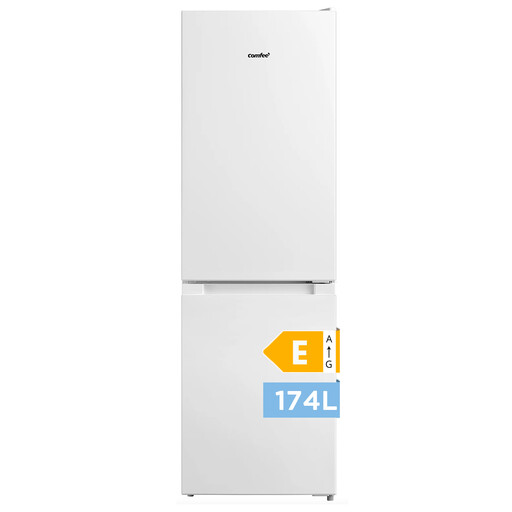 Image unavailable
Comfee' RCB169WH2(E) 174 L fridge freezer
This compact fridge freezer could be a good choice if you regularly buy both fresh and frozen food and have enough vertical space.
The product title states 174 L, a height of 150 cm, a 4-star freezer, Low Frost technology, 39 dB and a reversible door.
At 150 cm tall, it will not fit under a worktop. Also check the delivery route, door swing and ventilation clearances specified in the manual.
Joybuy
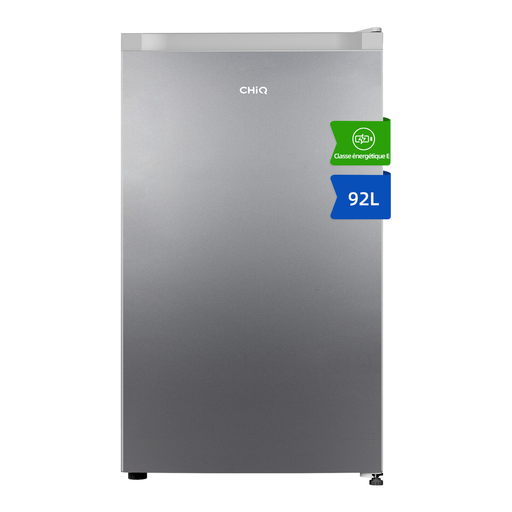 Image unavailable
CHiQ JR92DSE 92 L single-door fridge
This option is designed for small kitchens and frequent fresh-food shopping, where keeping the footprint to a minimum is the priority.
The product title states a capacity of 92 L, a compact freezer box and a stated footprint of 0.22 m².
Its 92 L capacity is below the 100 to 150 L benchmark for a main appliance. Check the freezer capacity, star rating and temperature, as well as the full dimensions and stated noise level.
Joybuy
Frequently asked questions
How do I know whether a mini fridge is enough for my studio-flat shopping?
For a main appliance used by one person, use a net capacity of 100 to 150 L as a starting point, according to UFC-Que Choisir. A smaller model may be suitable for drinks, snacks or very frequent shopping, but could be too limited for several days’ worth of fresh food.
What is the difference between a freezer box and a 4-star compartment?
If you regularly store or freeze frozen food, check the compartment’s star rating, capacity and temperature specifically. The Beko TSE1264FMGN, for example, states that it has a 13 L 4-star compartment at -18 °C; this capacity is still suited to limited use.
What should I measure before ordering?
Measure the height, width and depth of the space, the route through doors and stairways, and the room needed to open the door. Allow for the ventilation clearances specified in the model’s manual: these vary from one appliance to another.
What does the energy label on a fridge sold in France show?
The label uses a scale from A to G and includes information such as annual consumption in kWh, storage capacities and noise emissions. The European Commission explains that this information makes it possible to compare appliances on a consistent basis; use it when comparing models with a similar format and capacity.


