What should you check before choosing?
Choose a format that suits the way you shop, then compare models with capacities that genuinely meet your needs.
Fridge freezer
Consider this if: one appliance offers enough space for fresh food and a moderate amount of frozen food.
Keep in mind: a large fridge compartment won’t make up for a freezer that’s too small for your shopping.
Multi-door fridge freezer
Consider this if: you want easy access to plenty of fresh food, along with freezer space that suits the amount you store.
Keep in mind: check the width, weight and capacity of each compartment before choosing this format.
Separate freezer
Consider this if: you need to choose the amount of space for fresh and frozen food independently.
Keep in mind: you’ll need two suitable spaces, and should compare the appliances’ combined annual energy consumption.
| Criteria |
What to check |
Your needs |
| Usable capacity |
Compare the fridge and freezer capacities separately, in litres. Check that the shelves and drawers are arranged to suit the food you normally buy. |
I store several days’ worth of fresh food, but I also want to know how much room will be left for frozen food. |
| Size and noise |
Check the exact model’s height, width, depth and weight. Make sure it will fit through the delivery route, that the doors can open fully and that you can meet the specified installation clearances. Check the stated noise level in dB(A). |
In a kitchen close to living areas, noise matters just as much as being able to install and open the appliance properly. |
| Energy consumption |
Compare the kWh/year of models with the capacity you need, and check their energy labels too. If you’re buying a separate fridge and freezer, add together their stated annual energy consumption. The European Commission lists model-specific information in EPREL. |
I want enough capacity for my shopping, but I don’t want to judge energy consumption by the appliance’s size or energy class alone. |
| Food storage and care |
Check how to control the temperature and arrange food without overfilling the shelves. Anses recommends keeping the coldest part of the fridge between 0 and +4 °C. |
After a big shop, I want to be able to put food away while allowing cold air to circulate and keeping the temperature under control. |
Fridges available on Joybuy
This selection includes fridge freezers, multi-door models and a side-by-side fridge freezer, so you can compare different ways to divide up the capacity for a big shop. Check each compartment’s capacity and make sure the model you’re interested in will fit your available space.
 Image unavailable
Candy CFQQ5T817EPS, 467 L multi-door fridge freezer
If you shop in bulk, check that the split between fresh and frozen food suits the amount you store.
This four-door model is listed with a capacity of 467 L, Total No Frost and an E energy class. Check its dimensions and the clearances needed for installation too.
View on Joybuy
 Image unavailable
Haier HTW5618ENMG, 360 L three-door fridge freezer
This fridge freezer may suit a week’s shopping if its freezer capacity matches the amount of frozen food you buy.
Listed with a total capacity of 360 L, Total No Frost, an E energy class, Wi-Fi and My Zone. Compare the usable capacity of each compartment before choosing.
View on Joybuy
 Image unavailable
CHiQ JR263LGE, 262 L fridge freezer, 70/30 split
If space is limited in your kitchen, compare its capacity with your weekly shop before choosing this format.
Listed as 54 cm wide and 176 cm high, with Low Frost technology. Check that it offers enough freezer space and read the model’s defrosting instructions.
View on Joybuy
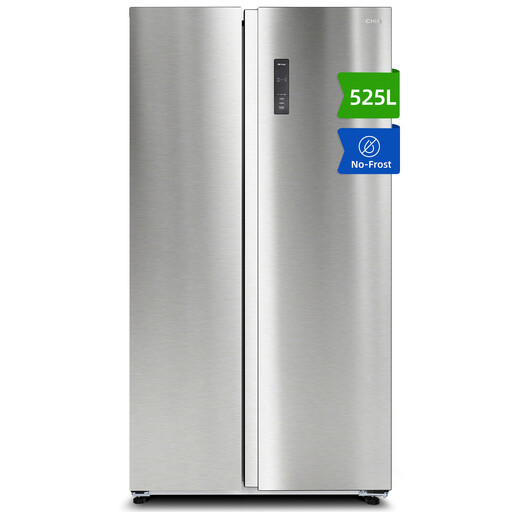 Image unavailable
CHiQ JR525WSE, 525 L side-by-side fridge freezer
If your shopping includes lots of frozen food, compare the stated freezer capacity with the space you need.
The model name indicates 333 L for the fridge and 192 L for the freezer, with No Frost and a noise level of 37 dB. Check its overall dimensions and kWh/year before opting for this larger model.
View on Joybuy
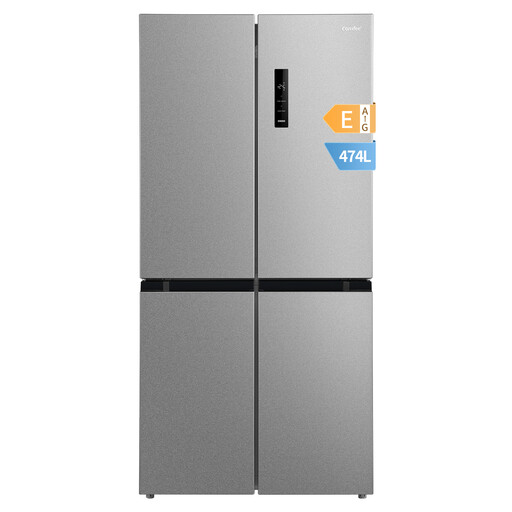 Image unavailable
COMFEE' RCF470LS2EU(E), 474 L four-door fridge
If you shop in bulk, think about how much of the 474 L capacity needs to be taken up by frozen food. The total capacity alone won’t tell you if it’s the right choice.
The product name mentions a three-temperature vegetable drawer and an E energy class. Check the usable capacity of each compartment, the kWh/year and the exact model’s noise level.
View on Joybuy
Frequently asked questions
Is a large total capacity enough for a week’s shopping?
No. Compare the fridge and freezer capacities separately. Depending on how much frozen food you buy, a fridge freezer may be enough, or you may want to look at the actual capacity of a multi-door model or a separate freezer.
Which figures should I compare on the energy label?
Check the energy class and kWh/year, then compare them with the usable capacity you need. The European Commission also lets you check standardised information for the exact model in EPREL, including the capacity of each compartment.
What temperature should I aim for in the fridge?
Anses recommends keeping the coldest part of the fridge between 0 and +4 °C. Check the temperature regularly and avoid overfilling the appliance, especially after a big shop.
Does No Frost mean I don’t need to check how food is stored?
No. Even with a model described as No Frost, check the temperature and leave space for air to circulate around the food. Follow the care instructions for your appliance too.
What should I do if the fridge delivered doesn’t match its description?
In France, when a business sells goods to an individual, the seller is required by the legal guarantee of conformity to deliver a product that matches the contract, as the Ministry of the Economy explains. Contact the seller and explain how the appliance you received differs from the agreed description.


