Households that do a big weekly shop
If you fill your fridge once a week and top it up between shops, look at the usable space in the fridge compartment. Que Choisir takes both of these shopping patterns into account when testing fridge-freezers.


First, choose the usable fridge capacity based on the size of your household and how often you shop. Then check separately how much space you need for frozen food. Que Choisir suggests starting with 100 to 150 L for one person, then adding 50 L for each additional person. A compact model may be enough if you buy smaller quantities, while a fridge-freezer or multi-door model may be worth considering depending on how much you need to store and the space available in your kitchen.
If you fill your fridge once a week and top it up between shops, look at the usable space in the fridge compartment. Que Choisir takes both of these shopping patterns into account when testing fridge-freezers.
Width, depth and door clearance matter just as much as capacity. If the appliance is close to your living area, check its stated noise level too: Que Choisir puts the quietest models below 40 dB(A).
If fruit, vegetables, dairy and ready meals take up most of your shelves, check how the capacity is divided and the size of any dedicated compartments. A large total capacity does not, by itself, tell you how much space is available for fresh food.
Work out how much space you need for fresh and frozen food first, then rule out any appliances that will not fit the space you have in mind.
Consider it: for a studio flat or a smaller shop, if its usable capacity is enough.
Bear in mind: its smaller capacity leaves less room for a full shop.
Consider it: if you’ll use most of the space for fresh food and buy little frozen food.
Check: whether it has a freezer compartment and, if so, how much space it offers.
Consider it: if your regular shop includes both fresh and frozen food.
Check: how the capacity is split between the two compartments, not just the total.
Consider it: if your larger shops call for several separate storage areas.
Bear in mind: its size, and check it against your doorways and the space needed to open the doors.
| What matters | What to check before buying | Who it matters to |
|---|---|---|
| Capacity for your shop | Compare the usable capacity of the fridge and freezer separately. Que Choisir suggests 100 to 150 L for one person, then 50 L for each additional person, adjusted to your shopping habits. | If you do a big shop or prepare meals for several days, you need enough room for fresh food without relying on the freezer space; around 31% of consumers would prioritise this capacity. |
| Space and noise | Measure the space, access routes and door clearance. For an open-plan kitchen, check the stated noise level in dB(A) on the label; Que Choisir puts the quietest models below 40 dB(A). | In a small kitchen or open-plan living space, an appliance that blocks a walkway or makes itself heard every day can affect your choice of style; around 25% of consumers would put space and quiet first. |
| Fresh-food storage | Check the size of the drawers and dedicated zones, as well as the settings available on the specific model. | If fruit, vegetables and ready meals take up most of the shelves, suitable compartments matter more than a large total capacity; around 25% of consumers would prioritise how fresh food is stored. |
| Energy use and maintenance | Compare the annual energy consumption in kWh of appliances with the same capacity requirements. Check which compartment an anti-frost function applies to. | For an appliance that runs all the time, some people mainly want to reduce electricity use and the need to defrost; around 19% of consumers would make these their priorities. |
Two appliances with the same total capacity may divide the space differently between fresh and frozen food. If you mainly buy fresh food, the total figure could hide a fridge compartment that is too small.
Compare the usable capacity of both compartments separately and match them to your usual shop.
An appliance may fit in its intended spot but still be difficult to get through a doorway or open properly once it is in place.
Check the model’s overall dimensions, measure the delivery route and make sure there is enough clearance for installation and opening the doors.
Extra capacity is no help if it does not suit the food you need to store or takes up too much room in your kitchen. When comparing energy use, you should also take capacity and features into account.
Compare the compartment layout, dimensions and annual kWh of a multi-door model with those of a fridge-freezer that meets your needs.
A specialist compartment or anti-frost function does not, on its own, tell you how much space will be available for your food or which settings you can use.
Check what the relevant compartment is designed for, how much space it offers and what the manual says for the model you choose.
If you’re looking at fridge-freezers with plenty of space for fresh food, the KGN86AIDP is a specific example rather than a guide to the whole range.
The CBNsfc 5223 fridge-freezer is an example of a configuration with BioFresh compartments and NoFrost.
If you’re considering a multi-door model, the HFR3718ENMM is an example of a four-door configuration with No Frost.
These models offer different ways to store your household shop: fridge-freezers for fresh and frozen food, a single-door model geared more towards fresh food, and a multi-door model for households that need more capacity. Compare the compartments and overall size to suit your kitchen.
 Image unavailable
Worth considering if you split your shop between fresh and frozen food and want separate storage zones. The model name indicates Total No Frost, My Zone, Wi-Fi connectivity and an E energy rating. Check the space needed for installation before choosing.
 Image unavailable
For a kitchen where width matters, this model is listed as 54 cm wide, with 153 L of fridge space and 74 L of freezer space. It has a reversible door, an E energy rating and Low Frost, which is not the same as No Frost. Also check its height, annual energy consumption and clearance requirements.
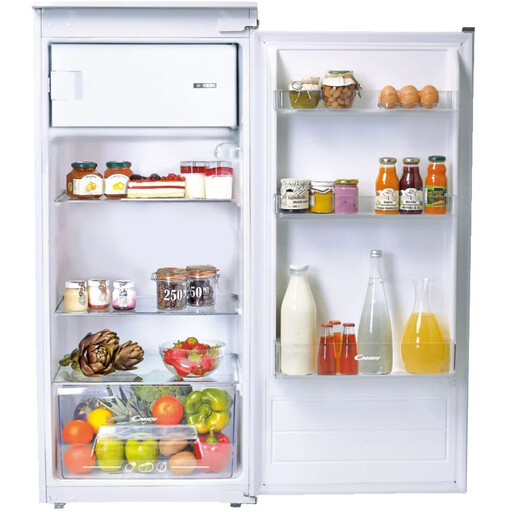 Image unavailable
Consider this if you mainly shop for fresh food and only need limited freezer space. Its small freezer compartment needs to be defrosted manually. Before buying, confirm the installation type and required clearances: the freestanding and built-in installation details contradict each other.
 Image unavailable
This fridge-freezer offers separate storage for fresh and frozen food; the model name indicates an E energy rating. If you plan to install it close to a living area, check its stated noise level before deciding.
 Image unavailable
Its four doors may suit a household that needs several storage areas for larger shops. The model name indicates Total No Frost and an E energy rating. Check the overall dimensions, delivery access and door clearance before choosing this style.
Que Choisir suggests starting with 100 to 150 L for one person, then adding 50 L for each additional person. Adjust this guide if you do a big shop or prepare several meals in advance, paying particular attention to the fridge capacity separately from the freezer.
Compare the stated noise level in dB(A) on the specific model’s energy label. Que Choisir puts the quietest fridges below 40 dB(A), a useful guide if the appliance is near your living room or a sleeping area.
No. It may help limit frost in the compartment it applies to, but it does not replace comparing capacity, noise and annual energy consumption. Check the model description to see which compartments are covered.
According to the European Commission, the EU energy label lets you compare the energy efficiency class, energy consumption, storage volumes and noise emissions of the appliances covered. Focus on models with compartments and capacities that meet the same needs.