Households keeping an eye on energy costs
You’re replacing an appliance that runs continuously and want to compare the kWh/year listed for each model with your household electricity tariff.


First, choose between a fridge, a fridge freezer and a separate freezer based on how much fresh and frozen food you actually store. Then compare the net capacity of each compartment and the annual energy consumption in kWh across appliances suited to the same needs. Extra capacity or features are only useful if they meet your requirements. ADEME points out that these appliances run continuously. To estimate the electricity cost, use the figures for the model you’re considering and your price per kWh.
You’re replacing an appliance that runs continuously and want to compare the kWh/year listed for each model with your household electricity tariff.
You regularly freeze food but aren’t sure whether a fridge freezer’s compartment will be big enough, or whether a separate appliance would meet your long-term storage needs.
You need to check the dimensions, access route and door opening while making sure there’s enough usable capacity for your food.
The right type of appliance depends first on how much space you need for fresh and frozen food. Once you’ve worked that out, compare the energy consumption and installation requirements of models that can genuinely meet your needs.
Consider this if: you mainly store fresh food and have few or no frozen items.
Bear in mind: you’ll need another way to freeze food if this becomes a regular need.
Consider this if: you want everyday refrigeration and freezing in one appliance.
Limit to consider: check the freezer capacity separately from the total capacity, especially if you buy frozen food in bulk.
Consider this if: your regular storage needs exceed the freezer capacity of a fridge freezer.
The trade-off: you’ll need space for a second appliance that runs continuously, and its energy consumption will add to the total.
| Factor | What to check | Who this matters to |
|---|---|---|
| Energy consumption | Compare kWh/year and the energy rating of models designed for the same purpose. To estimate the annual cost, multiply the kWh/year by your electricity price per kWh, including VAT. | I want to know what the new appliance could add to my bill, rather than relying on its energy rating alone. Around 42% of consumers would make this a priority. |
| Fresh and frozen capacity | Check the net capacity in litres for each compartment and compare it with your storage habits, including when the fridge is at its fullest. | If I freeze food regularly but don’t stock up in large quantities, I want enough space in both compartments without choosing an unnecessarily large appliance. This would be the main priority for around 33% of consumers. |
| Installation and use | Measure the space and access routes. For a built-in appliance, check the housing and door mounting system. Also check the noise level in dB if the appliance will be near a living area. | In my small kitchen, an appliance with enough storage won’t help if it won’t fit through the door or into the housing. Around 25% of consumers would prioritise this compatibility. |
A fridge freezer’s total capacity doesn’t tell you how much space is available for fresh or frozen food. The energy rating also doesn’t replace the kWh/year figure for the specific model.
Compare the net capacity of each compartment and the annual energy consumption of appliances that can meet the same storage needs.
ADEME’s average figures won’t necessarily match your electricity tariff or the appliance you choose.
Multiply the kWh/year shown for each model by the current price per kWh, including VAT, in your electricity plan.
The appliance dimensions, housing dimensions and door mounting system must all suit your installation. Even an appliance with the right external dimensions may need a different door fitting.
Measure the housing and access routes, then check the model’s instructions for door fitting, door opening and required clearances.
A separate freezer gives you extra storage, but it runs continuously. ADEME gives an average figure of 300 kWh/year for this category, but it won’t predict the consumption of the model you’re considering.
Work out how much extra space you regularly need, then compare the combined kWh/year of the appliances you’d use with that of a fridge freezer suited to your needs.
These ranges offer different formats and features to compare model by model. The brand name is no substitute for checking the dimensions and energy label figures.
Bosch’s range includes fridges, fridge freezers and freezers.
The range’s built-in fridges and fridge freezers are worth considering when the housing and door fitting determine your choice.
The range includes fridges and fridge freezers, including built-in models, to consider if capacity, housing dimensions and noise level matter to you.
Fridge freezers in the range come in different capacities, and selected models offer No Frost cooling or connected features.
These five appliances combine refrigeration and freezing in a single product. Compare their capacity split, format and energy rating with your kitchen and your habits. If you’re considering a fridge or a separate freezer instead, include the energy consumption of each appliance in your comparison.
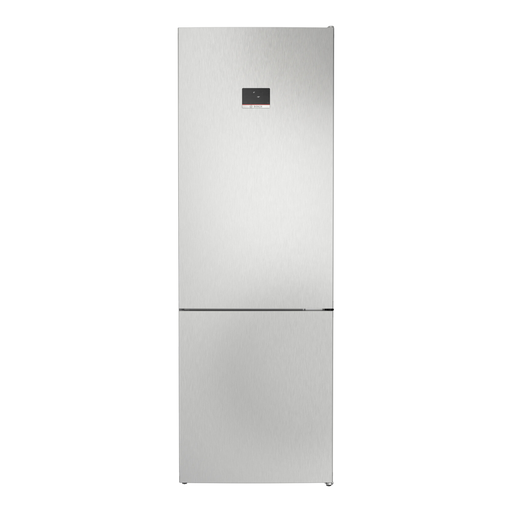 Image unavailable
Worth considering if you want a large capacity for both fresh and frozen food in one appliance. The product name gives a total capacity of 440 L and an energy rating of D. Check the capacity of each compartment and the kWh/year figure on the exact model’s label.
Also check the access route dimensions and required clearances before choosing where to put it.
 Image unavailable
Consider this if your kitchen needs a built-in fridge freezer rather than a freestanding model. The product name lists a capacity of 252 L, No Frost and an energy rating of C. Compare the fresh and frozen capacities, as well as the kWh/year figure, on the exact model’s label.
Before ordering, check the instructions against your housing dimensions, door fitting and required clearances.
 Image unavailable
Worth considering if you regularly need plenty of room for both fresh and frozen food. The product name lists a capacity of 467 L, Total No Frost and an energy rating of E. Check the product details and energy label for the capacity of each compartment and the kWh/year figure.
Measure the space and access route. Also check that the doors can open fully in your kitchen layout.
 Image unavailable
Consider this if you’re looking for a three-door fridge freezer to meet regular freezing needs. The product name lists a capacity of 360 L, Total No Frost, Wi-Fi, My Zone and an energy rating of E. Compare the capacity of each compartment and the kWh/year figure with your needs.
Check the available space, door opening and energy label figures for the exact model.
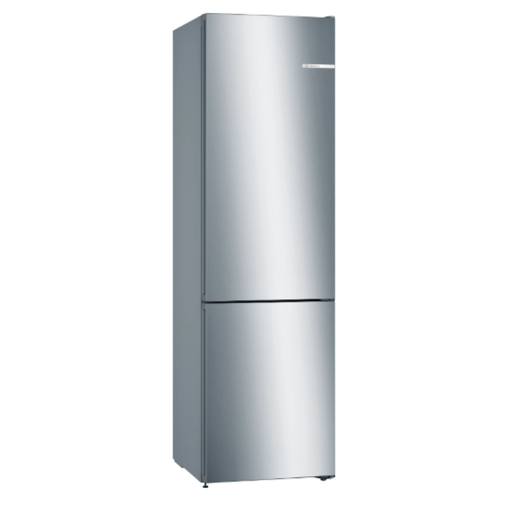 Image unavailable
Worth considering if a total capacity of 368 L meets your storage needs in a single appliance. The product name lists an energy rating of E. Check the capacity of each compartment and the kWh/year figure separately on the exact model’s label.
If the appliance will be near a living area, check its noise level in dB before making your choice.
Compare the energy rating, kWh/year, compartment capacities and noise level of appliances that meet the same needs. European Delegated Regulation 2019/2016 covers the energy labelling of mains-powered refrigeration appliances with a volume greater than 10 L and less than or equal to 1,500 L. Public information for the models concerned is also available in the European Commission’s EPREL database.
Multiply the model’s stated annual energy consumption in kWh by your current electricity price per kWh, including VAT. ADEME’s average consumption figures provide a guide for each appliance type, but they don’t predict your bill or the energy consumption of a specific model.
No, you can’t say without comparing the models and the capacity you need. Add together the kWh/year figures for the fridge and freezer you’re considering, then compare the total with the kWh/year figure for a fridge freezer that can provide the same storage.
Arrange for it to be collected or take it to an appropriate collection point for waste electrical and electronic equipment. France’s Ministry for Ecological Transition notes that these appliances can contain components, including greenhouse gases, that need to be handled through an appropriate treatment process. Arrange collection before delivery if needed.
Measure the housing and access routes, then check the fitting system, opening direction and required clearances in the instructions for the model you’ve chosen. Electrolux and Liebherr model specifications show that dimensions and door fittings vary from model to model.