Households that buy lots of frozen food
If you do a big weekly shop, look at the capacity for fresh food and the freezer separately. The total capacity doesn’t tell you how much space is available for each type of food.


If you shop once a week or less often, start by working out how much space you need for fresh and frozen food. Then check that the appliance can be delivered, installed and opened in your kitchen. A fridge freezer combines both uses in one appliance. A multi-door model or two separate appliances may be better if you need more storage or freezer space, as long as you have room for them and compare their energy use and noise levels.
If you do a big weekly shop, look at the capacity for fresh food and the freezer separately. The total capacity doesn’t tell you how much space is available for each type of food.
The appliance’s width isn’t the only thing to consider. Check the delivery route, how the doors open and the clearances required for ventilation.
If your kitchen is close to your living space, compare the dB(A) rating and noise class. To keep electricity costs in check, compare the kWh/year figures of models with similar storage capacity, as recommended by ADEME.
Choose this if: you want to store fresh and frozen food in one appliance and don’t have room for two full-height units.
Bear in mind: the freezer space may not be enough for a big shop with lots of frozen food, even if the total capacity looks sufficient.
Choose this if: you need wide storage spaces for your shopping and have a suitably sized kitchen.
Bear in mind: its width and doors may make it harder to move through your home and install. Check the exact model.
Choose this if: you need enough freezer space to justify sizing the two appliances independently, perhaps with a single-door fridge.
Bear in mind: you’ll need space for both appliances and should check the energy use and noise level of each one.
| Criterion | What to check | Who should consider this? |
|---|---|---|
| Fresh and frozen capacity | Compare the capacity in litres of each compartment with what you usually buy, rather than focusing on the total capacity alone. | If I need to freeze a large part of my shop, I want to know how much space will be left for fresh food. Around 31% of consumers prioritise this balance. |
| Installation and doors | Measure the space and delivery route, then check the door clearance and the gaps required according to the instructions. | In a small kitchen, a larger appliance is no use if it can’t be installed or opened properly. This is the priority for around 31% of consumers. |
| Energy use and noise | For models with the right capacity for your needs, compare the kWh/year figures, dB(A) ratings and noise class shown on the energy label. | If my fridge is near a living space, I want to consider everyday noise as well as electricity use. Around 19% of consumers put these factors first. |
| Internal layout | Check how easy it is to reach the drawers and how the shelves are arranged, while making sure not to block the airflow. | After a big shop, I need to be able to put food away and find it again without overfilling the compartments. Around 19% of consumers prioritise ease of use above other criteria. |
Two appliances with a similar total capacity may offer very different amounts of space for fresh and frozen food. If the freezer is too small, you may need to change what you buy.
Work out how much space you need for each type of food, then check the capacity of each compartment on the energy label and in the model’s product details.
A wall, nearby unit or narrow doorway could make installation or access to the storage spaces difficult. The appliance also needs room around it for ventilation.
Check the delivery route, door clearance and the model’s instructions. Whirlpool recommends 5 cm above and 10 cm behind its freestanding fridges; built-in models have their own specifications.
Anses recommends not overfilling your fridge, so that air can circulate, and keeping the temperature at 4 °C in its coldest area.
Choose storage spaces that suit your shopping and leave enough room for air to circulate.
The energy rating on its own doesn’t tell you how much energy appliances use when their capacities and uses differ. ADEME notes that size and excess capacity can affect electricity costs.
Compare the kWh/year figures of models that can store your shopping, then check their compartment capacities and noise levels.
The range includes fridge freezers.
Its range includes both fridge freezers and side-by-side fridge and freezer sets.
The multi-door range may suit households looking for wide storage spaces.
The brand offers built-in fridge freezers, which you can compare based on the space available.
These models combine fridge and freezer space in one multi-door or side-by-side appliance. If you’re considering two separate appliances, compare their space requirements and features individually.
 Image unavailable
Worth a look if you want to store fresh and frozen food in one four-door appliance.
Listed total capacity of 467 L, Total No Frost and energy rating E.
Check the capacity of each compartment, the delivery route and the space needed to open the doors.
 Image unavailable
Worth considering if your kitchen can accommodate a multi-door model for a mix of fresh and frozen food.
Listed total capacity of 495 L and energy rating E.
Check the capacity of each compartment, the door clearance and the model’s connection requirements if you plan to use a water dispenser.
 Image unavailable
Worth a look if frozen food makes up a large part of your shop and you have enough room for this style of appliance.
Listed capacities of 333 L for the fridge and 192 L for the freezer; No Frost, 37 dB and energy rating E.
Before choosing, check the installation dimensions, door clearance and the model’s stated annual energy use.
 Image unavailable
Worth considering if you’re looking for a single 444 L appliance for shops made less often.
The product name indicates frost-free operation, 40 dB and energy rating E.
Check how many litres are available in each compartment, then measure the space and access route before ordering.
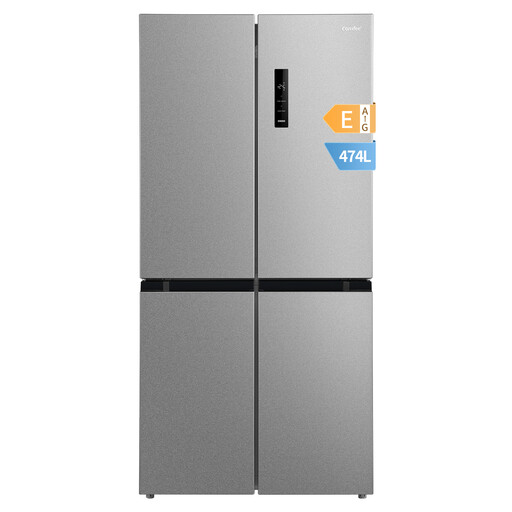 Image unavailable
Worth a look if you want to organise a big shop in a four-door appliance.
Listed total capacity of 474 L, a three-temperature crisper drawer and energy rating E.
Compare the fridge and freezer capacities, kWh/year and noise level; also check the space needed for the doors and ventilation.
Work out how much space you need for fresh and frozen food separately. Que Choisir gives a general guide of 100 to 150 L for one person, plus 50 L for each additional person. Then adapt the two compartments to the size of your household and what you usually buy.
Measure the space, delivery route and room needed to open the doors and ventilate the appliance. Whirlpool recommends 5 cm above and 10 cm behind for its freestanding models. For a built-in model, follow the niche measurements and instructions in its manual.
Compare annual energy consumption in kWh, the capacity of each compartment and the noise information, as well as the energy rating. The European Commission says this information appears on fridge and freezer energy labels. Start by choosing models that meet the same storage needs.
No. You also need to be able to store food without blocking the airflow. Anses recommends keeping the temperature at 4 °C in the coldest area of the fridge and avoiding overfilling it.
First compare the fridge and freezer capacities you need, then consider the space they take up, their noise levels and the kWh/year figures for the models you’re looking at. If you’re considering two appliances, check the specifications of each one rather than estimating their energy use from a general average. ADEME notes that size and features affect electricity costs.