First, work out how much space you need for meals to keep chilled and portions to freeze, then check that your containers will fit on the shelves and in the drawers. A fridge-freezer suits you if you need to switch between the two types of storage; a separate freezer is a better choice if your priority is building up a stock of frozen food and you have room for a second appliance. Compare the capacity of each compartment, the dimensions, noise level and annual energy consumption rather than looking only at the total capacity.
Who are these options for?
Households that mainly prepare meals to keep chilled
If you eat your meals within a few days of preparing them, look at shelf height, space for containers and how easy it is to see your food before choosing a large freezer. ADEME recommends taking stock of what you have and organising your fridge regularly.
Households that alternate between chilled meals and frozen portions
If you keep some meals in the fridge and freeze the extra portions, the usable capacity of each compartment matters more than the total capacity. The EU energy label lists the capacity of each compartment separately.
Households building up a stock of frozen food
If you prepare lots of portions to freeze, check the capacity and drawer layout. A separate freezer does, however, need its own space and runs alongside the fridge you use for fresh food.
What should you prioritise?
Decide how many meals you’ll keep chilled and how many you’ll freeze before choosing an appliance style. Then check the space available, both inside and out.
Fridge for meals you’ll eat soon
Worth considering: you mainly keep fresh ingredients and meals to eat over the next few days.
Trade-off: this option leaves little room to build up a stock of frozen portions, so organising and keeping track of your food remains essential.
Fridge-freezer
Worth considering: you regularly need chilled storage for upcoming meals and freezer space for extra portions.
Trade-off: the space is split between two compartments; a high total capacity doesn’t guarantee that the freezer section will fit your portions.
Separate freezer
Worth considering: your main priority is organising and storing a stock of frozen meals.
Trade-off: you’ll need space and a power supply for a second appliance, but it won’t give you more room in the fridge for fresh ingredients.
| Criterion |
What to check |
Who should consider it? |
| Capacity split |
Compare the usable capacity of the fridge and freezer separately, then check how much room your usual meals will take up. |
When I prepare meals to eat soon and freeze the extra portions, I want enough room in each compartment without choosing an oversized appliance. Around 33% of consumers prioritise this balance. |
| Frozen storage |
Check the freezer capacity and drawer sizes against the number and size of your portions. |
If I cook in batches to build up a stock, I want to organise my portions and find them easily. Freezer capacity is the main priority for around 27% of consumers. |
| Internal storage |
Check the shelf height and usable dimensions of the compartments using your own containers and dishes. |
My meals come in different shapes and sizes, and I want to see the food I need to use before I forget about it. Around 20% of consumers therefore prioritise the internal layout. |
| Installation and running costs |
Measure the space and delivery route; compare the annual energy consumption in kWh and noise level in dB of the models you’re considering. |
When space is limited or the appliance will be close to living areas, I want the right capacity without overlooking its size, noise level and energy consumption. These considerations come first for around 20% of consumers. |
ADEME recommends planning meals and checking what you have to avoid buying duplicates. The information on the EU energy label includes details such as capacity, annual energy consumption and noise level, making it useful for comparing appliances.
Mistakes to avoid before you buy
-
Looking only at the total capacity
Two fridge-freezers with a similar total capacity may split the space differently between the fridge and freezer. The EU energy label lists these capacities separately.
Make a note of the meals you’ll chill, the portions you’ll freeze and the fresh ingredients you use in a typical week, then compare both compartments on the exact model you’re considering.
-
Measuring the kitchen but not the delivery route
An appliance may fit in its intended spot but not through a doorway, along a hallway or in a lift. An integrated model must also fit the housing unit.
Note down the dimensions of the appliance and its packaging, measure the entire route to the kitchen and check the manufacturer’s installation requirements.
-
Relying on No Frost to manage your meals
Manufacturers describe No Frost as a feature for managing frost, not as a substitute for keeping track of or organising your food.
Check the drawers and shelves, label your portions and make organising your food part of your routine. ADEME recommends taking stock and identifying products that need to be used.
-
Forgetting what to do with your old appliance
In France, used fridges and freezers are handled through the collection scheme for waste electrical and electronic equipment, as described by the ministry responsible for the ecological transition.
Before delivery, find out whether collection of your old appliance is available with your order or locate a suitable collection point.
Brands to consider when comparing models
Bosch
Bosch’s product specifications for the freestanding KGN392XCF and integrated KIN86SFE0 fridge-freezers let you compare two different capacity splits.
- Bosch lists 260 L of fridge capacity and 103 L of freezer capacity for the KGN392XCF, compared with 184 L and 76 L for the KIN86SFE0.
- These figures apply to these two models. Check the configuration and dimensions of the model you’re considering.
Liebherr
Liebherr’s product specifications let you compare both a large fridge-freezer and separate freezers in different sizes.
- Liebherr lists a total capacity of 485 L for the CNsfa 7723 fridge-freezer; its freezer range includes models with capacities of 92 L and 260 L.
- Extra freezer capacity requires a suitable space. The frost-management features listed by the brand don’t replace organising your portions.
Samsung
The Samsung BRB30600EWW integrated fridge-freezer shows why it’s worth checking the settings for a dedicated zone as well as the available capacity.
- Samsung lists a total capacity of 298 L for this model and a Cool Select+ zone with adjustable temperatures from −23 °C to 2 °C.
- Check the capacity of each compartment, the housing dimensions and the settings for the exact variant. The food preservation benefits highlighted by the brand are not an independent measure.
Fridges and freezers available on Joybuy
These models include fridge-freezers that split the space between fresh meals and frozen portions, as well as a separate freezer for building up a stock. Compare their capacity with your habits and check the usable dimensions before choosing.
 Image unavailable
Candy CFQQ5T817EPS, 467 L four-door fridge-freezer
Worth considering if you keep both chilled meals and frozen portions, and have room for a 467 L appliance.
The model name lists four doors, Total No Frost and an E energy rating. Check the capacity split and internal dimensions against your containers.
View on Joybuy
 Image unavailable
CHiQ JR227LSE, 227 L fridge-freezer
Worth considering if you want to split your chilled and frozen meals between the compartments of a 227 L fridge-freezer rather than choosing a large model straight away.
The model lists 153 L of fridge capacity, 74 L of freezer capacity, a width of 54 cm, Low Frost and an E energy rating. Measure the available height too, and compare annual energy consumption before you buy; Low Frost doesn’t mean No Frost.
View on Joybuy
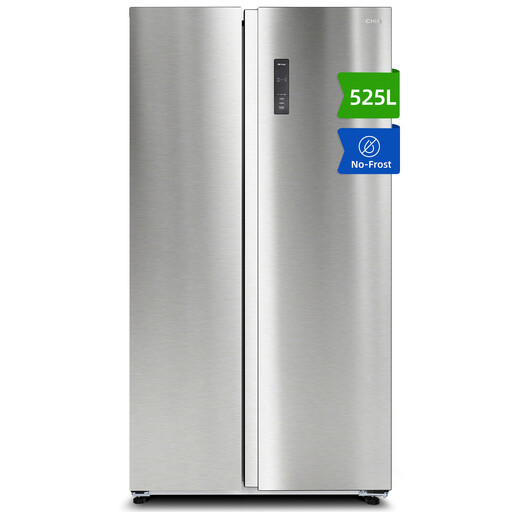 Image unavailable
CHiQ JR525WSE, 525 L side-by-side fridge-freezer
Worth considering if you need plenty of room for both fresh ingredients and frozen portions, provided this style suits your home.
The model lists 333 L of fridge capacity, 192 L of freezer capacity, No Frost, 37 dB and an E energy rating. Measure the space and delivery route, then check the internal layout for your meals.
View on Joybuy
 Image unavailable
Samsung RF50C530EB1, 495 L multi-door fridge
Worth considering if you need to store a large quantity of meals and ingredients, provided this capacity is right for your household.
The model is listed with a capacity of 495 L and an E energy rating. Compare the capacity of each compartment and the usable dimensions of the shelves and drawers before choosing your containers.
View on Joybuy
 Image unavailable
Heinrich’s, 161 L No Frost freezer
Worth considering if your priority is organising a stock of frozen portions and you already have a solution for food that needs to stay chilled.
The product name lists a capacity of 161 L, three freezer drawers, No Frost and a C energy rating. Make room for this second appliance and check its external dimensions.
View on Joybuy
Frequently asked questions
How do you compare two appliances with different capacities?
First compare the space available in each compartment with the portions you plan to store there. The EU energy label lists storage capacity, annual energy consumption and noise emissions. Compare these details for the exact models you’re interested in, then check their internal dimensions.
Is a fridge-freezer enough for preparing meals for several days?
A fridge-freezer may suit you if the fridge section holds the meals you’ll eat soon and the freezer section fits the portions you want to keep for longer. If building up a stock of frozen food is your main priority, compare it with a separate freezer, taking into account the space and energy consumption of an extra appliance.
Does No Frost make it easier to find and manage prepared meals?
No. No Frost doesn’t replace organising your meals: manufacturers describe this feature in relation to frost build-up. To find your meals easily, check the size of the drawers and shelves, label your portions and organise your food regularly.
What should you measure before a large fridge or freezer is delivered?
Measure the intended space and the whole delivery route, including doorways, hallways and the lift. For an integrated model, also check the housing dimensions and the door-fixing system required for the exact model.


