Buying priorities
Start by working out how much capacity you really need, then compare the information on the energy label with the installation requirements for the exact model.
| Priority |
What to check |
Your needs |
| Continuous energy consumption |
Compare kWh/year between appliances of the same format and with similar capacities. The A to G energy class is a useful guide, but it does not replace this comparison. The European Commission states that the label also shows capacity and airborne acoustical noise emissions. |
I want to reduce electricity use without choosing an appliance that is too small or unnecessarily large. |
| Usable capacity |
Check the litres allocated to fresh and frozen food separately. For a built-in appliance, also check the overall dimensions and the dimensions of the housing unit. |
My fresh and frozen food must fit without forcing me to add a second appliance. |
| Frost and maintenance |
Confirm whether the model you are considering has No Frost or Low Frost. Also check the alarms and temperature settings if they are important for the way you use it. |
I would rather minimise manual defrosting, especially if the freezer is opened frequently. |
| Noise and placement |
Check the dB figure and the noise class on the label. Confirm the door-opening direction, required ventilation and clearance around the appliance. |
In an open-plan kitchen or a small home, I want continuous operation to remain discreet and compatible with the available space. |
Joybuy products
Joybuy options covering standalone refrigeration, fresh-and-frozen fridge freezers and separate freezers for this choice of continuously powered appliance.
 Image unavailable
Haier HTW5618ENMG three-door fridge freezer 360 L
For a household that wants fresh and frozen food together in one appliance, with separate compartments.
Listed specifications include 235 L of fridge capacity, 125 L of freezer capacity, 271 kWh/year, an E rating and 35 dB(A). Total No Frost, reversible door and dimensions of 185 × 59,5 × 66,7 cm are also stated.
Check ventilation clearances and access space before installation.
Joybuy
 Image unavailable
CHiQ JR263LGE Low Frost fridge freezer 262 L
An option for a household looking for a slimline fridge freezer with a clearly defined split between fresh and frozen food.
Listed specifications include 187 L of fridge capacity, 75 L of freezer capacity, 215 kWh/year, an E rating and 39 dB(A). A width of 54 cm, height of 176 cm and reversible door are also stated.
Low Frost reduces frost build-up but does not eliminate manual defrosting; the appliance is specified for an ambient temperature of 16 to 38 °C.
Joybuy
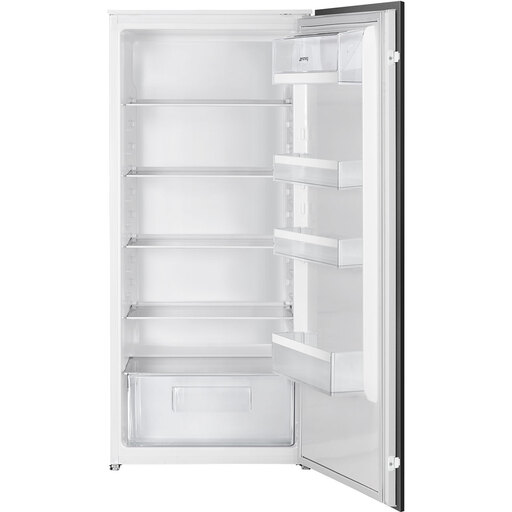 Image unavailable
SMEG S4L120E built-in one-door fridge
For households that use little frozen food and want a built-in appliance dedicated to fresh produce.
Listed specifications include 101 kWh/year, an E rating, automatic defrosting, 34 dB and dimensions of 54,8 × 121,8 × 54,9 cm.
Before buying, check the exact net capacity, housing-unit dimensions, door-panel fixing system and ventilation requirements.
Joybuy
 Image unavailable
AEG NSC6M18FES built-in fridge freezer 249 L
For a built-in kitchen that needs separate compartments for fresh and frozen food.
Listed specifications include 186 L of fridge capacity, 62 L of freezer capacity, TwinTech Total No Frost, 37 dB(A), reversible doors and sliding-hinge fixing.
Check the energy label, housing-unit dimensions, compatibility with your sliding door panel and your kitchen’s ventilation.
Joybuy
 Image unavailable
Heinrich’s No Frost upright freezer 161 L
An option for regular frozen-food storage when the capacity justifies a separate appliance.
Listed specifications include a net capacity of 161 L, a C rating, No Frost, three drawers, two shelves, an LED display, an alarm and a reversible door.
Check the label for kWh/year, as well as noise level, dimensions, ventilation and the permitted installation temperature range.
Joybuy
Frequently asked questions
How should I compare two fridges or freezers to reduce energy consumption?
Compare appliances of the same type and with similar capacities using the kWh/year shown on the energy label, then look separately at fridge and freezer capacity. The European Commission states that the A to G label also provides information about capacity and airborne acoustical noise emissions; the QR code provides access to detailed information in EPREL.
Does a large fridge always cost more to run?
Size is an important factor, but it is not the only one. ADEME states that newer models can be more energy efficient, while greater size and excessive features can increase consumption. Choose the usable capacity you need and compare the kWh/year of comparable models.
Does No Frost automatically reduce electricity consumption?
No. No Frost mainly limits frost formation and the need for manual defrosting when it is included on the model. To assess energy consumption, always check the kWh/year shown for the exact model rather than assuming a saving based solely on the No Frost label.
Can I claim the Bonus Réparation for a fridge or freezer in France?
Yes, subject to conditions. According to ecosystem, as at 1 January 2026, the Bonus Réparation is €25 for a fridge, freezer or fridge freezer. The appliance must be owned by a household, purchased in France, no longer covered by a warranty or insurance, and have an eligible fault. The amount is deducted from the invoice by a QualiRépar-accredited repairer.
What should I check before buying a built-in fridge freezer?
Check the height, width and depth of the housing unit, the fixing or hinge system, the door-opening direction and the ventilation specified in the instructions. Two built-in fridge freezers may require housing units 56 cm or 69 cm wide, so they are not necessarily interchangeable.


