Which criteria should you compare first?
Fridge with a small freezer compartment
Worth considering: if you mainly store fresh food and rarely need an integrated freezer.
Bear in mind: check the freezer compartment on the exact model and how you’ll store your frozen food.
Fridge-freezer
Worth considering: if you regularly use both fridge and freezer space in the same appliance.
Compare: two fridge-freezers can divide their capacity very differently between fresh and frozen food.
Separate freezer
Worth considering: if your frozen food takes up more space over time than you can comfortably fit in a fridge-freezer.
Bear in mind: you’ll need space and power for a second appliance, and should check its annual energy consumption separately.
Once you’ve chosen the configuration, compare the usable capacity with the energy information and the constraints of your kitchen.
| Criteria |
What to check |
How it suits my needs |
| Annual energy consumption |
Check the kWh/year and energy rating on the label for the exact model. Compare these with its capacity and configuration, rather than looking at the rating letter alone. |
I want to take into account the energy use of an appliance that runs continuously, without choosing a capacity that’s too small for my needs. |
| Capacity and compartments |
Check the fridge and freezer capacities separately. For an upright freezer, also make sure its internal layout works for the way you store food. |
My needs for fresh and frozen food may not be the same: how the capacity is divided matters as much as the total. |
| Installation and noise |
Measure the space and check the required clearances. For a built-in model, check the housing space and hinges; also look at the stated noise level in dB. |
In a fitted kitchen or an open-plan living space, I need an appliance that fits the available space and suits my sensitivity to noise. |
| Convenience features |
Check whether it has the features you want, such as No Frost, rapid cooling or an alarm. Check the model’s kWh/year separately. |
A feature may suit my daily routine, but its name alone doesn’t tell me the annual energy consumption. |
A guide to selected brands
These examples show different configurations and points to check for specific models; they don’t represent every range from each brand.
Electrolux
Two built-in fridge-freezers from the brand let you compare total capacity with stated energy consumption.
- Electrolux France product information gives 249 L and 139 kWh/year for the ENC8MC18S, compared with 269 L and 220 kWh/year for the LND5FE18S.
- These models have different capacities, so their figures alone can’t show how a particular cooling feature affects energy consumption.
Bosch
Bosch built-in fridge-freezer product information gives you details to check installation and selected features of the model you’re considering.
- Bosch Home Appliances France lists sliding hinges for the KIV875SE0 and a noise class of B, at 30 to 35 dB, for the KIN86SFE0.
- A feature listed for one model shouldn’t be assumed to apply to another Bosch fridge-freezer: check its own product information and manual.
Liebherr
A fridge from this brand may be a good starting point if you mainly need space for fresh food.
- Check the total capacity, dimensions and noise level of the model you’re considering against the needs of your kitchen.
- Check the exact configuration of the freezer compartment and the energy label before comparing it with a fridge-freezer.
Whirlpool
The WHFF 6403 W4E upright freezer is an example of a separate option for storing frozen food.
- Whirlpool France lists a freezer capacity of 404 L, energy consumption of 292 kWh/year and a noise level of 38 dB for this model.
- These specifications don’t mean that adding a freezer is right for every household; consider the space available and whether you need extra storage long term.
Fridge-freezers available on Joybuy
These models combine refrigeration and freezing in one appliance. If that suits your needs, they offer a range of fridge-freezer capacities and formats to consider. Check the energy label and installation requirements for the model you choose.
 Image unavailable
Hisense RB3B250SAWC built-in, 252 L
A fridge-freezer to consider if you want to store fresh and frozen food in one appliance in a fitted kitchen. Its product title lists a 252 L capacity, No Frost, an Inverter compressor and a C rating. Check the housing dimensions and installation instructions, then check the energy label for this model.
View on Joybuy
 Image unavailable
Samsung RB33B612EBN, 344 L, black
This fridge-freezer is worth considering if you’re looking for a stated capacity of 344 L for fresh and frozen food. Its product title specifies an E rating. Measure the space, check the ventilation clearances in the manual and check the model’s energy label.
View on Joybuy
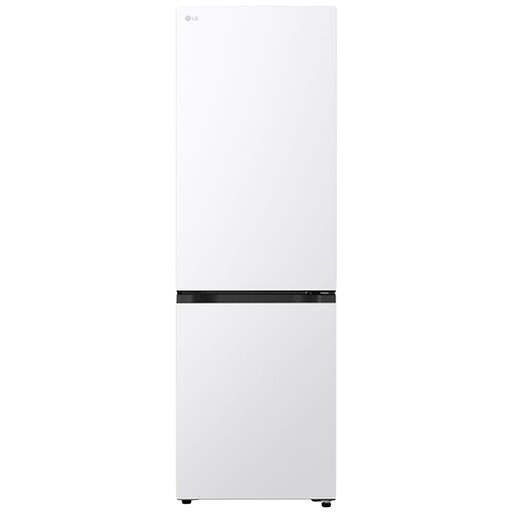 Image unavailable
LG GBBSJ1CCSW, 333 L, white, C-rated
This 333 L fridge-freezer is worth considering if you regularly store fresh and frozen food. Its product title lists a C rating, along with NatureFRESH™, DoorCooling+™ and LinearCooling™ features. These don’t replace checking the kWh/year on the energy label. Also check the clearances needed for installation.
View on Joybuy
 Image unavailable
Candy CFQQ5T817EPS four-door, 467 L
This multi-door fridge-freezer is worth considering if your usual storage needs justify its stated 467 L capacity. Its product title specifies an E rating, Total No Frost, a Smart Inverter system and a silver finish. Check the available space and installation clearances before choosing this format.
View on Joybuy
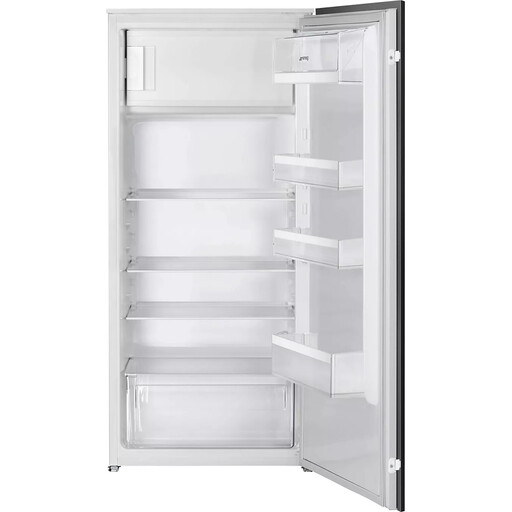 Image unavailable
SMEG S4C122E built-in, 188 L
This single-door model with a freezer compartment at the top is worth considering if you use most of your storage space for fresh food. Its product title lists a capacity of 188 L and an E rating. Check that the freezer compartment suits your needs, as well as the housing space and installation system; the furniture door isn’t included.
View on Joybuy
Frequently asked questions
What should you compare on an appliance’s energy label?
For models sold in France, check the energy rating, stated annual consumption in kWh, compartment capacities and noise emissions. Delegated Regulation (EU) 2019/2016 covers energy labelling for refrigerating appliances. Then compare this information with the configuration you need.
Is the energy rating enough to choose between two fridge-freezers?
No: check their kWh/year and usable capacities too. For example, Electrolux France product information lists 139 kWh/year for 249 L on the ENC8MC18S and 220 kWh/year for 269 L on the LND5FE18S. These models have different capacities, so their energy consumption shouldn’t be compared without taking that into account.
What should you check before ordering a built-in fridge-freezer?
Compare the dimensions of your housing space with those required in the manual, then check the depth, hinges and installation instructions for the exact model. As two separate examples, Electrolux France lists a 1,780 mm housing height for the ENC8MC18S, while Bosch Home Appliances France specifies sliding hinges for the KIV875SE0.
How can you check after-sales and spare parts information?
Check the documentation for the exact model, information about its spare parts, and the service and warranty terms provided by your chosen seller. Bosch Home Appliances France, for example, has spare parts and service sections for the KIV875SE0; check the applicable terms before buying.


