What to check before replacing an appliance
First compare appliances designed for the same purpose and with a similar capacity, then relate the label figures to your actual usage pattern.
| Priority |
What to check |
Your needs |
| Appliance to examine first |
For refrigeration, note the kWh/year and compare appliances with similar capacities and configurations. For a dishwasher or oven, start with the label’s reference unit and your usage frequency. |
I want to know whether an appliance used 24 hours a day or equipment used frequently is genuinely worth investigating before other options. |
| Volume and capacity |
Compare the litre capacity of the fridge and freezer compartments, or the number of place settings for a dishwasher. Check whether permanent features, such as ice-making, are essential. |
My new appliance must meet my usual storage or load requirements without steering me towards an unnecessarily large capacity. |
| The right comparison unit |
For a dishwasher, calculate kWh/100 Eco cycles × annual number of cycles ÷ 100. For an oven, compare kWh/cycle using conventional or fan-assisted heat, depending on the mode used. |
I want to compare figures that reflect my usage, rather than looking at an energy class or rated power in isolation. |
| Service life and repairs |
For a dishwasher, check the repairability index for the exact model and the information available about spare parts. In France, the repairability index applies to dishwashers among other products, according to the ministry responsible for ecological transition. |
If my current appliance is still usable, I want to weigh up replacement, repairability and the expected period of use. |
Joybuy options for this topic
This selection brings together compact dishwashers and refrigeration appliances to compare with your current appliance, usable capacity and frequency of use.
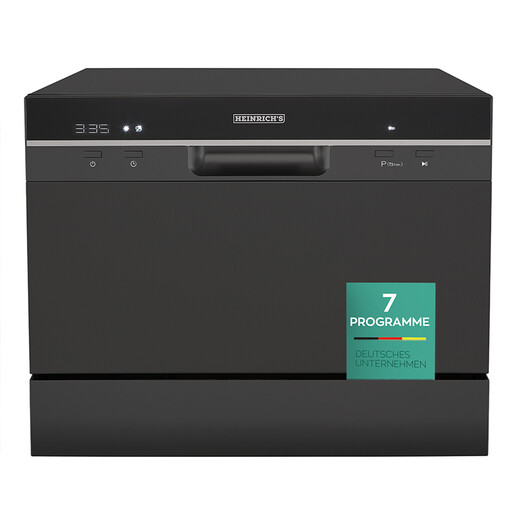 Image unavailable
Heinrich's HTG 8840 table-top dishwasher, 6 place settings
A compact option for a small household that can tailor its cycles to a 6-place-setting capacity.
The product information states 49 kWh/100 uses, 6.5 L per cycle, 7 programmes and a 215-minute Eco programme.
Check that the capacity avoids the need for multiple cycles, and consult the exact model’s repairability index before buying.
View on Joybuy
 Image unavailable
Candy CFQQ5T817EPS multi-door fridge-freezer, 467 L
For comparison with a large-capacity refrigeration appliance that runs continuously.
The stated consumption is 290 kWh/year, with 311 L of fridge space and 156 L of freezer space.
Check that the dimensions of 181.5 × 83.3 × 65.0 cm, the freestanding installation and this capacity suit your home and household.
View on Joybuy
 Image unavailable
Sonlu CC-520WE fridge-freezer, 444 L
A large-capacity format to assess against a genuinely high storage requirement.
The product information states 289 kWh/year, a total capacity of 444 L, a frost-free system and a noise level of 40 dB.
Before comparing it with your old appliance, check the respective capacities of the fridge and freezer compartments.
View on Joybuy
 Image unavailable
Samsung RF50C530EB1 multi-door fridge, 495 L
Consider this only if your household genuinely uses very large storage compartments.
The product information states 301 kWh/year, 330 L of fridge space, 165 L of freezer space and a total capacity of 495 L.
Check the dimensions of 177.6 × 81.7 × 71.5 cm, the clearance required and the installation requirements for the water and ice dispenser.
View on Joybuy
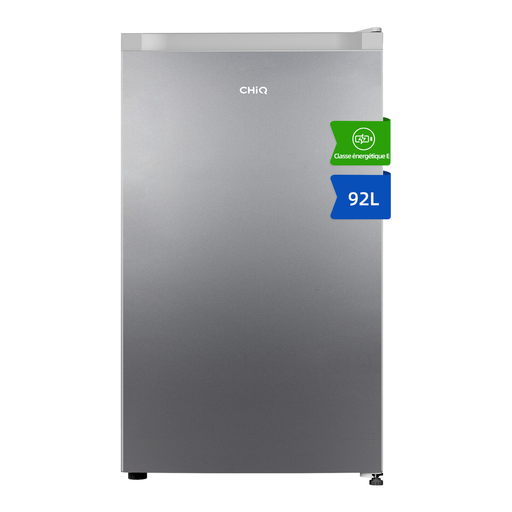 Image unavailable
CHiQ JR92DSE single-door fridge, 92 L
A compact solution when limited space is the main concern rather than storing food for an entire household.
The model offers 92 L of capacity, a width of 47 cm, a reversible door and a compact freezer compartment.
Check the kWh/year on the label or model information, as well as the freezer compartment capacity, before assessing it as a way to reduce consumption.
View on Joybuy
Frequently asked questions
Which figure should I compare for a fridge or freezer?
Compare kWh/year between appliances of a similar type and capacity. The European Commission states that the label also gives the compartment volumes and noise level; these details help you check that the models meet the same storage requirement.
How can I estimate a dishwasher’s annual consumption from the label?
Divide the Eco programme’s kWh/100 cycles by 100, then multiply the result by the number of cycles your household realistically expects to run in a year. Also check litres per cycle, place settings, Eco programme duration and noise level.
Is the Eco programme the right basis for comparing two dishwashers?
Yes, for a regulated comparison: the label expresses consumption for 100 reference cycles of the Eco programme. ADEME and the European Commission present this programme as the basis for comparison, but it must still suit your washing routine.
Does an electric hob have an energy label comparable to that of an oven?
No. The European Commission states that energy labelling is mandatory for ovens and cooker hoods, while hobs are covered by ecodesign requirements. For an oven, compare kWh/cycle according to the cooking mode; for a hob, do not infer annual consumption from its rated power alone.
Is the repairability index useful when buying a dishwasher in France?
Yes, it complements the energy label for dishwashers covered by the scheme. The ministry responsible for ecological transition explains that this score out of 10 indicates how repairable a product is; it does not replace checking spare parts, capacity, consumption or installation requirements.


