To store your household’s fresh food shopping, start with the space you actually have, the usable fridge capacity you need and the internal layout, rather than the total capacity alone. A single-door fridge is suitable if you don’t need an integrated freezer; a fridge-freezer gives you space for both fresh and frozen food, while a multi-door fridge needs careful consideration of its overall dimensions and delivery access. Whatever the style, compare the model’s energy consumption and check that its coldest area can be kept between 0 °C and 4 °C, in line with Anses recommendations.
Who are these criteria for?
Households that buy plenty of fresh food
If you stock up on fresh food, ready meals and perhaps some frozen food for several days at a time, check the usable capacity of each compartment. Shelf and drawer layouts also matter, helping you store food without piling it up.
Kitchens with limited space
If you’re fitting the appliance into an alcove, placing it near a wall or moving it through a narrow accessway, measure both the appliance and its route into the kitchen. Also check the manual for door-opening requirements and the clearances needed for installation.
Households mindful of energy use
A fridge runs continuously. ADEME recommends using the energy label as a guide: compare the annual energy consumption of models whose capacity and features meet your needs, without choosing one that’s too small for your food shopping.
Which criteria should you prioritise?
First, choose a format that suits your storage needs, then check each model’s capacity split, installation requirements and energy consumption.
Single-door fridge
Consider this if: you mainly buy fresh food and don’t need an integrated freezer.
Bear in mind: this format doesn’t provide space for both fresh and frozen food in the same appliance.
Fridge-freezer
Consider this if: your household regularly buys fresh and frozen food and you’d like to store both in one appliance.
Bear in mind: some of the total capacity is used for freezing, so the space available for fresh food varies between models.
Multi-door fridge
Consider this if: you need plenty of capacity with separate storage areas and have enough room for the appliance.
Bear in mind: a large model can be harder to fit and deliver; check its energy consumption on the individual product label.
| Criteria |
What to check |
Who is this important to? |
| Capacity and storage |
Check the usable capacity for fresh food and freezing separately. See whether the shelves and drawers have room for the containers you usually use. |
After doing enough shopping to last several days, I want to store fresh food without squashing it. Around 33% of consumers put capacity and organisation at the top of their list. |
| Storage temperature |
Find the coldest area in the manual and check how to set and monitor its temperature. Anses recommends keeping this area between 0 °C and 4 °C. |
If my shopping includes perishable food, I want to be able to monitor its storage temperature. This is the main priority for around 27% of consumers. |
| Dimensions and installation |
Measure the space and delivery route; check the door swing and ventilation clearances against the model’s instructions. |
In a narrow kitchen or one with an alcove, the appliance needs to fit through the accessway and its doors must open properly. Around 20% of consumers prioritise these installation requirements. |
| Energy consumption and noise |
Compare the kWh/year, usable capacity and noise level shown on the label or product information for models intended for similar use. |
For an appliance that runs continuously, I want enough capacity without overlooking energy consumption or noise. This is the main priority for around 20% of consumers. |
What should you avoid before buying?
-
Looking only at the total capacity
On a fridge-freezer, this figure combines compartments used for different purposes. A high total capacity doesn’t necessarily mean there’s enough room for fresh food shopping.
Compare the usable capacity of each compartment and check whether the shelves, drawers and bins can accommodate the containers you usually use.
-
Measuring the kitchen, but not the access route or door clearance
An appliance may fit the space you’ve set aside but still be difficult to get into your home or use once its doors are open. Ventilation requirements vary by model.
Measure doorways, corridors and any lifts, then check the installation diagram, door swing and clearances in the manual.
-
Relying on a freshness zone without checking the temperature
A feature advertised on some models is no substitute for setting the fridge correctly and storing food appropriately. Anses recommends keeping the coldest point between 0 °C and 4 °C.
Check the temperature, follow the storage instructions on food packaging and avoid overfilling the fridge so air can circulate.
-
Comparing only the energy label rating
Two appliances with different capacities and features won’t necessarily meet the same needs, even if their ratings appear on the same scale.
For models with similar uses and capacities, compare the energy rating with the kWh/year, usable capacity and noise level shown on their labels.
Brands worth considering
Bosch
Its freestanding fridge-freezers offer different splits between fridge and freezer capacity to consider.
- Bosch Electroménager France lists 311 L for the fridge and 129 L for the freezer on the KGN492IAF; the KGN86VIEA is listed with 479 L and 152 L respectively.
- These capacities are for two specific models. Check their dimensions and energy labels too before comparing them for your kitchen.
Liebherr
The brand offers models focused on fresh food, as well as fridge-freezers, depending on whether your household needs an integrated freezer.
- Liebherr France lists a total capacity of 160 L for the RBa30 425i fridge and 320 L for the CBNsfc 5223 fridge-freezer.
- Liebherr describes the BioFresh zone on some models as being close to 0 °C, but you should still check the settings and the storage instructions for each type of food.
Electrolux
Its KNA7CE18S integrated fridge-freezer is worth comparing if you need an appliance to fit an alcove with specific dimensions.
- Electrolux France lists recess dimensions of 1780 × 560 × 550 mm for this model.
- Before choosing it, check your existing alcove and installation requirements against the installation diagram and manual.
Samsung
The RM70F63NER multi-door fridge can help you assess whether a large capacity will fit in your home.
- Samsung France lists a capacity of 648 L and a width of 912 mm for this model.
- Samsung advises checking that the boxed appliance will fit through doorways, corridors and lifts. These dimensions and this capacity don’t apply to all its multi-door models.
A single-door fridge available on Joybuy
This selection features an integrated fridge designed for fresh food storage, worth considering if you don’t need an integrated freezer. When comparing the formats discussed above, keep capacity, installation and energy consumption in mind too.
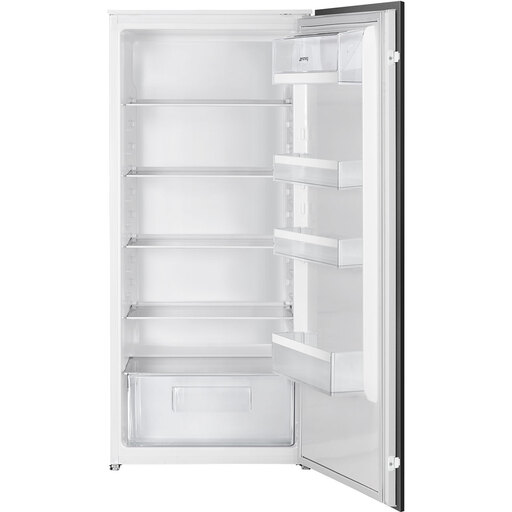 Image unavailable
SMEG S4L120E, integrated single-door fridge
Worth considering if you’re looking for an integrated appliance dedicated to fresh food. The product title gives it an energy rating of E, but the stated capacities differ, at 188 L and 208 L. Ask the retailer to confirm the usable capacity before deciding whether it suits your food shopping. Also check the manual for the required recess dimensions and clearances, and find out how the temperature can be adjusted.
View on Joybuy
Frequently asked questions
What temperature should I set my fridge to for fresh food?
Anses recommends a temperature between 0 °C and 4 °C at the coldest point. Check it especially when the kitchen is warm, the door is opened frequently or the fridge is very full. Also follow the food’s storage instructions.
Is a large capacity enough reason to choose a multi-door fridge?
No. The way capacity is divided and the space needed for the appliance matter too. For the RM70F63NER, which is listed as 912 mm wide, Samsung France advises checking that it will fit through doorways, corridors and lifts. Also make sure its doors can open fully in your kitchen.
How do I compare the energy consumption of two fridges?
Compare the kWh/year shown on the energy label with each model’s usable capacity and features, ideally for appliances intended for the same use. ADEME also presents the label as a way to compare noise levels, so check this figure if the appliance will be near a living area.


