Sleeping or working near your fridge
You share a room with the appliance and want to compare stated noise levels without assuming that one figure describes every sound it makes during its cycles.


In a studio flat, first choose a fridge that fits the space and suits your needs for fresh and frozen food. A table-top model isn’t automatically quieter than a fridge-freezer. Specifications from Liebherr, Beko and Bosch show that capacity, dimensions and stated noise levels vary between models. Compare their annual energy consumption too before making your decision.
You share a room with the appliance and want to compare stated noise levels without assuming that one figure describes every sound it makes during its cycles.
You need to fit the appliance into the space, open its door and still have enough room for fresh food. A table-top model could be an option, but it doesn’t guarantee lower noise levels.
You’ll need to check the freezer capacity separately: a small freezer compartment and the freezer section of a fridge-freezer won’t suit the same shopping habits.
First, measure the space and work out how much capacity you need for your shopping. Then compare the stated noise level and annual energy consumption of the models that fit.
| What matters to you | What to check before you buy | Who this matters most to |
|---|---|---|
| Noise near areas where you sleep or work | Compare the dB(A) re 1 pW rating and noise class for each exact model. These figures are different from an assessment of the sounds it makes during its cycles. | If I sleep or work in the room, I want to minimise disturbance without assuming the figure describes every cycle. Around 36% of consumers prioritise noise near areas where they sleep or work. |
| Overall size and capacity for fresh food | Check the height, width, depth, door opening and fresh-food compartment capacity of the exact model. | When space is tight, I want an appliance that fits without taking up too much of the room needed for fresh food. Around 29% of consumers put overall size and fresh-food capacity first. |
| Capacity for frozen food | Compare the fridge and freezer capacities separately against your shopping habits. | If I regularly buy frozen food, I want to know how much freezer space there is before choosing a small model. Around 21% of consumers prioritise frozen-food storage. |
| Energy consumption over time | Compare the kWh/year figures and energy ratings on the labels of your shortlisted models; actual consumption depends on how you use the appliance. | For an appliance used all year round, I want to compare the stated kWh figures once I’ve found models suited to the room. Around 14% of consumers prioritise energy consumption over time. |
Bosch states 39 dB for the KTR15NWEB table-top fridge and 35 dB for the KGN367LDF fridge-freezer. Comparing these two models shows that you can’t work out a stated noise level from the format alone.
Compare the rating and noise class of the exact model, after checking that its dimensions will fit the space.
For the Beko TSE1285N, the manufacturer states 101 l of fridge capacity and 13 l of freezer capacity. The total capacity alone therefore doesn’t tell you how much space is available for each use.
Check the fridge and freezer capacities separately before choosing between a table-top model and a fridge-freezer.
The KTe550 and CUele231-26 show two different formats, from a table-top model to a taller fridge-freezer.
The TSE1285N is an example of a table-top model with separate figures for fridge and freezer capacity.
The KTR15NWEB and KGN367LDF let you compare a table-top model with a fridge-freezer in a different size.
This selection includes compact models and fridge-freezers. Check their capacities and dimensions, as well as the stated noise level where one is provided, to make sure each model suits your space and habits.
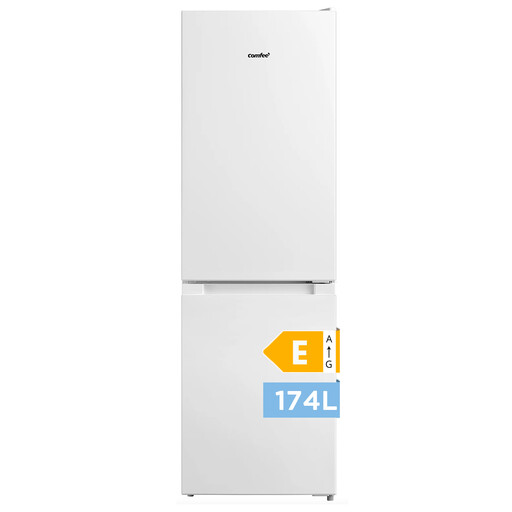 Image unavailable
Worth considering if you want fridge and freezer storage in one appliance for a compact living space.
The title lists 115 l for the fridge and 59 l for the freezer, Low Frost, 39 dB and energy rating E.
 Image unavailable
Worth considering if you’re looking for a compact-width fridge-freezer with a separate freezer compartment.
The title lists 153 l for the fridge, 74 l for the freezer, a width of 54 cm, Low Frost and energy rating E.
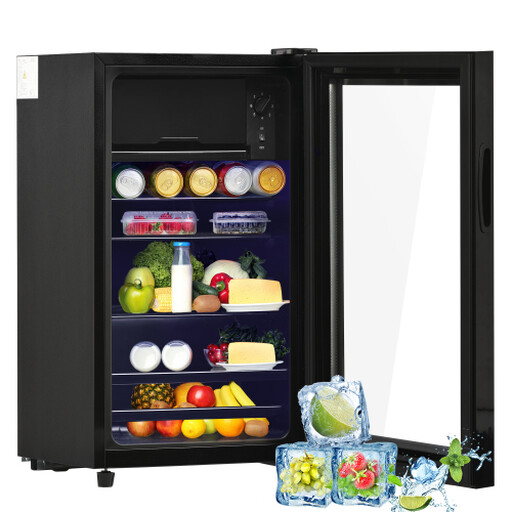 Image unavailable
Worth considering for a compact setup where a small ice compartment can complement the fridge space.
The title lists 70 l and a 6 l ice compartment. Check that these capacities suit your storage needs.
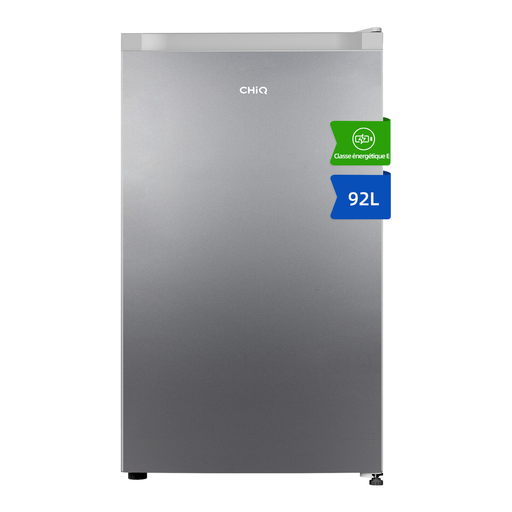 Image unavailable
Worth considering if you’re looking for a small single-door fridge with a compact freezer compartment.
The title lists a capacity of 92 l, a stated footprint of 0.22 m² and energy rating E. Check the detailed dimensions and door opening to make sure it suits your space.
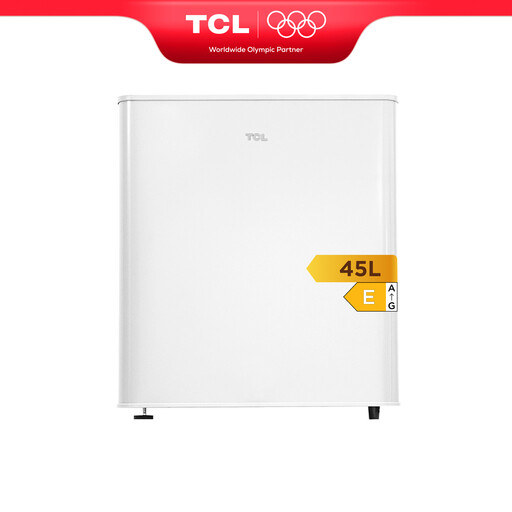 Image unavailable
Worth considering for keeping drinks and snacks cool in a compact table-top format.
The title lists a capacity of 45 l, adjustable feet and energy rating E. Consider whether this capacity suits your usual shopping.
It lets you compare stated emissions, but it can’t predict exactly how loud the appliance will seem next to a bed or desk. The European Commission gives these emissions in dB(A) re 1 pW alongside a noise class. Compare models on the same basis and distinguish these figures from an assessment of the sounds made during operating cycles.
Measure the space and check the dimensions and door opening, as well as fridge and freezer capacities separately. Que Choisir Ensemble gives 100 to 150 l as a typical guide for one person, which you can adjust to how often you shop and how much frozen food you buy.
Anses recommends a temperature of 0 to +4 °C at the coldest point and regular checks, for example with a thermometer. It also advises against overfilling the appliance and recommends cleaning it regularly. These guidelines relate to food storage, not the performance of any particular model.
In France, contact the professional seller under the legal guarantee of conformity if the product covered by the guarantee doesn’t match its description or labelling. The Ministry of the Economy and Finance distinguishes this mandatory guarantee from any optional commercial warranty.
For fridges covered by the rules, an energy label is required both in shops and online, according to the Ministry of the Economy and Finance. This requirement doesn’t apply to second-hand products. The European regulation covers mains-powered refrigeration appliances with a capacity of more than 10 l and up to 1 500 l, subject to its exclusions.