One person with few frozen foods
In a studio flat, a table-top fridge may be enough for your everyday fresh food, as long as its internal capacity and dimensions suit your shopping habits and available space.


Start by measuring the space, access route and door clearance: these determine which size you can fit. A table-top fridge can work for limited everyday storage, while a fridge freezer is a better choice if you regularly freeze food, provided its height and depth fit. An integrated model also requires a compatible housing unit, door fixing and ventilation, as specified in its instructions. Then compare the usable capacity of each compartment, noise levels and energy consumption for the models that will actually fit in your kitchen.
In a studio flat, a table-top fridge may be enough for your everyday fresh food, as long as its internal capacity and dimensions suit your shopping habits and available space.
If you store prepared portions or frozen food, check the freezer capacity separately. A compact fridge freezer is worth considering if its height and depth work in your home.
To fit an appliance under a worktop or behind a cabinet door, measure the housing unit and check the door fixing, opening clearance and ventilation requirements for the exact model.
First, choose a format that fits your available space. Then decide how much room you need for fresh and frozen food.
Consider this: for one person's shopping when headroom is limited; some models include a small freezer compartment.
Bear in mind: if there is a freezer compartment, it reduces the space available for fresh food, and capacity is limited in the compact models mentioned.
Consider this: if you freeze food regularly and have room for a taller appliance with a separate compartment.
Bear in mind: its height and depth may make it harder to move through the kitchen or open the door in a small space.
Consider this: if your kitchen already has a cabinet suitable for the type of installation you want.
Bear in mind: housing dimensions, cabinet-door fixing and ventilation requirements limit which models will fit. You can’t confirm an appliance is suitable for integration from its external dimensions alone.
| Feature | What to check | What shoppers say |
|---|---|---|
| Size | Measure the width, height and depth, the delivery route and door clearance; follow the instructions for the required gaps around the appliance. | In a studio flat, I want to open the fridge without blocking the way. Around 36% of shoppers would make size their top priority. |
| Capacity and freezing | Compare the usable litres in the fridge and freezer compartments, not just the total capacity. Que Choisir suggests 100 to 150 L for one person, depending on their storage habits. | If I shop for several days at a time and keep frozen food, I need enough room in each compartment; nearly 29% of shoppers would prioritise this. |
| Noise and energy | Check the dB(A), energy rating and kWh/year on the product specification; compare appliances with similar capacities and layouts. | With an open-plan kitchen and living area, I keep an eye on noise and energy use; around 21% of shoppers would put these at the top of their list. |
| Integration | For an integrated model, check the housing dimensions, door fitting and ventilation instructions against the guide for the exact model. | I want my fitted kitchen cabinets and doors to stay as they are. Nearly 14% of shoppers would prioritise this. |
A similar appearance doesn’t guarantee the same housing dimensions or fitting method. Electrolux specifies a 1225 × 560 × 550 mm housing unit and sliding hinges for the LRB3AE12S, while Bosch describes pantograph hinges for the KUR21VFE0.
Measure the cabinet, take a photo of the existing fitting and compare it with the installation guide, including the ventilation requirements.
The Beko TSE1284N product specification lists 101 L for fresh food and 13 L for its 4-star compartment, giving 114 L in total.
Check how the capacity is divided before choosing a small appliance with a freezer compartment, especially if you store a lot of fresh food.
A small capacity can be limiting when you need to fit bottles, vegetables, meals and frozen food into the same appliance.
Make a list of your usual shopping and check the internal layout and capacity of each compartment.
In France, the ministries responsible for the ecological transition state that a ‘one-for-one’ take-back scheme applies when you buy an appliance of the same type.
Ask the retailer how to arrange for your old fridge to be taken back and whether you need to organise collection or drop-off.
These examples show different formats; their specifications don’t apply to every appliance from each brand.
The TSE1284N is a 54 cm-wide freestanding table-top fridge to consider when space is tight.
The R4TT140BE combines a table-top format with a small freezer compartment.
The Rdi 1620 Plus and CTPe231-26 let you compare a table-top fridge with a compact fridge freezer.
The KUR21VFE0 is an under-counter integrated fridge to consider if your cabinet is compatible.
The LRB3AE12S is a useful comparison for a fitted kitchen with a precisely measured housing unit.
These fridge freezers offer both refrigeration and freezing for a small kitchen. One is freestanding, while the two integrated models require you to check your cabinet and their installation instructions.
 Image unavailable
Worth considering for a fitted kitchen if you want refrigeration and freezing in one integrated appliance.
The model name indicates a capacity of 252 L, No Frost and a C energy rating. Check the housing dimensions, cabinet-door fixing and ventilation instructions: the appliance dimensions alone aren’t enough to confirm it will fit.
 Image unavailable
Worth considering for a narrow kitchen if you need separate compartments for fresh and frozen food.
The product name indicates 153 L for the fridge, 74 L for the freezer, a width of 54 cm, a reversible door, Low Frost and an E energy rating. Also check the height, depth, door clearance and kWh/year for the exact model.
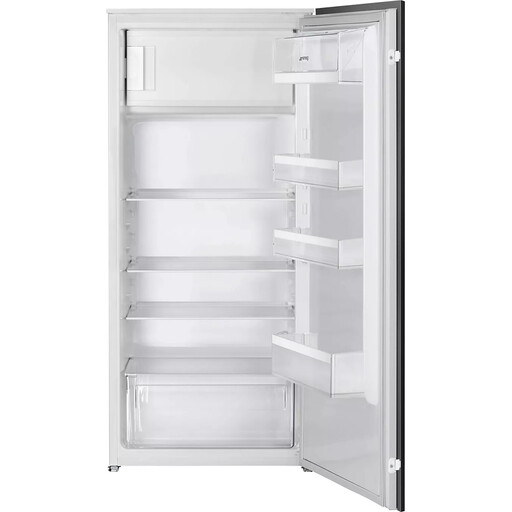 Image unavailable
Worth considering if your fitted kitchen can accommodate an integrated appliance with a small freezer compartment.
The product name indicates a capacity of 188 L, a single door, a freezer at the top and an E energy rating. Check that the freezer capacity meets your needs, then compare the housing dimensions, cabinet-door fixing and ventilation requirements with the model’s instructions.
Measure the space in width, height and depth, as well as the delivery route and the clearance needed to open the door. For an integrated model, also measure the inside of the housing unit and check the cabinet-door fixing system and ventilation requirements in the instructions for your chosen model.
It may suit you if you store a small amount of food and shop frequently, but check there’s enough room for bottles, fresh food and any frozen items. If you need more storage, compare the capacity of each compartment in a larger table-top fridge or a fridge freezer, without overlooking their external dimensions.
Compare their noise levels in dB(A), annual energy consumption in kWh and energy ratings, choosing models with similar capacities and layouts. An appliance with a separate freezer compartment won’t meet the same needs as a fridge without a freezer, so first make sure both layouts suit you.
When you buy an appliance of the same type, the ministries responsible for the ecological transition state that a ‘one-for-one’ take-back scheme applies. Before placing your order, ask the retailer how to arrange for your old appliance to be collected or dropped off.