It may be worth replacing your fridge if it uses more energy than a new appliance that offers the same amount of storage, or if its size no longer suits your shopping habits. If it can be repaired, ask for a quote first. To choose a replacement, compare the annual energy consumption in kWh of appliances with similar functions and capacity, then check the space available, the stated noise level and how much freezer space you need.
Who is this guide for?
Households with an older fridge
If you’re considering replacing a fridge that runs all the time to cut energy use, compare the kWh/year of models with similar capacities and freezer functions. ADEME notes that a newer model may use less energy, but a larger capacity or unnecessary features can increase consumption.
Households with changing shopping habits
A change in your routine may affect how much space you need for fresh and frozen food. Start by working out how much storage you need, then choose between a fridge-only model, a fridge freezer or a compact design. Don’t base your decision on the energy rating alone.
People with an open-plan or small kitchen
Measure the space and delivery route, then check the noise level of the specific model. UFC-Que Choisir points out that the stated noise level alone isn’t enough to predict how disruptive an appliance will feel in your home.
What should you check before replacing your fridge?
First, consider whether you can keep your current appliance. Then work out the storage and space you need before comparing the labels of the models you’re considering.
| Priority |
What to check |
My needs |
| Repair or replace |
Ask for a quote if the appliance can be repaired, and find out which parts are needed. Then compare your current appliance with a model suited to the same use, if you have comparable energy consumption figures. |
I want to know whether my fridge can still meet my needs before buying another one. |
| Annual energy consumption |
Compare the kWh/year figures for models with similar functions and capacities. Check the fridge and freezer capacities separately: the energy rating alone doesn’t tell you the annual energy consumption. ADEME notes that size and extra features can also affect it. |
I want to reduce the energy use of an appliance that’s on all the time, without choosing a larger capacity than I need. |
| Capacity and freezing |
Work out how much space you need for fresh and frozen food. UFC-Que Choisir suggests starting with 100 to 150 litres for one person, then allowing around 50 litres for each additional person. Adjust this guideline to suit your shopping habits. |
If I regularly buy frozen food, a fridge freezer gives me both compartments. If I rarely freeze food or already have a freezer, I can consider a fridge-only model; a compact one may be enough if I need less storage. |
| Space and installation |
Check the height, width and depth, the delivery route and the clearances required for your chosen model. For a built-in appliance, also check the cabinet space and door-fixing system. |
I need an appliance that will actually fit in my small kitchen. If I’m keeping my built-in unit, compatibility will determine my choice. |
| Noise |
Check the stated noise level in dB(A), then look for reviews of the specific model. UFC-Que Choisir classes models rated below 40 dBA among the quietest, while noting that the label alone can’t predict how disruptive the appliance will feel. |
My kitchen is open-plan or close to a living area, so noise matters just as much as size. |
| Useful features |
Check the cooling system, whether it needs defrosting and how any extra features work. In particular, distinguish a feature that reduces frost from a No Frost system. Don’t assume that a connected feature will save energy. |
I’d rather prioritise features I’ll use, such as making freezer maintenance easier, than options that don’t have a clear purpose in my home. |
What mistakes should you avoid?
-
Comparing only the energy rating letters
Appliances with different capacities or functions may not meet the same needs. ADEME notes that a larger model or extra features can increase energy consumption.
To compare models, check their kWh/year figures and the capacity of each compartment too.
-
Choosing a larger capacity ‘just in case’
Extra storage is only useful if it suits your household’s shopping habits. ADEME lists size as one of the factors that can increase energy consumption.
Assess your needs for fresh and frozen food separately, then compare them with the usable capacity and dimensions of the appliance.
-
Assuming convenience features guarantee energy savings
A connected feature or a particular mode doesn’t, by itself, tell you how much energy the appliance will use in your home. Results quoted for some features depend on how they’re used.
Check whether you’ll use each feature and compare the stated annual energy consumption for the exact model.
-
Ordering a built-in fridge without measuring the space
The cabinet space, door fixing and delivery route can all limit your options. Samsung recommends measuring the access route the packaged appliance will need to pass through.
Measure the cabinet space and access route, then check the installation instructions and door-fitting method for the model you’re considering.
Which branded models should you consider?
These models illustrate details to check on manufacturers’ product pages; their features aren’t necessarily shared across the whole brand.
Bosch
For a built-in fridge freezer, Bosch’s KIN86ADB0 product page lets you check the stated dimensions, capacities and noise level.
- Bosch lists this model as having a 184 l fridge, a 76 l freezer, a B rating, No Frost and a noise level of 33 dB(A).
- Check that its dimensions of 177,2 × 55,8 × 54,8 cm and installation requirements suit your kitchen.
Liebherr
The CBNsdc 765i Prime is an example of a large freestanding fridge freezer to consider if its capacity suits your household’s shopping habits.
- Liebherr lists this model as having a 423 l capacity, a 34 dB noise level and a NoFrost system designed to reduce frost in the freezer.
- Its stated width of 74,7 cm means you’ll need to check the space available and delivery route.
Beko
The B5RCNE405HG may be worth considering if you need to install your appliance in a room that isn’t heated much.
- Beko describes this model’s Freezer Guard feature as suitable for ambient temperatures as low as -5 °C.
- Check the installation and operating conditions for the specific model before deciding it’s right for this use.
Samsung
The BRB80F30AES0/EF is an example of a built-in fridge freezer that Samsung lists as having a 298 l capacity.
- The manufacturer’s product page recommends measuring doorways, lifts and corridors to check that the packaged appliance will fit through.
- Samsung says the results of its AI Energy Mode may vary depending on conditions and usage habits, so don’t treat the claimed savings as guaranteed.
Fridges to consider on Joybuy
This selection includes freestanding fridge freezers and built-in models. First, choose a format that suits your kitchen and freezer needs, then compare the energy consumption figures of the models that meet your requirements.
 Image unavailable
Candy CFQQ5T817EPS, 4-door fridge freezer, 467 L
Worth considering if you need plenty of space for fresh and frozen food, plus four doors. The model name indicates Total No Frost and an E rating. Check the dimensions, door clearance and kWh/year on the label for the exact model before comparing it with a smaller appliance.
View on Joybuy
 Image unavailable
Haier HTW5618ENMG, 3-door fridge freezer, 360 L
This three-door fridge freezer combines fridge and freezer storage. Its name indicates Total No Frost, an E rating, Wi-Fi and My Zone. Check whether you’ll use these features. Check the dimensions and kWh/year for the exact model before making your choice.
View on Joybuy
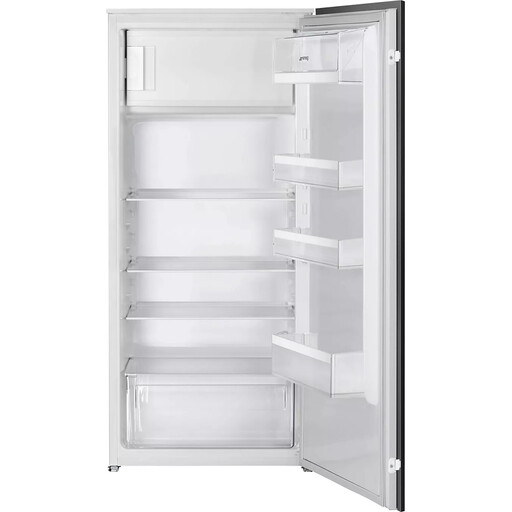 Image unavailable
SMEG S4C122E, built-in, 188 L
This single-door model with a freezer compartment at the top is designed for a fitted kitchen and may suit you if you need freezer space. Its name indicates a capacity of 188 L and an E rating. Before replacing a built-in appliance, check the cabinet dimensions, door fitting and capacity of each compartment.
View on Joybuy
 Image unavailable
AEG NSC6M18FES, built-in TwinTech No Frost fridge freezer
Consider this model if you want to keep a built-in setup with both fridge and freezer compartments. Its name indicates TwinTech No Frost and an E rating. Before choosing it, check the capacity of each compartment, the kWh/year on the label, and whether the cabinet space and door are compatible.
View on Joybuy
 Image unavailable
CHiQ JR227LSE, 227 L fridge freezer, 54 cm wide
According to its name, this fridge freezer combines 153 L of fridge space with 74 L of freezer space in a width of 54 cm. It lists a reversible door, Low Frost and an E rating. Low Frost doesn’t mean you’ll never need to defrost it. Check the height, clearance needed to open the door and kWh/year for the exact model.
View on Joybuy
Frequently asked questions
How do you compare the energy consumption of two fridges?
Compare their kWh/year figures for models with similar freezer functions and capacities, rather than looking only at their energy rating letters. ADEME notes that size and features can affect energy consumption, so check the label for the exact model and the capacity of each compartment.
Should you automatically replace a fridge that can be repaired?
No. Ask for a quote first and find out which parts are needed. If you then consider buying a new appliance to reduce energy use, compare it with your old one for an equivalent storage need. ADEME’s general guidance can’t guarantee the results you’ll see in your home.
Is a noise level below 40 dBA enough for an open-plan kitchen?
It’s a useful first filter, but it doesn’t guarantee a quieter experience. UFC-Que Choisir classes fridges rated below 40 dBA among the quietest, but notes that the stated figure alone can’t predict how disruptive the appliance will feel. Look for reviews of the specific model too.
Does a commercial warranty replace the statutory warranty in France?
No. According to the DGCCRF, the statutory guarantee of conformity applies to new, second-hand and refurbished goods sold by a trader to a private individual. Check the terms of any commercial warranty separately.


