Housemates who share the shopping
If several people use the same appliance, work out how much room you need for shared and individual shopping. Storage areas that are easy to divide up are also useful when kitchen space is limited.


For a shared household’s weekly shop, start by choosing the usable fridge and freezer capacity based on how many people will use the appliance and how much space you need for frozen food. UFC-Que Choisir suggests 100 to 150 L for one person, plus 50 L for each additional person. A fridge freezer can meet your needs without taking up excessive width; a multi-door model needs more space, while a built-in appliance must fit its housing and meet the requirements for its doors and ventilation.
If several people use the same appliance, work out how much room you need for shared and individual shopping. Storage areas that are easy to divide up are also useful when kitchen space is limited.
Choose a capacity to suit the people who actually use the fridge and how often you shop. UFC-Que Choisir also recommends taking frozen food consumption into account: the total capacity alone won’t tell you how the space is divided.
An existing housing unit, limited width or narrow delivery access may determine which type of appliance will fit. Also measure the clearance needed to open the doors. For a built-in model, follow the ventilation requirements in the manual.
Think about what you buy in a typical week before choosing a style, then check the space you need for fresh food, frozen food and the appliance itself in your kitchen. The points below are for shoppers looking for a fridge for a shared household’s weekly shop.
| Consideration | What to check | Who is it for? |
|---|---|---|
| Space for fresh food | Compare the usable capacity of each compartment. UFC-Que Choisir’s guide is 100 to 150 L for one person, plus 50 L for each additional person, adjusted to suit your actual shopping habits. | When several people put their shopping away at the same time, I want everyone to have enough room without relying on the total capacity alone. Around 33% of consumers would make this their priority. |
| Amount of frozen food | Check the freezer capacity and drawer layout against the frozen food you buy for the week. | If frozen food makes up a large part of our shop, I don’t want more fridge space at the expense of the freezer. Around 33% of consumers would make this their priority. |
| Installation and access | Measure the space, door clearance and delivery route. For a built-in model, check the housing, hinges and ventilation requirements in the manual. | In a narrow kitchen or one with a dedicated housing unit, I need to be able to get the appliance in and open its doors once it’s installed. Around 20% of consumers would prioritise this constraint. |
| Energy use and noise | When comparing appliances with similar capacity, check the energy rating, stated annual energy consumption and noise level. | If the kitchen opens onto the living area, I want to keep noise to a minimum while also considering the energy use of an appliance that runs continuously. Around 14% of consumers would make this their main consideration. |
A spacious appliance may still leave too little room for the frozen food your household usually buys. UFC-Que Choisir recommends considering both how often you shop and how much frozen food you use.
Make a note of what you keep in each compartment over a typical week, then compare their usable capacities separately.
The stated width alone won’t tell you whether a multi-door model will fit through the access route or whether its doors will open fully. For a built-in appliance, the housing dimensions and ventilation requirements matter too.
Measure the delivery route and the space where the appliance will go, then check the hinges and ventilation openings in the manual for the model you’re considering.
A small appliance and a large multi-door model won’t necessarily suit the same shopping needs. The energy label helps you compare energy use, but capacity and noise are separate considerations.
First decide on the capacity and style that suit you, then compare the energy rating, annual consumption and stated dB levels of those models.
Replacing your fridge also means arranging for the old one to be taken away through an appropriate electrical-appliance recycling scheme.
Find out whether collection is offered when you place your order, and check the practical instructions for disconnecting the appliance and providing access to your home.
If you’re considering a built-in fridge freezer, Bosch France’s product details for the KIN86SDD0 list its dimensions as 1 772 × 558 × 548 mm, with 184 L of fridge capacity and 76 L of freezer capacity.
The Liebherr France catalogue includes built-in fridge freezers designed for housings measuring 178, 194 or 203 cm high.
Samsung France lists the multi-door RF65DG960ESL with a capacity of 646 L. It measures 912 mm wide, 1 830 mm high and 723 mm deep.
The Cube 83 Series 3 HCR3818DWMM listed by Haier France measures 833 mm wide, 650 mm deep and 1 815 mm high, offering another multi-door model to compare for size.
This selection includes fridge freezers, multi-door appliances and a side-by-side model. For a shared household’s shopping, compare their stated capacity with the fresh-to-frozen split you need and the space you have available.
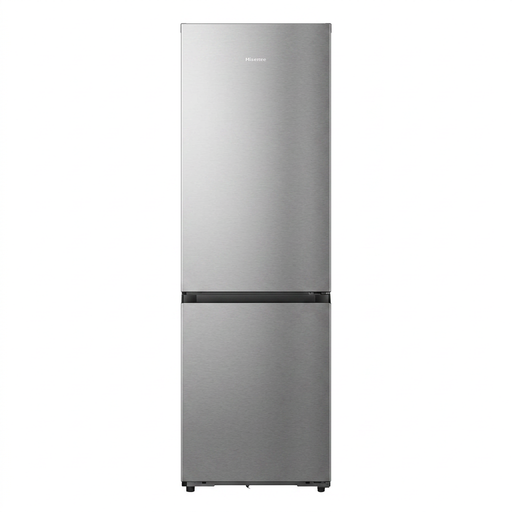 Image unavailable
This fridge freezer offers 330 L of capacity and a noise level of 35 dB, with room for shared shopping in both the fridge and freezer. Check the capacity of each compartment and the space needed for installation.
 Image unavailable
Its four doors may appeal to a household that wants to organise shared shopping into separate areas. It has a stated total capacity of 467 L, Total No Frost and an E energy rating. Measure door clearance and the delivery route before choosing this style.
 Image unavailable
This three-door model is worth considering if you want to separate the storage areas for shared shopping. It offers 360 L of capacity, Total No Frost and an E energy rating. Check the layout of the compartments and the clearance needed to open the doors.
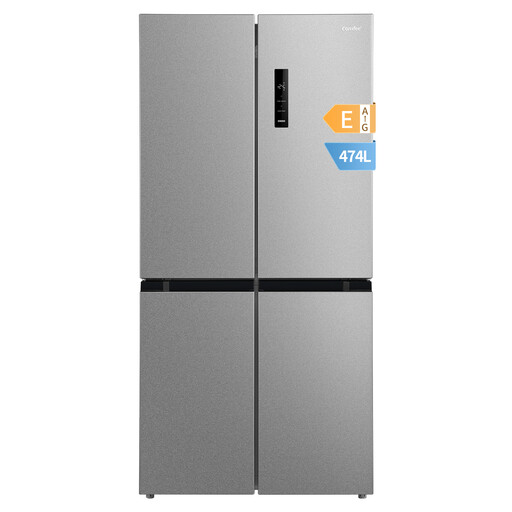 Image unavailable
This four-door style may suit you if shared shopping calls for a large total capacity. It offers 474 L and an E energy rating. Check the separate fridge and freezer capacities before deciding whether the layout suits your shopping.
 Image unavailable
If your shared shopping calls for a large appliance, this model offers 444 L of capacity, an E energy rating and a noise level of 40 dB. Check the dimensions, door clearance and fridge and freezer capacities before choosing a side-by-side model.
Start with the number of people who will actually use the appliance. UFC-Que Choisir suggests 100 to 150 L for one person, plus 50 L for each additional person. Adjust this to suit your household’s shopping and compare the fridge and freezer capacities separately.
It may be enough if you have little to share or another appliance already provides most of your storage. UFC-Que Choisir describes this style as suitable for studio flats. If several people shop for the week, pay particular attention to the space available for frozen food.
Measure the space, how far the doors can open and the entire delivery route. For a built-in appliance, also check the internal dimensions of the housing, the door fitting and the ventilation openings specified in the model’s manual. For the appliance it covers, a Liebherr manual specifies ventilation openings of at least 200 cm² at the plinth and at the top of the cabinet.
First compare fridges with similar capacities, then check their energy ratings, stated annual energy consumption and noise levels in dB. ADEME describes the energy label as a useful guide when choosing an appliance; these details don’t replace checking the usable capacities.
In France, the Ministry for Ecological Transition says retailers must offer to take back a used appliance when you buy a new one of the same type. Ask about collection arrangements when you place your order, and prepare access to the old appliance according to the instructions provided.