Households mindful of energy use
If your old appliance needs replacing, its stated annual energy consumption can help you compare models. Consider this alongside capacity and intended use, rather than relying on the energy rating alone.


When replacing a fridge, first choose a format that suits your freezing needs and the space available. Then compare appliances with similar uses and capacities by checking their annual energy consumption in kWh, the volume of each compartment and the noise level shown on the energy label. The A to G rating alone doesn’t tell you everything.
If your old appliance needs replacing, its stated annual energy consumption can help you compare models. Consider this alongside capacity and intended use, rather than relying on the energy rating alone.
If you’re choosing between a single-door fridge and a fridge-freezer, your shopping and freezing habits matter more than the total capacity alone. Check how much space each compartment offers.
Whether you’re replacing a built-in appliance or fitting a freestanding model into a specific space, check the dimensions, door clearance and installation requirements before comparing features.
Start by deciding whether you need an integrated freezer, then rule out any models that won’t fit your kitchen. You can then compare the energy consumption of appliances designed for the same purpose. The European Commission states that the energy label for household fridges includes an A to G rating, annual energy consumption and compartment volumes.
| Criterion | What to check | Who is it for? |
|---|---|---|
| Energy consumption | Check the kWh/year figure and A to G rating; compare models with similar uses and capacities. | If I’m replacing an appliance that runs constantly, I want to understand its stated energy consumption before choosing its features. Around 27% of consumers put running costs at the top of their list of concerns. |
| Compartment capacity | Compare the litres allocated to fresh and frozen food separately, rather than looking only at total capacity. | If I regularly freeze food, I need enough room for frozen items without sacrificing space for fresh food. This balance is a priority for around 33% of consumers. |
| Installation | Measure the appliance and access route; for a built-in model, also check the housing and door system. | If my kitchen already has a cabinet or a narrow space for an appliance, I need to be sure the new fridge will fit and its door will open. Around 20% of consumers put compatibility ahead of other criteria. |
| Food preservation and maintenance | Check the temperature settings and defrosting system. Only choose a specialist compartment if it suits the food you usually store. | I mainly want to organise the food I store regularly, without choosing features I won’t use. Around 20% of consumers prioritise food preservation and maintenance. |
The rating alone doesn’t tell you the appliance’s annual energy consumption, particularly if you’re looking at different formats and capacities.
Check the kWh/year figure and compartment volumes on the energy label for the exact model. Then compare appliances designed for the same purpose and with similar capacities.
A high total capacity can conceal an unsuitable balance between fresh and frozen storage. A freezer compartment that you rarely use also takes up valuable kitchen space.
Before settling on a capacity or extra features, consider what you usually store in each compartment.
Height and width aren’t enough: depth, door clearance and installation requirements vary by model. A built-in appliance must also fit the housing and work with the cabinet’s door system.
Measure the space and delivery route, then check the installation instructions for your chosen model, including the required clearances.
No Frost and specialist storage compartments may suit certain needs, but they don’t remove the need to set up and maintain your appliance.
The Ministry of Agriculture recommends a temperature of +4 °C in the fridge and -18 °C in the freezer. Check which features are genuinely useful for the food you store.
These examples show what to check for a specific model; their features won’t necessarily apply to other appliances from the same brand.
The freestanding KGN392XCF fridge-freezer lets you compare capacity, energy rating, noise level and dimensions side by side.
The CBNsda 572i Plus is an example of a freestanding fridge-freezer to consider if compartment layout and noise levels matter to you.
If you’re replacing a built-in appliance, the WHC18T132FR shows why it’s important to check the housing before considering the features.
These models include freestanding fridge-freezers, a four-door freestanding appliance and a built-in fridge-freezer. First, choose a format that suits your kitchen and freezing needs. Then check the annual energy consumption on the energy label for the exact model.
 Image unavailable
Worth considering if you want a fridge and freezer in one appliance. The product details list a total capacity of 344 L and an E rating. Check the capacity of each compartment, the kWh/year figure on the exact model’s energy label, and the dimensions required for installation.
 Image unavailable
Worth considering if you need a four-door appliance and have space for its stated capacity of 467 L. The title lists Total No Frost and an E rating. Check the available space, the balance between fresh and frozen storage, and the kWh/year figure for the exact model.
 Image unavailable
Worth considering if a three-door fridge-freezer suits the way you store food. The title lists a capacity of 360 L, an E rating, Total No Frost, Wi-Fi and My Zone. Check whether these features are useful to you, the capacity of each compartment and the kWh/year figure for the exact model.
 Image unavailable
Worth comparing if you’re looking for a fridge-freezer with a bottom freezer. The title lists a capacity of 282 L and an E rating; check the capacity of each compartment and the annual energy consumption. The NoFrost information applies to the freezer in this model, not the appliance as a whole.
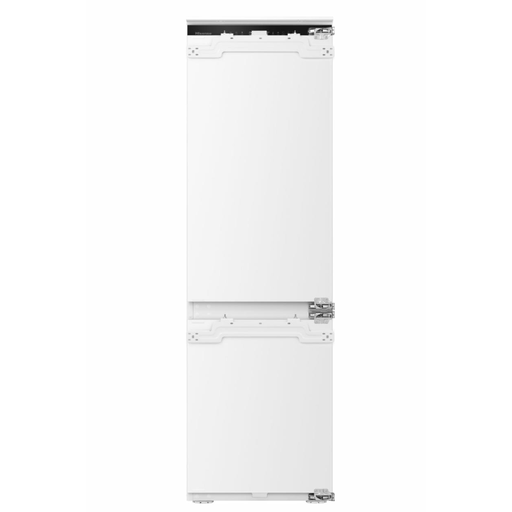 Image unavailable
Worth considering as a replacement for a built-in fridge-freezer, but only if it suits your kitchen cabinet. The title lists a capacity of 252 L, No Frost and a C rating. Check the kWh/year figure on the exact model’s energy label, then check the housing dimensions, door fixing and ventilation requirements.
Compare the annual energy consumption in kWh, the capacity of the fresh and frozen compartments, the A to G rating and the noise level. The European Commission lists these details for household refrigeration appliances. They’re most useful when you’re comparing models with similar uses and capacities.
Don’t judge annual energy consumption by the rating letter alone. Check the kWh/year figure for the exact model and compare appliances with similar functions and capacities. Changing the capacity or format also changes what you need the appliance to do.
The Ministry of Agriculture recommends +4 °C in the fridge and -18 °C in the freezer. Also follow the manufacturer’s instructions for setting up and adjusting your appliance.
You can find out about taking it to a collection point or recycling centre, returning it to a retailer, or giving it to a social and solidarity economy organisation. These are the options listed by the ministry responsible for the environment for electrical equipment. Before your new appliance is delivered, ask the retailer what take-back and removal services are available.