Households that prepare meals in advance
If portioned meals and frozen supplies already fill the freezer compartment, compare its capacity with that of a larger fridge-freezer before considering a separate freezer.


Start by choosing the compartment that’s running out of space: a larger fridge for fresh food, a fridge-freezer if you need more room for both chilled and frozen food, or a separate freezer if your fridge still has enough space. Then compare the usable capacity in litres for each compartment, the installation dimensions and the models’ kWh/year figures. A large total capacity doesn’t guarantee the right balance of space.
If portioned meals and frozen supplies already fill the freezer compartment, compare its capacity with that of a larger fridge-freezer before considering a separate freezer.
If fruit, vegetables, drinks and fresh meals take up most of the space, focus on the fridge capacity. A larger freezer compartment won’t solve a lack of room for fresh food.
Check that the appliance fits the space and that you can still open the doors and access the drawers. Consider usable capacity alongside the dimensions and installation type.
If you want to shop less often, start with the food that’s overflowing today. Then compare the configurations that will fit it into the space you have.
| What to compare | What to check | What I need |
|---|---|---|
| Capacity in each compartment | Compare the usable capacity in litres for the fridge and freezer separately. Also check the layout of the drawers and shelves against the containers you use. | Are my large dishes and fresh food overflowing, or am I mainly short of space for frozen portions? |
| Configuration | A fridge keeps all its space for fresh food; a fridge-freezer splits its capacity between fresh and frozen food. A separate freezer adds another appliance and needs its own space. | If my fridge still has enough room for fresh food, I can consider adding a freezer. If both compartments are too small, I’ll compare fridge-freezers instead. |
| Energy consumption | Check the energy rating alongside the kWh/year figure on the label and the usable capacities. Compare appliances with a suitable capacity and configuration for the same use. According to ADEME, refrigeration appliances run continuously. | I want to take into account the consumption of every appliance I’ll leave running, especially if I add a second one. |
| Installation | Measure the available height, width and depth. Check the installation type, door opening direction and clearance requirements in the chosen model’s instructions. | In a narrow kitchen, I need enough room to open the doors and pull out the drawers, as well as space for the appliance itself. |
| Maintenance | Check whether the model has a No Frost or Low Frost feature, and read the maintenance instructions. A dedicated storage zone doesn’t replace the capacity you need. | If I want to reduce the need to deal with frost, I’ll check the specific model’s features without compromising on the capacity I need. |
Two fridge-freezers can split their capacity differently between the fridge and freezer. A large total capacity could still leave too little room for the food that’s overflowing at home.
Make a note of what’s short of space, then compare the stated usable capacity in litres for each compartment.
The energy rating alone doesn’t tell you a model’s annual consumption. ADEME notes that the size and extra features of refrigeration appliances can affect how much energy they use.
Compare the kWh/year figures, capacities and features of appliances designed for the same needs.
A separate freezer gives you dedicated storage space, but it takes up room and runs continuously. ADEME’s benchmark for the category is 300 kWh/year; this doesn’t predict the consumption of the model you choose.
First check that your current fridge still has enough space, then compare the footprint and kWh/year figures of the options you’re considering.
A dedicated zone or an anti-frost feature won’t create the usable capacity you need for your supplies. The claimed benefits of these features depend on the model and, for food storage, on the food and storage conditions.
Choose the right balance of capacity first, then check whether the model’s features suit the way you’ll use it.
These examples show different ways of splitting capacity and features to compare. They don’t cover every model from each brand.
Bosch’s product details for the KGN492IAF and KIR81VFE0 highlight the difference between a fridge-freezer and a fridge without a freezer compartment.
The WHK25364XBR4E fridge-freezer lets you assess the space for fresh food separately from the space for frozen food.
Liebherr describes BioFresh as a zone with specific storage conditions for certain fresh foods.
These models combine fridge and freezer space. If you’re comparing them with a view to shopping less often, check how much space is available for each use, not just the stated total capacity.
 Image unavailable
If you need to store both fresh food and frozen supplies, compare the capacity of each compartment with your needs. The model name states a total capacity of 467 L, Total No Frost and an E energy rating. Check the dimensions and clearances needed for installation.
 Image unavailable
If you want more space for fresh and frozen food in one appliance, check the usable capacity of each section. This model is listed with a total capacity of 360 L, Total No Frost, My Zone, Wi-Fi and an E energy rating. Check its dimensions and the clearances required for installation.
 Image unavailable
For a narrow space, its stated width of 54 cm is worth checking against the available room, as well as the installation clearances. The model is 176 cm tall; its name indicates a 70/30 split between fridge and freezer capacity, and Low Frost. Check the freezer’s defrosting instructions.
 Image unavailable
If you’re considering this total capacity for fresh and frozen supplies, check how many litres are allocated to each section. The model name states a capacity of 444 L, a frost-free feature, 40 dB and an E energy rating. Also check its dimensions, installation clearances and kWh/year figure on the model’s energy label.
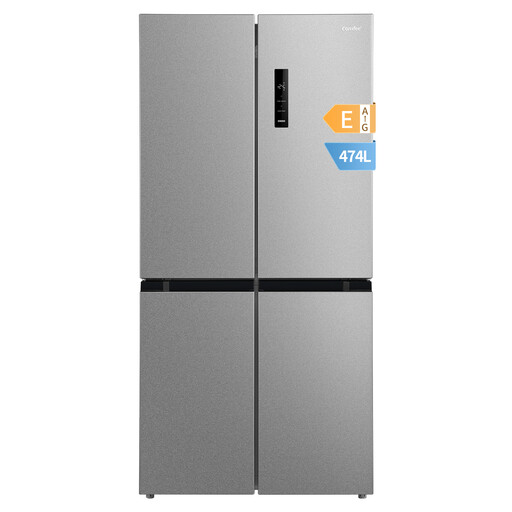 Image unavailable
If you want to store supplies across several doors, first compare the usable capacity for fresh and frozen food. The model name states a total capacity of 474 L, a three-temperature vegetable drawer, Vario Box, Flip Tray and an E energy rating. Check the dimensions, installation clearances and kWh/year figure before comparing it with another appliance.
Take stock of the food and containers that no longer fit: prepared meals, frozen portions, fresh food or drinks. Then compare the stated usable capacity in litres for the fridge and freezer separately. The Bosch and Whirlpool model details show why total capacity alone doesn’t tell you how the space is divided.
No. Category averages can’t predict the energy consumption of the specific appliances you’ll use. ADEME gives 180 kWh/year for a fridge, 315 kWh/year for a fridge-freezer and 300 kWh/year for a freezer as category benchmarks. Compare the kWh/year figures on the labels of the models you’re considering, along with their capacities and configurations.
Measure the height, width and depth of the space, then check the installation type and clearances specified in the model’s instructions. Allow room to open the doors and access the drawers, too. A suitable internal capacity isn’t enough if the appliance is difficult to install or use.